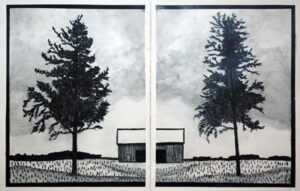
Panamerican Colours II
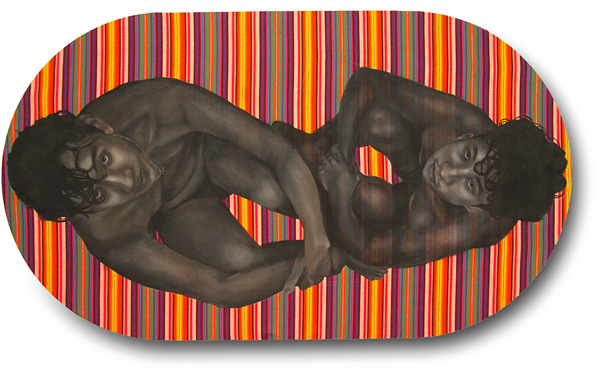
Omar Canales-Cisneros, El Salvador, Hermanos, 2024, Ashes and Oil on Salvadorian Textiles, 60 x 36 in. (oval). Image courtesy of the artist.
Panamerican Colours II
July 9 – 19, 2026
Opening Reception: July 9, 2026, 7 pm
Gallery 1313, Toronto
The new group exhibition, Panamerican Colours II opens on Thursday, July 9, 2026 at 7 pm, and runs until July 19 at Gallery 1313. Curated by Francisco Alvarez, the exhibition brings together artists from across the Americas who are responding to global diasporas and displacement in a variety of media, ranging from photography through painting to textiles and sculpture.
The artists are brought together for the first time to celebrate the 14th Panamerican Food and Music Festival, which will be presented at Nathan Phillips Square in Toronto from July 24 to 26. The first Panamerican Colours took place at Gallery 1313 in 2022. This exhibition is its continuation—an ongoing inquiry rather than a standalone event, asking deeper questions with a different group of voices.
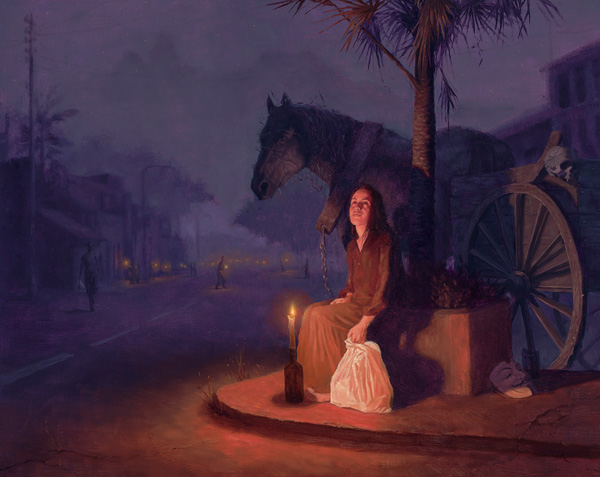
Diego de la Rosa, Venezuela, Apagón (Lights out), 2024, Oil and acrylic on panel, 16 x 20 x 1 in. Image courtesy of the artist.
The title is a deliberate provocation. “Panamerican” has sometimes been used to flatten political differences across the hemisphere, in service of agendas that had little to do with the people living there. This exhibition borrows the word to do something different with it: to insist on specificity rather than the general. The countries represented—Colombia, El Salvador, Mexico, and Venezuela—are not interchangeable. What connects them in this exhibition is not a shared culture but a shared condition: the condition of having left, and of making work that cannot forget that fact.
The eight artists presented—Alejandro Rizzo Nervo, Carolina Delgado-Duruflé, Diego de la Rosa, Ernesto Cabral de Luna, Francisco Alvarez, Janne Reuss, Omar Chris Canales-Cisneros, and Omar Saenz—are based in the Greater Toronto Area, a city that congratulates itself as a global model of multicultural coexistence at a moment when that model is being tested across the world. What does it mean to make diasporic work here, in this particular place, and under these particular conditions? That question runs through every work in the exhibition.
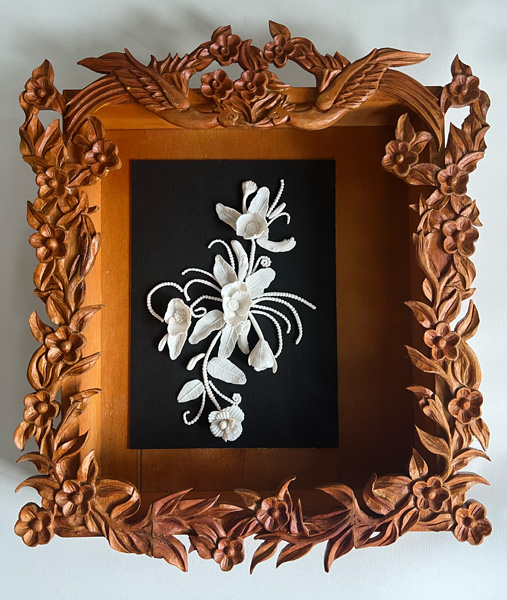
Carolina Delgado Duruflé, Colombia, Zambrano, 2024, Porcelain, hand-carved wood, 22 x 12 in. Image courtesy of the artist.
What also runs through several of these works is a politics of material. Omar Canales-Cisneros burns objects representing prejudice and hatred, then uses the ash as pigment on textiles and objects where the paint is literally the residue of destruction.
Carolina Delgado-Duruflé sets found vintage porcelain figurines within arrangements of her own handmade white porcelain flowers—including one work titled after the Cattleya, Colombia’s national orchid. The figurines come from elsewhere, someone else’s manufacture; the flowers name where she is from.
Ernesto Cabral de Luna transfers family photographs by emulsion lift onto found surfaces—soldered glass, metal frames, ceramic tile—where the image is preserved and altered at once.
Omar Saenz paints the objects of ordinary life—a shopping bag, heavy drapes, torn paper—with an attention so concentrated they become enigmatic. Each canvas is a veil between the visible and the concealed, the mundane and the charged.
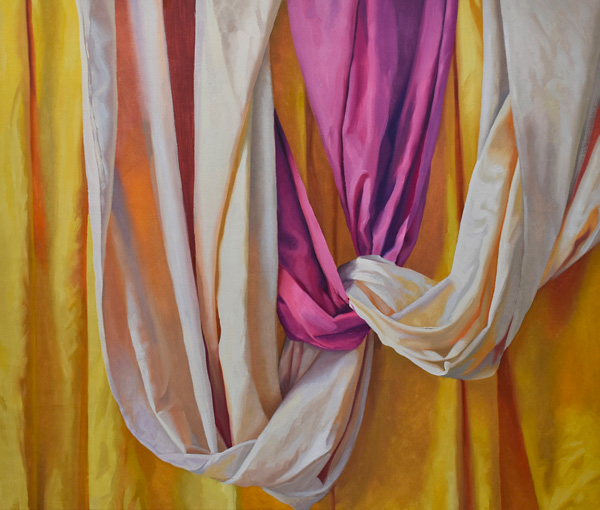
Omar Saenz, Mexico, A body slowly twisting towards light, 2024, Oil on canvas, 35 x 43 in. Image courtesy of the artist.
Diego de la Rosa’s allegorical paintings collect found imagery from Venezuela—real people and places—and rearrange them into surreal narratives populated by anthropomorphic animals and theatrical figures drawn from critical theory on diaspora, resilience, and the desire for change.
Janne Reuss works from a single question: what happens to a tree when it is transplanted from its original habitat? Her Replanted series uses photocollage and installation to map that displacement onto the experience of migration—the tree as a figure for the person who carries their roots into soil that did not grow them.
Francisco Alvarez both curated this exhibition and exhibits in it—two roles he sees as continuous rather than conflicting. Stages is a self-portrait organized as a diamond: four quadrants, each aligned with a season, an element, and a state of being. Animals, plants, and symbols populate the field surrounding the stark figure. It is a portrait of the self as a personal cosmology—private in origin but inviting navigation.
Alejandro Rizzo Nervo works in collage and photomontage, building fragmented compositions from real-life imagery that blur the boundary between documentation and the surreal. Driven to engage consciously with the unconscious, their work moves between questions of identity, loss, and the experience of Venezuelan diaspora.
Together, these works move between the intimate and the political, the personal archive and the shared fact of displacement. They do not offer comfort or resolution. Panamerican Colours II proposes a set of honest conversations between artists whose distance from home has sharpened and complicated how they see the world they left and the one they now inhabit.
Gallery 1313
1313 Queen Street West
Toronto, ON M6K 1L8
gallery1313.org
Related Content
Fall 2026 Programming at the Workers Arts & Heritage Centre
Call for Submissions: Korea–Canada Women Artists Exchange Exhibition Her Voices, Our Time