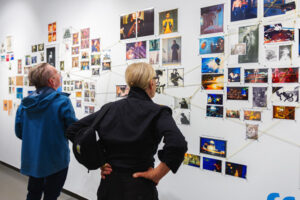
Holly Chang: How to Disappear When No One is Looking
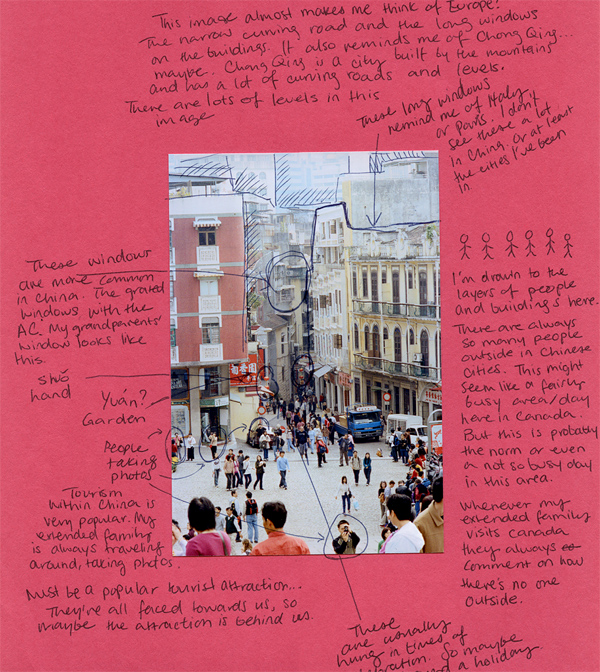
Holly Chang, How to Disappear When No One is Looking
Holly Chang: How to Disappear When No One is Looking
Curated by Sally Frater
May 1 – July 31, 2026
Opening Reception: Friday, June 12, 7 – 9pm
Centre[3] For Artistic + Social Practice, Hamilton
How to Disappear When No One is Looking is a meditation on place, memory, and kinship. The project centers recently found photographs taken by the artist’s late uncle during a trip to Hong Kong and China in 2003. Though China and Hong Kong are places that Chang is connected to ancestrally, she has not travelled to either. The photographs document places that her relatives knew intimately but remain unfamiliar to her.
In this project, Chang affixed the images to a sheet of construction paper and invited individuals of the Chinese diaspora who had traveled to China or Hong Kong to respond to the images by identifying the locations within them and transcribing their memories on the borders of the surrounding paper. Through the eyes and recollections of strangers and friends, the sites are animated for the artist, connecting her in more fulsome ways both to the locations and relatives whom she can no longer question.
The project, at once participatory and archival, is also a reflection on the role that community can hold in constituting one’s sense of identity and belonging.
About the Artist & Curator
Holly Chang is an interdisciplinary artist working across photography, ceramics, textiles, sculpture, natural dyeing, collage and installation. In particular, she is drawn to found and discarded textile materials, archives, and images which she repurposes and transforms – she is fascinated in how forming and reforming can construct new narratives around identity. Holly is focused on the transformation of materials and processes of making as a way to explore hybridity – between herself and the mediums she engages with. She is a queer mixed-race artist from Toronto, Canada and these experiences inform her approach to material practice—investigating the intersections and parallels between alternative ways of existing. Holly often looks at these topics through the lens of nature, ecologies, and history. Holly often works to transform craft into her exhibitions and installations where she attempts to dissolve the boundaries between the viewer and the work—she looks towards installation as a way to live inside of something. Holly maintains a pedagogical practice and contributes to community-based engagement and facilitation work, where she engages with community for inspiration, ways of retelling stories, and how she can give back through teaching. Community not only applies to her home in Toronto, but is integrated into her time abroad when she undertakes residencies.
Sally Frater is the daughter of immigrants from the Caribbean. Curatorially she is interested in decolonial praxis, space and place, Black and Caribbean diasporas, photography, art of the everyday, and issues of equity and representation in museological spaces. She has curated solo and group exhibitions for institutions such as the Art Gallery of Ontario, Art Gallery of Guelph, the Ulrich Museum of Art, Glassell School of Art at the Museum of Fine Arts, Houston, Justina M. Barnicke Gallery at the University of Toronto, Project Row Houses, and Centre[3] for Artistic and Social Practice. The recipient of grants from the Canada Council for the Arts, the Ontario Arts Council, the Toronto Arts Council, and the Andy Warhol Foundation for the Visual Arts she is a member of the Association of Art Museum Curators and is an alumna of Independent Curators International. Recently a shortlisted candidate for The Hnatyshyn Foundation Mid-Career Award for Curatorial Excellence she is the senior curator and curatorial manager at the Remai Modern in Saskatoon.
Centre[3] for Artistic + Social Practice is an artist‐run centre that supports artists and collaborates with communities to create social change through the arts.
As a not-for-profit centre they’ve established programming to help bring arts education and community arts to the greater Hamilton area. Thanks to donor support their programming is always expanding to meet the needs of the region.
Centre[3] acknowledges that their organization, located in Hamilton, is situated on the traditional territory of the Eerie, Neutral, Huron-Wendat, Mississauga and Haudenosuanee nations, whose presence here reaches back to time immemorial.
They recognize the historical oppression of Indigenous peoples, cultures, and lands in what is now known as Canada. They are committed to healing and decolonizing together through the arts.

Centre[3] for Artistic + Social Practice
173 James Street North
Hamilton, ON L8R 2K9
centre3.com
info@centre4arts.com
365-378-8053
Facebook @Centre3
Instagram @centre3_
Accessibility:
The Centre3 Main Gallery is fully accessible, but please be aware that the front door operates by remote. For more information, please call 365-378-8053.
Image Description:
A photograph is fixed to red pastel paper. The paper contains handwriting from two individuals that identify the work, and recall their memories of visiting the place.
Related Content

Laakkuluk Williamson: Nuliaminik Neqilik (The Flesh of Wives)