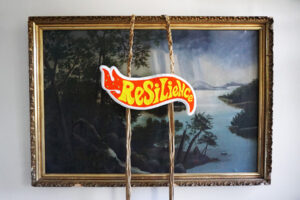
International Ceramic Art Fair 2026 at the Gardiner Museum
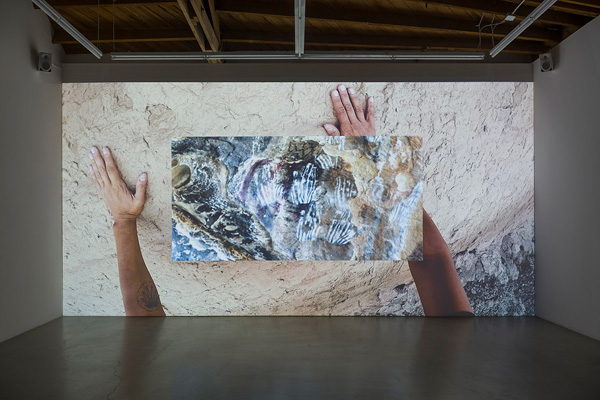
Christine Howard Sandoval, Niniwas – to belong here, 2022, Courtesy of parrasch heijnen gallery
Gardiner Museum’s Ceramics Biennale Returns
May 28 – August 16, 2026
Gardiner Museum, Toronto
The Gardiner Museum presents the return of the International Ceramic Art Fair (ICAF), a biennial celebration of innovation and contemporary directions in ceramics.
This year, ICAF is expanded to a full 12-week exhibition and public program, positioning the fair at the forefront of how ceramics is evolving across art, design, and emerging technologies.
At the heart of this year’s edition is the theme “the city and the commons,” presenting ceramics as both material and method for examining how we live together in rapidly changing cities. From architecture to infrastructure, ceramics shelter, connect, and ground us, offering new ways to think about belonging, resilience, and shared space.
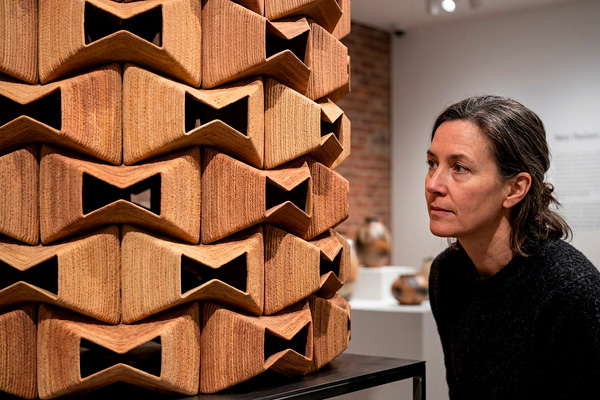
Courtesy of artist Ronald Rael
Technology, Land, and the Politics of the Commons
The artists in the exhibition engage directly with the political realities that shape how land is defined, divided, and experienced, employing ancestral practices and new technologies.
Designer and activist Ronald Rael considers borders not only as physical barriers, but as sites of exchange and possibility. A central highlight of the exhibition is his pioneering use of 3D printing, which merges ancestral adobe building techniques with cutting-edge digital fabrication. A custom ceramic printer will operate live in the gallery, producing modular clay forms that evolve into a large-scale installation over the course of the exhibition.
Iranian Canadian artist Hadi Jamali draws on the visual language of Middle Eastern cities to explore political instability and its impact on daily life. His installation, constructed as a shifting ceramic terrain, incorporates sensors triggered by the visitor’s presence. As the structure tilts, the landscape destabilizes and dark liquid spreads across its surface, reflecting the fragility of cities shaped by conflict, displacement, and uncertainty.
Christine Howard Sandoval, an enrolled member of the Chalon Nation in Bakersfield, California, examines land through an Indigenous lens, reflecting on how colonial systems have reshaped relationships to territory. Drawing on her community’s connection to California, her video work and sculptural clay mounds revisit sites marked by missionization to consider how land, memory, and identity are continuously redefined across borders.
These and other works in the exhibition consider who has access to space, how boundaries are constructed, and what it means to belong within increasingly contested landscapes.
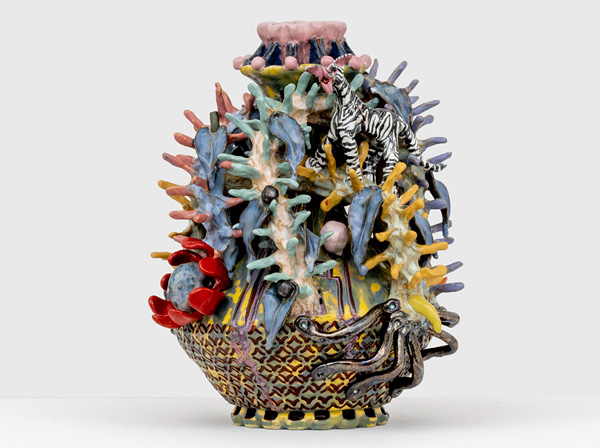
Sharif Farrag, Mega Spike Jug, 2026, Glazed ceramic, 18 x 11 x 12 inches. Photo: Charles White / JW Pictures. Courtesy of the artist and Jeffrey Deitch, New York and Los Angeles.
The Artists
Anders Herwald Ruhwald, Christine Howard Sandoval, Eve Tagny, Hadi Jamali, Jolie Ngo, Magalie Guérin, Mel Arsenault, Noor Ali Chagani & Clio Lloyd-Jacob, Ronald Rael, Suzanne Morrissette & Jaimie Isaac, Sharif Farrag
About the Gardiner Museum
The Gardiner Museum welcomes and inspires audiences of diverse backgrounds, abilities, and experiences through the rich history and storytelling power of clay. We steward and animate an internationally significant collection of ceramics while centering hands-on learning and making. We engage in important cultural conversations taking place in our city and beyond through gallery programming and collaborative partnerships. We work to advance Indigenous self-determination and build human connections, creating space for reflection and dialogue.
Learn more at gardinermuseum.com.

Gardiner Museum
111 Queen’s Park
Toronto, ON M5S 2C7
gardinermuseum.com
mail@gardinermuseum.com
416.586.8080
Instagram @gardinermuseum
Facebook @thegardinermuseum
X @gardinermuseum
Accessibility:
The Gardiner Museum is an accessible venue with a ramp from the street leading up to the main lobby entrance. The entrance is accessible via two sets of double doors with an access button. Accessible restrooms are available on the second and third floors. Third floor washrooms are also gender neutral.
The Gardiner strives at all times to provide goods and services in a way that respects the dignity and independence of people with disabilities. We are committed to giving people with disabilities the same opportunity to access and benefit from our services in the same place and in a similar way as other customers whenever possible. We welcome your feedback.
Image Descriptions:
1. An installation of a projection on a wall in an enclosed space. The still from the video that is visible shows two hands on a bed of clay with a smaller image collaged on top of the first image. The smaller image is abstract, with references to geological formations.
2. A woman is looking at a tower of 3-D printed terracotta bricks. The bricks have a bowtie shape and are stacked on top of each other.
3. A colourful ceramic vase with spikey projections. It’s decorated with yellow, blue, red, pink, and black glazes. A figure of a flower and a zebra are visible.
Related Content
Fall 2026 Exhibitions Launch at Esker Foundation
Request for Qualifications: Site-Specific Artwork for Riverside South Community Centre & Library, Ottawa