Sharl G. Smith: Sanctuary III/Load-Bearing
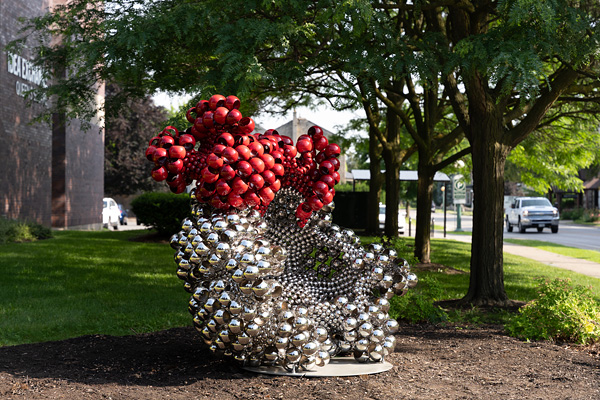
Sharl G. Smith, Sanctuary III/Load-Bearing, 2026, stainless steel spheres (powder-coated and mirror-polished), stainless steel cable and hardware, 67″ x 61″ x 48″. Photo: Conan Stark.
Sharl G. Smith: Sanctuary III/Load-Bearing
Queen’s Square Artist Garden, Cambridge Art Galleries
June 26 – November 29, 2026
Cambridge Art Galleries is pleased to present Sanctuary III/Load-Bearing, a new public art sculpture in the Queen’s Square Artist Garden from Kitchener-based artist Sharl G. Smith. Known for her intricate beadwork and her expansion into large-scale architectural pieces, this project is the first of a new, experimental direction incorporating powder-coated coloured beads. In conjunction with Sanctuary III/Load-Bearing at Queen’s Square, Smith’s prototypes for this sculpture are on display at Cambridge Public Library, Clemens Mill.
Sharl G. Smith’s sculptural practice draws together structure, beadwork, and feminist inquiry. Emerging from a background in architecture and shaped by her evolution from making jewellery to large scale sculpture since 2021, her work draws on the history of beadwork and the relationship between the visible beads and the nearly invisible network of cable. These hidden structural bonds echo the unseen care networks, often sustained by women, that absorb weight within formal systems. Her lived experience with caregiving finds resonance in the historical devaluation of beadwork and other forms of feminized labour.
Influenced by the feminist writing of bell hooks and the collection of essays found in Circles of Care: Work and Identity in Women’s Lives, Smith considers the concept of “load-bearing” in relation to the systemic under-valuing and under-funding of the care economy while working towards her new steel sculpture Sanctuary III/Load-Bearing. In architecture, weight doesn’t disappear, it transfers somewhere. A load-bearing element carries a critical amount of weight in a structural system. Undermining this element without adequate reinforcement leads to structural collapse. In this work, Smith considers where load travels.
In raising her child diagnosed with autism and navigating care workers, which have only been women, Smith reflects on the range of roles that sustain her family’s everyday life. While specialized therapists and other support roles are economically recognized through wage labour via funding structures, and/or charitable organizations, those roles found in the supportive architecture of family and friends are crucial yet unpaid and therefore invisible to production-oriented economies.
While both waged and unwaged care-labour operate in tandem, when formal funding structures under-support care, the load disproportionately redistributes onto this invisible community of mothers, grandmothers, sisters, and aunties. The responsibility for the complex needs of all humans in society weighs heavy on precarious and underfunded charities and transfers to communities overburdened by unpaid labour, marginalizing the vulnerable that need this support: children, disabled, the chronically ill, those experiencing mental precarity, and the elderly.
In Sanctuary III/Load-Bearing, Smith’s weaving with industrial steel beads continues her practice of beading in an architectural realm. Part of an ongoing series investigating what makes us safe, the sculpture’s varying hues of red beads introduce a contrast to the slick, mirrored steel beads that the artist is recognized for. Where mirrored structures can feel both spectacular and monolithic—from skyscrapers to Anish Kapoor’s famous Cloud Gate in Chicago—the spectacle of Sanctuary III/Load-Bearing invites a sense of comfort and intimacy.
Woven together with airline cable, the mirrored beads fracture the reflection of the environment around it and appear to delicately envelop something invisible. Smith calls into question how we might better recognize, measure, and value the labour of care-practitioners. What comes to mind is a culture of valuing care from the start, and asking, “who holds us and who bears the weight?”
– Co-written by Sharl G. Smith, Artist, and Žana Kozomora, Senior Curator

Portrait of artist Sharl G. Smith. Photo: Carol Spooner
Sharl G. Smith was born and raised in Jamaica, W.I. She moved to New York City in 1998 to attend university where she obtained a Bachelor of Architecture degree in 2003. Smith continued to live in various parts of the US, working as a designer and architectural professional for 12 years before moving to Canada. She started Sun Drops Studio as a jewellery business and then pivoted to a full-time art practice in 2021 after the birth of her first child. Smith has participated in the 2024 AGO X RBC Artist-In-Residence, and presented solo exhibitions at Design TO, the Grimsby Public Art Gallery, the University of Waterloo Art Gallery, the Canadian Clay & Glass Gallery, the Homer Watson House and Gallery, and Kitchener City Hall.
Sanctuary III/Load-Bearing is generously supported by the Region of Waterloo Arts Fund. The artist acknowledges the additional support of the Canada Council for the Arts, Ontario Arts Council, and Pat the Dog.
Cambridge Art Galleries
cambridgepl.ca/art
Instagram | Facebook | YouTube
Cambridge Public Library, Queen’s Square
1 North Square
Cambridge, ON N1S 2K6
Hours of Operation
Visit the website for hours at each location
Admission is free. All are welcome.
Cambridge Public Library acknowledges that our services and facilities are located on lands that are part of the Haldimand Tract. We recognize the complex history of the Haldimand Tract, the traditional lands of the Haudenosaunee, Anishinaabe, and Chonnonton. We honour the enduring connection between our shared past, collective present, and collective future through listening, reflecting and learning.
Accessibility:
The Cambridge Public Library Board is committed to accessibility. For more information: cambridgepl.ca/accessibility
Media Contact:
Žana Kozomora, Senior Curator
Cambridge Art Galleries
zkozomora@cambridgepl.ca
519-621-0460 ext. 160
We gratefully acknowledge the generous support of the City of Cambridge, Canada Council for the Arts, the Ontario Arts Council, and the Government of Ontario.

Image Descriptions:
1. A photo of a large curved sculpture in the shape of a throne, made from hundreds of silver and red steel, spherical beads sits outdoors surrounded by green grass, trees, and a red brick building in the background.
2. A portrait photo of the artist sitting in her studio with her steel bead sculptures sitting on tables behind her. The artist is wearing a mint blue coloured suit and her long, braided hair rests on her right shoulder.
Related Content
Call for Expressions of Interest: James Stevenson Park Legacy Project, Peterborough

Request For Proposals: 2027 Floating Public Art, Waterfront Toronto