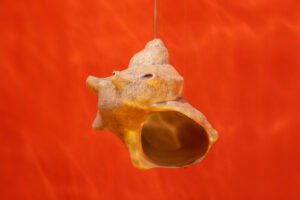
Bill Burns: It’s the Sun and the Rain that Makes the Salt and Goats and Honey Bees
Book Launch at Art Metropole
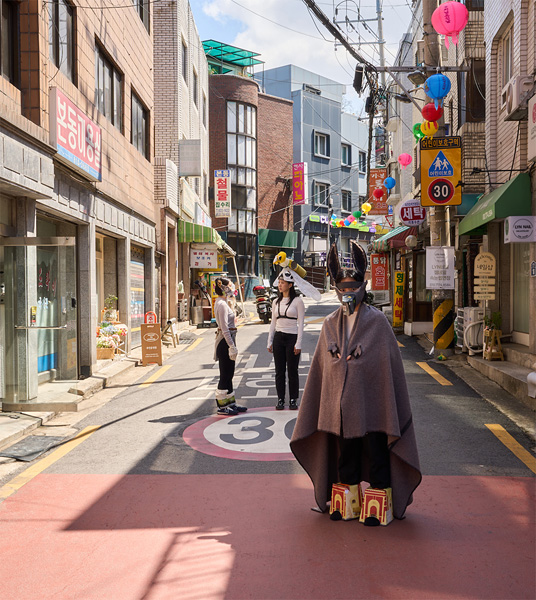
Photo: Chul-lim Choi, 2025
It’s the Sun and the Rain that Makes the Salt and Goats and Honey Bees Book Launch and Signing
Saturday, August 29, 2026, 2 – 4pm
Art Metropole, Toronto
More information >
Upcoming book signings:
Marcus Campbell Art Books, London, England | September 19, 2 – 4pm
Bienal de Curitiba, MON, Curitiba, Brazil | November 14, 2 – 4pm
Cite des Arts, Paris, France | February 6, 2027, 2 – 4pm
Please join Art Metropole on Saturday, August 29, 2–4pm to celebrate the launch of Bill Burns’ most recent publication: It’s the Sun and the Rain that Makes the Salt and Goats and Honey Bees. Stop by to pick up a copy of the publication, and stick around for refreshments and a drop-in signing with the artist. It’s the Sun and the Rain that Makes the Salt and Goats and Honey Bees is a book about a happening at Seoul, Korea. The happening involved more than a dozen farmers, beekeepers, musicians, goats and farmers at and around Seoul. Goats were milked, bees provided honey, and salt was harvested from the sea. Investment bankers planted a pollinator garden, children tasted the goat’s milk infused with salt and honey and players dressed as a donkey, a goat and a honey bee carried the milk, honey and salt across the city until it was finally mixed together at the Oil Tank Culture Park. The happening was directed by Bill Burns who also mixed the milk, honey and salt and made the drawings in this book. The dramaturg was Yeni Ma. The associate producer was Juwon Park. The players were Dongsol Seo, Hyeyoung Na, Yeji Lim. The violinist was Hyojin Kan. The goat farmer was Youngki Min. The principal beekeeper was Jin Park. The salt was procured at Sorae Salt Farm. Costume design was by Pascale Déry. Photography was by Chul-lim Choi and Bill Burns.
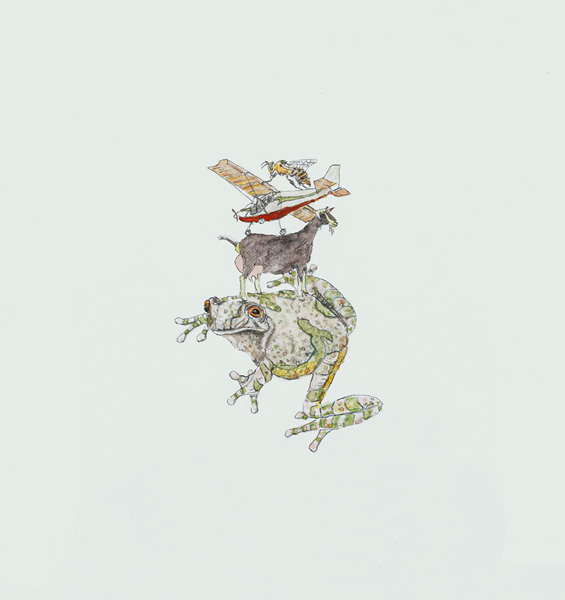
Photo: Toni Hafkenscheid
Graphic Design and typography of this book is by Seoul-based graphic designer Gunjung Lee, whose award-winning work often blurs the lines between typography and image. The book includes many pictures and words, including a meandering conversation between Yeni Ma and Bill Burns touching on the joys and contradictions of consumer culture, container shipping, acceleration, slow farming and collaboration between species.
ISBN: 978-1-0696681-0-3
Publisher: The Oil Tank Culture Project, Seoul
Authors: Bill Burns and Yeni Ma
144 printed pages in Korean and English
The authors thank the Arts Council Korea and the Canada Council for the Arts for generously supporting this project.
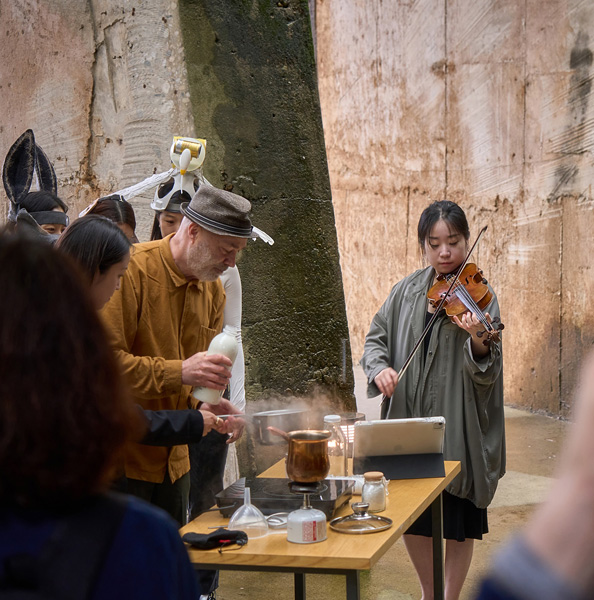
Photo: Chul-lim Choi, 2025
About the Artists
Bill Burns was born into a book selling family in Saskatchewan where he learned about art and books and tractors from monks and poets and farmers. His solo projects have been shown at the Institute of Contemporary Arts, London; KW Institute for Contemporary Art, Berlin; 303 Gallery, New York; Mendes Wood DM, São Paulo; Hippolyte, Helsinki; and the Oil Tank Culture Park, Seoul. His artists’ books and multiples are held in many collections including the Getty Center, Los Angeles; MoMA, New York; Cabinet des Estampes, Geneva; and Kunstmuseum Liechtenstein, Vaduz; and Tate Britain Archives, London. Bill Burns is represented by MKG127 and all photos are courtesy of MKG127.
www.billburnsprojects.com
@billburnspictures
Yeni Ma, a curator and researcher based in Berlin, has dedicated her efforts to exploring methods for presenting and preserving the intangibility and ephemerality of transformative and vanishing artworks, such as performance and time-based works. She participates in and organizes collective projects and exhibitions based on her interest in the relationships between different species. She is a member of the multidisciplinary research collective Getbol Lab, which studies the intersection of art and the hybrid ecosystem of wetlands.
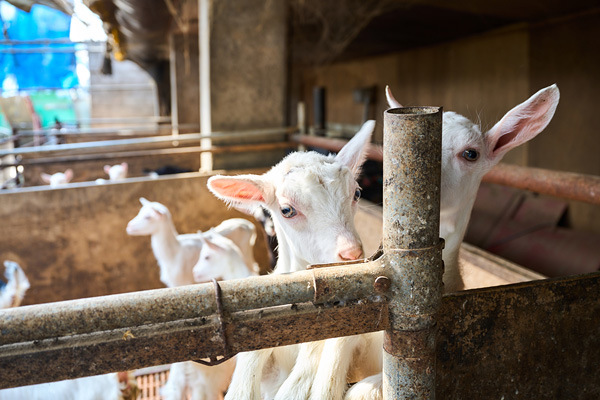
Photo: Chul-lim Choi, 2025
About Art Metropole
Art Metropole is a non-profit artist-run centre that publishes, promotes, exhibits, archives, and distributes artists’ books, multiples, and related media. We produce exhibitions, talks, readings, and other programs that highlight artists who make books and other artworks that can be widely circulated.
Our shop at 895 College Street, Toronto, stocks artists’ books and publications on contemporary art in all formats, with over 16,000 inventory items. Established in 1974, Art Metropole operates the oldest and longest-running artist-run bookstore in the world. We also distribute works through our online shop, and at art book fairs, pop-ups, and satellite locations internationally.
Art Metropole
896 College Street
Toronto, Ontario
M6H 1A4 Canada
www.artmetropole.com
info@artmetropole.com
+1 416 703 4400
Facebook @artmetropole
Instagram @artmetropole
Accessibility:
Art Metropole is partially accessible. For more information, visit here.
Image Descriptions:
1. Three women stand in a narrow, colorful street in Seoul, each in a hand-made animal costume: a donkey (grey shawl, ears, snout, hoofs) in the foreground, and a goat (floppy ears, snout, mittens) and a bee (white helmet with bee topper) in the background. The foreground woman looks at the viewer, the other two look at each other.
2. Documentation of a watercolor by Burns showing a stack of animals and objects on a white background: a large grey-green frog at the base, an oversized brownish-grey donkey with a pink udder standing on it, a white-red-green airplane on the donkey, and a black-and-yellow wasp on top. Rendered in a loose, semi-realistic style.
3. Documentation of Burns’ performance at Seoul’s Oil Tank Culture Park. In an industrial stone space, seven people gather around a wooden table holding an electric burner, funnel, jars, and sheet music. A bearded man in a grey hat pours milk from a jar into a steaming pot; beside him a woman in a grey jacket plays violin, reading the sheet music. Behind him, two women in donkey-ear and bee-helmet costumes are partly visible. A woman in a black jacket offers her hand to assist.
4. Interior of an industrial goat farm in Seoul. A metal gate spans the frame, behind which four white goats stand, with two gazing off to the left, two resting their hooves on the gate and staring directly at the viewer.
Related Content
Lustre Contemporary Opens Its New Gallery with The Harbingers
Toronto Biennial of Art 2026 – Convening: An Arrival, A Grounding, A Departure