Studio Rat at the Grimsby Public Art Gallery
By Jennifer Cavanagh
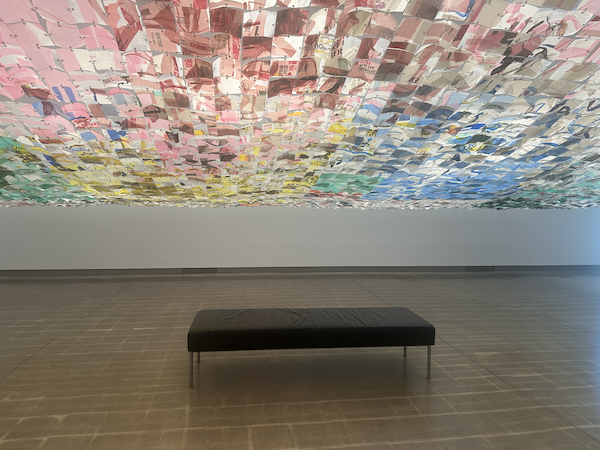
Studio Rat, Pressing Futures, 2026, installation view (photo: Jennifer Cavanagh)
Montreal-based artist collective Studio Rat was founded by Emily Allan and Dom Di Libero in 2018 as a “site for investigation into plastics, inflatables, and community building.” They create soft sculptural dreamscapes that explore the lasting presence of plastic in our environments and everyday lives. Both artists were born in 1997, the same year that sailor and researcher Charles Moore encountered a vast concentration of floating plastic debris in the North Pacific – an area widely known as the Great Pacific Garbage Patch. I don’t know if they’re aware of this coincidence, but the synchronicity was not lost on me when I recently visited the Grimsby Public Art Gallery to see their Pressing Futures exhibition.
The centrepiece of the exhibition, Lamination 1.0, is composed of 3,600 handmade tiles and more than 70 pounds of reclaimed sheet plastics and packaging, to make a 30-by-30-foot quilted sheet diagonally bisecting the gallery space. Each tile is made of often recognizable scraps of discarded plastic, which have been laminated into squares and then organized into a dynamic colour composition with clusters of pink, yellow, green, and blue gradually transitioning into one another across the installation. The meticulous, handmade construction positions it at the intersection of craft and contemporary installation.
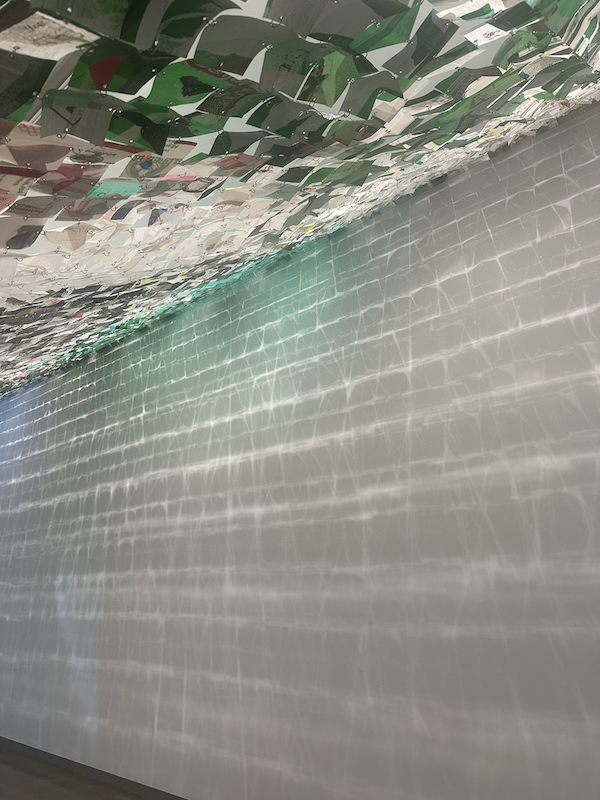
Studio Rat, Pressing Futures, 2026, installation view (photo: Jennifer Cavanagh)
Standing beneath the plastic quilt, I recalled the sense of childhood wonder from playing under a rainbow-patterned parachute, a feeling that existed only briefly before it and the parachute would collapse. Lamination 1.0, on the other hand, is made from a material whose environmental persistence far exceeds the fleeting experience of play it evokes. The gallery lights also pass through the installation to create a shimmering pattern on the wall, reminiscent of being underwater. The illuminated tiles create a calming muted pastel glow and establish an interplay between light and shadow, air and sea.
Prior to my visit, my research into Studio Rat’s past exhibitions had me expecting a lecture on environmentalism in the gallery. I came of age in the 1990s when we had entered a new period of discourse around waste as responsibility shifted from manufacturers onto consumers of single-use and other disposable plastics. I thought I was about to encounter an extension of this same message, that we were meant to feel badly for our personal consumption and discarding of plastic waste, which was a pervasive lesson in popular art and culture back then. But, to my surprise, I didn’t end up feeling this way either during my visit or in my reflections afterward. The tiles are described by the artists as a living archive, and that is how they felt to me. We are invited to reflect on the ways we handle, remember, and reimagine waste, so after experiencing the installation with a wider lens, I spent time exploring the tiles more closely. I inspected them for recognizable examples of discarded plastic, and I found plenty. Almost like a treasure hunt, memories were triggered as I identified No Name grocery store products and a St. Urbain bagel bag that would likely be found in my own garbage bin.
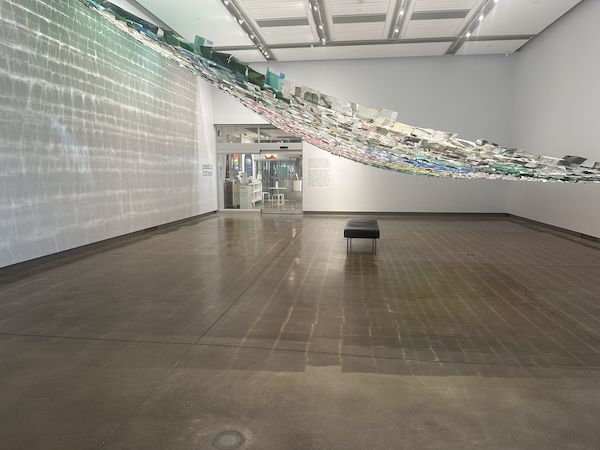
Studio Rat, Pressing Futures, 2026, installation view (photo: Jennifer Cavanagh)
Studio Rat explicitly positions plastic as a “curious and amorphous conduit for queer ecological theory and broader systems thinking.” It is a manufactured material, yet they transform into something that feels almost organic. Rather than simply asking us to reconsider plastic as an environmental problem, Allan and Di Libero invite us to think differently about the material – in their words, as a “tool for soft resistance, ecological storytelling, and gathering.”
Studio Rat: Pressing Futures continues until November 28.
Grimsby Public Art Gallery: https://www.grimsby.ca/parks-recreation-and-culture/art-gallery/
The gallery is accessible.
Jennifer Cavanagh runs a Canadian independent music company and is currently pursuing a master’s degree in Arts Management at Trent University.