Material Journeys at Carleton University Art Gallery, Ottawa
By Michael Davidge
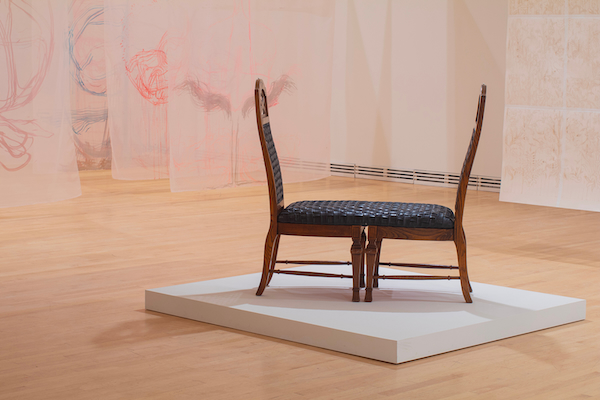
Marisa Gallemit, Naghalog/Embracing, 2026, installation (photo: Kathryn Desplanque)
The opening wall text for Material Journeys starts with a question: “What did you bring here with you?” Curators Heather Anderson and Kathryn Desplanque explicitly connect the way the artists in this group exhibition engage with materials to the relationships that viewers might have with their own possessions. Our things, they say, anchor us to a place we call home, wherever that might be.
Of course, in addition to the sundry material objects that might be at hand, like an umbrella or a phone, the question also refers to any preconceived notions about art that visitors might have. They have chosen to visit a gallery after all. I’ve been reading John Dewey’s Art as Experience lately, and even though I left the book at home, it did colour my reception of the exhibition, mostly through the phrase, “Only where material is employed as media is there expression and art.” I’m not going to get too deep into Dewey here, but I will say that the artists Marisa Gallemit, Zoe Kreye, and Sukaina Kubba put their materials to work, expressively and impressively, in strikingly different ways in this exhibition. Due to this focus, my viewing experience was enriched by paying close attention to the list of materials on the wall labels for each artwork.
For example, I never would have noticed that Gallemit used a “found plastic rice package” as a kind of tablecloth for the display of a collection of trophies in her installation Tennis Family, or that the cushions supporting a collection of jewelry, seashells and beach rocks in Dominiko (Philippine Magpie-Robin) are made from “deconstructed house dresses.” Gallemit has created a body of work from items she inherited from her deceased parents, thereby commemorating their lives. In Naghalog/Embracing, she employs the traditional Filipino weaving technique of solihiya (using bicycle tire inner tubes in another nod to her personal history) to transform two separate oak dining chairs affectingly into a loveseat. As Dewey might say, this object is representative of a life and not a prescribed mode of living.
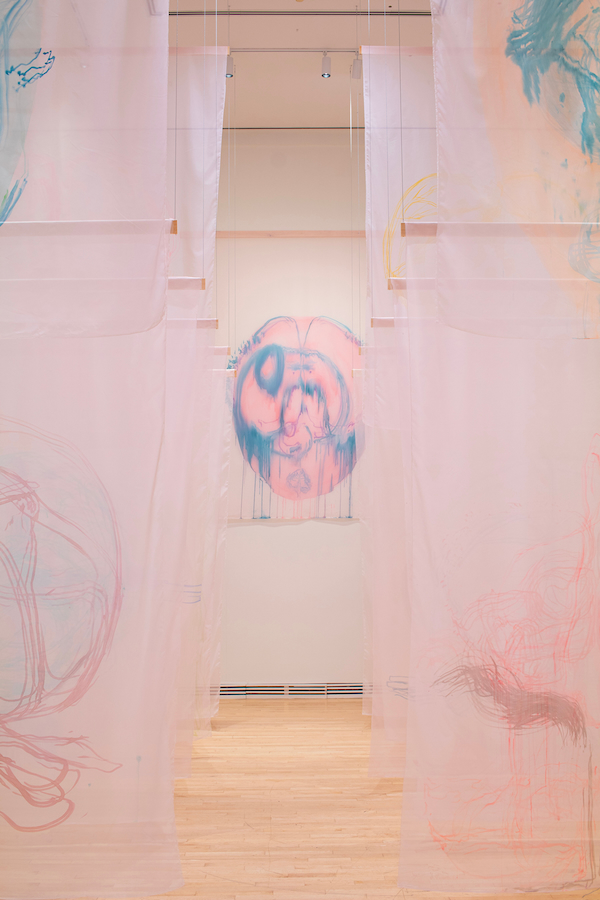
Zoe Kreye, Seventeen Energy Paintings: Fields, 2024-2025, installation view (photo: Kathryn Desplanque)
In another manner, Kreye conveys her inner experience through a personal ritual that is manifested in two bodies of work on display, stemming from a larger practice identified as “energy painting”. These works are numbered in a way that suggests there are even more to be inventoried: Seventeen Energy Paintings: Fields and Five Energy Paintings: Centres use ink on sheets of rayon fabric, but to different effect. In these works, gestural swathes of colour, at a scale seemingly circumscribed by the span of the artist’s arms, evoke shapes that recall the body’s interior: rib cages, intestines, or cross sections of the brain. The Centres, on canvas stretchers, are opaque, but appear to seep, shimmer, or vibrate in the course of looking at them. Suspended in mid-air, the Fields are diaphanous, and surpass perception through sheer scale and number. Kreye aims to harness and further the transformative power of politicized somatics through her work. I certainly became aware of the limits of my own body as I traversed the space, which might be considered a preliminary step towards greater awareness.
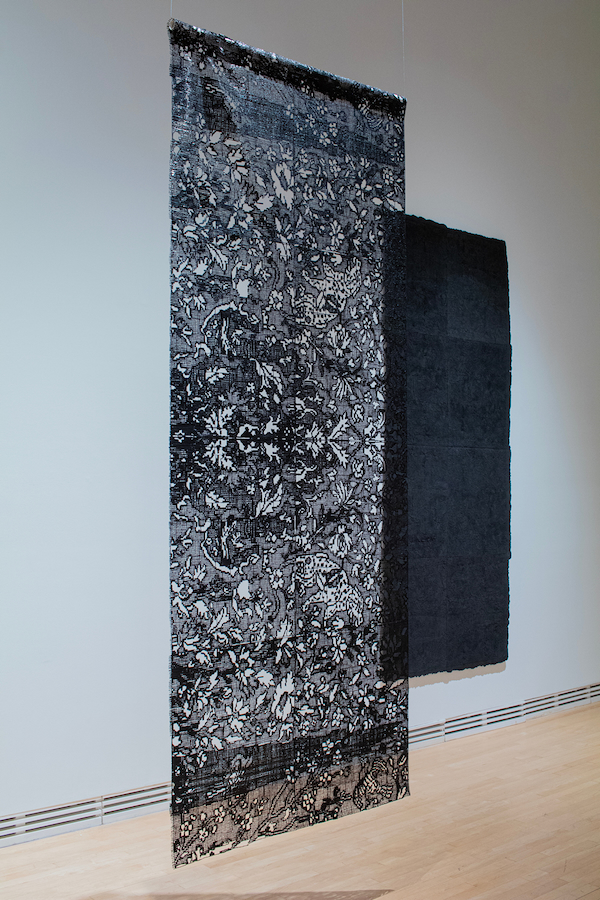
Sukaina Kubba, Afterfeather I and Afterfeather V, 2025, installation view (photo: Kathryn Desplanque)
To invoke Dewey one last time, art affords a new experience by orchestrating a break with habitual perception. Through the works by Kubba included in the exhibition, I saw floor rugs as I had never seen them before. Kubba has engaged in a sustained material investigation of Middle Eastern and North African rugs and their history, reinscribing and re-embodying their weaving techniques through a tracing of their patterns by hand. These drawings are then used to reproduce the rugs at scale and with unorthodox materials, creating prints and towering sculptural works that, hung vertically in the space or on the walls, hover between apparitions of their original forms and genetic mutations of them. Based to some degree on personal experiences and recollections of family possessions, but largely on the holdings of museums and archival collections, Kubba’s work shows how these rugs have been transformed through appropriation and industrial manufacturing. Numbered series that are iterations of the same pattern, such as Mountain in the Room or Afterfeather are variously silkscreened on latex or differing qualities of paper, embossed or cast in paper, 3D printed with thermoplastic polyurethane filament, or laser etched on paper until it verges on transparency. The materials are seemingly taken to the limits of their capacity. The discoloration on Mountain in the Room II even indicates that the process of laser etching has burned the paper holding the pattern in relief. Ironically, the strong presence of these works, meant to guarantee the posterity of their subjects, simultaneously reveals the precarity of their status.
Altogether, a visit to Material Journeys offers a beautiful and moving experience. The brightly coloured and airy environment it provides is nevertheless tinged with dark undercurrents of grief, vulnerability, and trauma. We don’t find ourselves at home but somewhere else, separated from familiar objects and surroundings. And yet, in the context of the ever worsening news cycle of war and devastation, the works on view are still exemplary reminders that investing in art is the best bet for achieving longevity.
Material Journeys continues until May 3.
Carleton University Art Gallery: http://cuag.ca/
The gallery is accessible.
Michael Davidge is an artist and writer who lives in Ottawa, Ontario. His writing on art and culture has appeared in Border Crossings, BlackFlash, and C Magazine, among other publications.