Jenine Marsh at Kitchener-Waterloo Art Gallery
by Kim Neudorf
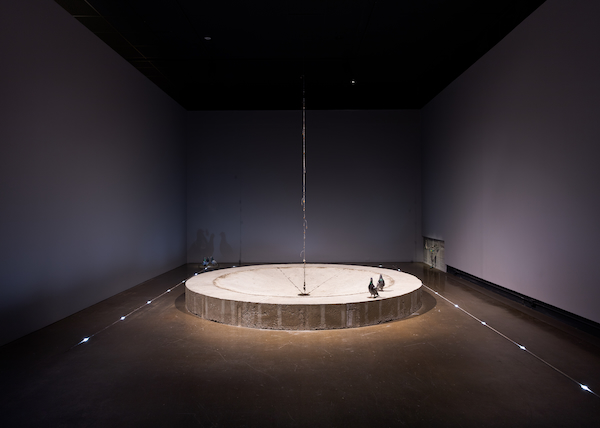
Jenine Marsh, HARBINGER, 2025, installation detail (photo: Laura Findlay, LF Documentation)
Reading the word “harbinger” (the name of Jenine Marsh’s solo exhibition currently on display at Kitchener-Waterloo Art Gallery), my first thought is of the wizened stranger in a horror film whose role is to warn travelers of dangers ahead (inevitably, doom-filled ends). A harbinger, according to various dictionaries, is what (or who) “foreshadows or foretells the coming of someone or something”, such as the appearance of a ghost as a sign from the beyond, or spring growth as proof of warmer weather to come. In exhibition notes provided by the artist, the word “harbinger” (“a scout”, “an omen”) starts to take on more shape. Its interlocutors in/through coins, pigeons, windchimes, LED lights (“fairy lights”), and their pathways and imprints forewarn perhaps – but in language more grounded in fiction (speculatively and materially) than direct ties to the world outside.
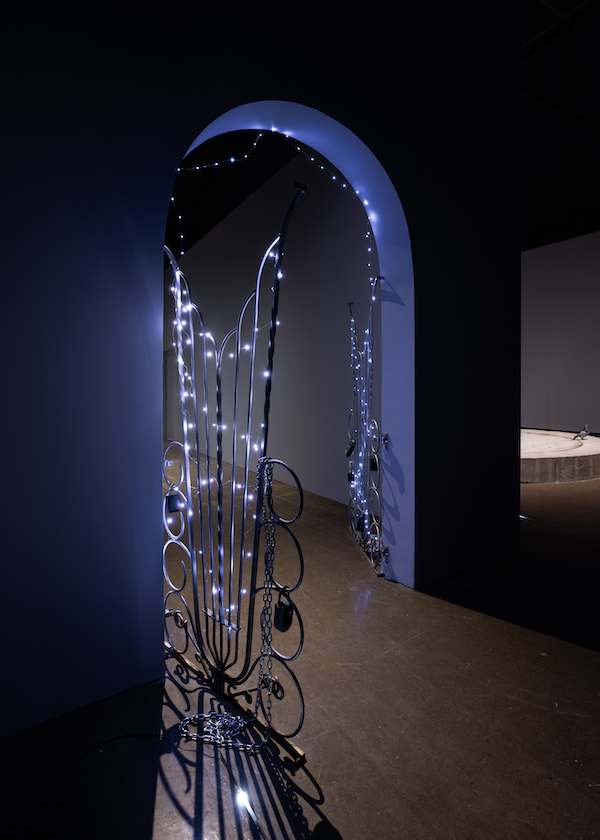
Jenine Marsh, HARBINGER, 2025, installation detail (photo: Laura Findlay, LF Documentation)
Two steel gates are swung open, allowing entrance through an arched doorway. Delicate white-blue LED lights are woven through the gates’ loops and spires, creating a casual Christmasy/Halloween vibe. The steel design is harp-like, wings expanding with tips sharp or truncated as if cut free from a previous location. Key-pad locks and lengths of chain hang and drag from the gates, suggesting an enthusiastic, DIY security system. A pile of receipts, flyers, newspaper, and a few feathers are piled on the floor, appearing wind-blown and random. The lighting on this threshold is dim, gothic. The gate’s skeletal steel casts dramatic shadows on the grey-blue walls.
Just inside the main gallery, LED lights embedded in the floor reveal a deep cut in the concrete that frames the installation – an “excavation” hinted at earlier via wall text. Crumpled paper and gravel-like material have been placed (or perhaps excavated, if you suspend your disbelief) within the length of the cut. The glowing pathway resembles the safety floor lighting on airplanes or in movie theaters, or recessed lighting seen in corporate or modern suburban spaces. The effect here, with wiring and surrounding debris still partly visible, emphasizes the installation’s stage-like presence while evading relegation to mere mood lighting or generic ambiance.
Jenine Marsh, HARBINGER, 2025, installation detail (photo: Laura Findlay, LF Documentation)
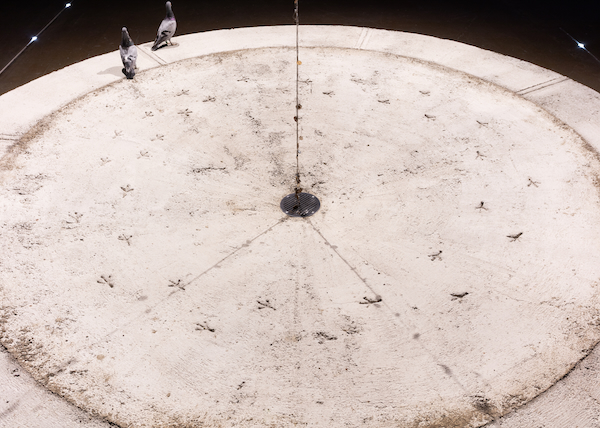
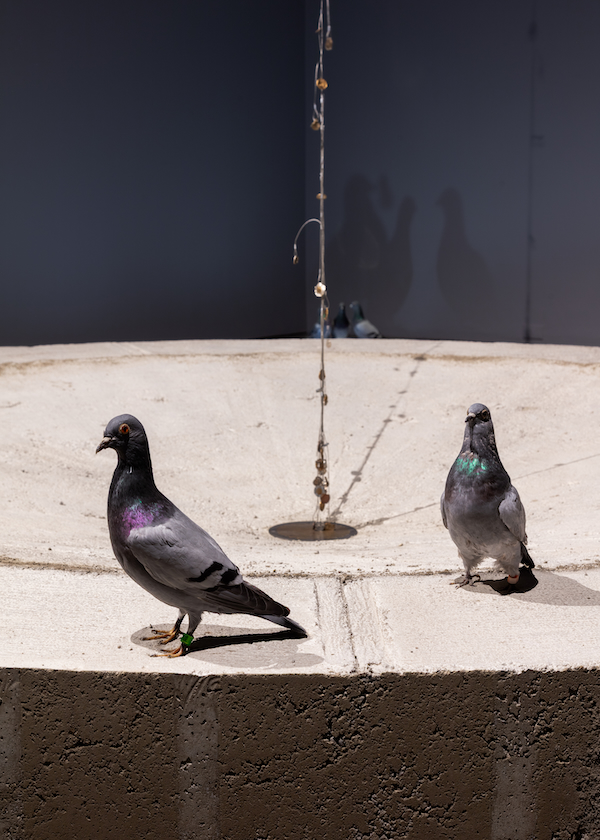
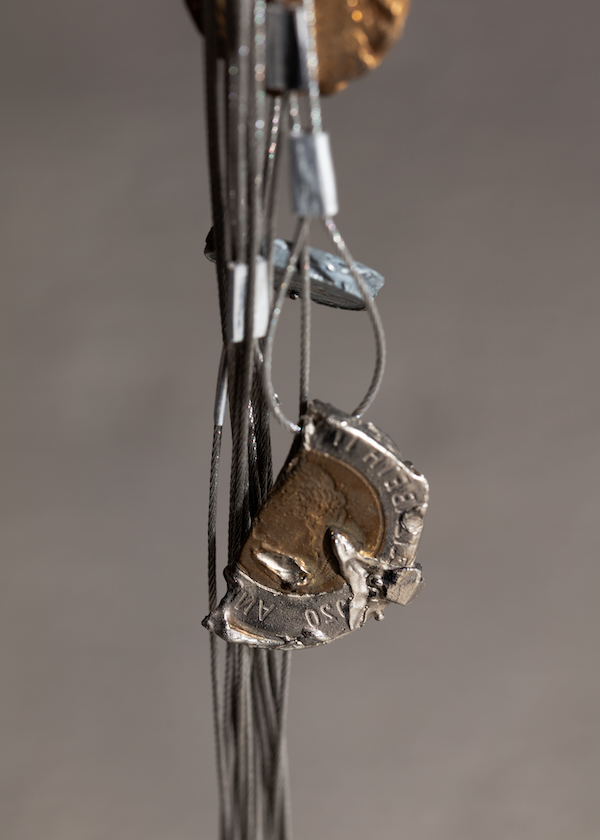
The centrepiece of the installation is a large, flat, white-grey concrete circle, its concave interior suggesting a shallow pool or the classic shape of a public fountain. Dramatic lighting showcases the fountain (or deifies it) in the otherwise darkened space. The exhibition’s wall text speaks of “sacrifice and utopic hope”, tying these ideas to the “near-universal ritual” of making wishes by tossing a coin into a fountain. In Marsh’s reimagined version, the usual signifiers are indeed present but completely transmuted. The “water” that shoots from the fountain’s central grate is a length of taut wire interwoven with wire arcs, like watery-wire “spray”. Affixed to the wire are various discs in coppery pinkish-orange or shades of burnished bronze or silvery grey, occasionally with a greenish-blue patina. The discs are coins in various states of intelligibility; all are flattened, stretched, studded, gouged, or pierced, their coin identities dissolved from a process of defacement. Looking more closely, the taut wire isn’t actually taut, but hung, weighed down, and attached to the grate to create the illusion of “water” flowing both downwards and upwards.
Two taxidermy pigeons perch upon the right-side lip of the fountain, each with an intact band (or secret message?) securely looped around an ankle. Little pigeon tracks loop around the interior of the fountain in an ornate pattern of embedded footprints, the only decorative elements visible amidst seams, air gaps, and raw exterior of the otherwise naked fountain. The wire-water casts two shadows upon the face of the fountain in a triangular shape, like shadow paths on a sundial.
Jenine Marsh, HARBINGER, 2025, installation detail (photo: Laura Findlay, LF Documentation)
In an accompanying exhibition text, much is made of the installation’s greyness as both resulting material aesthetic and reference to the drained (greyed-out) energy and neutral-grey uniformity of urban space, particularly its architecture. The repeated, material rawness of this grey in the installation – illuminated so dramatically in the dimness of the gallery – invites slow, close inspection, contrary to the seamless presence and transactional role of a conventional (Western, modern) fountain. As a kind of demonstration (or consequence) of close engagement, this roughness of exterior appears precarious, vulnerable – a sensitive surface with the ability to record touch by wire-water, pigeon, indentation, and shadow.
To the right of the fountain, windchimes hang from vines made of paper and fabric leaves. World maps – like the kind you see in an atlas – have been recycled as the upper and lower shell of the chimes (listed as “crushed globe coin bank”), from which hang metallic chimes as well as coins and flowers encased in synthetic rubber. Hung directly in front of the gallery’s large ventilation grate, they are animated by constant gentle air. Further up the same wall at the level of the ceiling hangs another set of windchimes, this one more spare in construction. In modern versions of the civic fountain, the sound and movement of water is often meant to dull city noise, thus losing its meditative potential as yet another familiar sound in an overall daily texture. In the silent, empty space of Marsh’s installation, windchimes replace the sound of water. Free from being swallowed by city noise, they provide a kind of anchor to the “when” and “where” of the installation. The sound of the chimes holds my attention subtly, but also insistently, tethering me to “here”, and helping me stay present in the conditions of “now”.
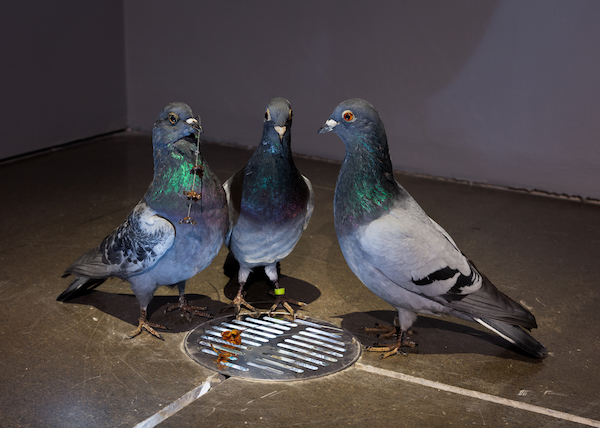
Jenine Marsh, HARBINGER, 2025, installation detail (photo: Laura Findlay, LF Documentation)
In the furthest left corner of the gallery, three more taxidermy pigeons converge around a floor grate, their shadows casting large silhouettes. One pigeon holds the stem of a rubber-encased flower in a picturesque pose. Pigeons, Marsh reminds us, have become synonymous with public city life but are treated like pests or ignored. What they offer in contrast to coins or currency, Marsh suggests, cannot be used and consumed (or even comprehended) within the usual capitalist systems of value and exchange, just as what her damaged coins offer, or the wishes that might be made with them.
While much is counterfeit in the installation – the coins (cast and fake, many of them “double-faced”), the non-functional fountain is neither fountain nor drain, the wind powering the windchimes is artificial indoor wind, the pigeons taxidermy, the wing-like gate a repurposed trellis – the fiction that Marsh redirects me to is what is/could be because of (and not in spite of) these conditions. What is/could be signalled, foretold, and wished for here? Her picturesque, convening pigeons “present offerings” or messages – perhaps as the yield of their mission as “scouts”. But what their messages and intentions are isn’t made clear, or isn’t meant for me to know so directly.
Jenine Marsh, HARBINGER, 2025, installation detail (photo: Laura Findlay, LF Documentation)
Marsh’s false coins, pierced by wire, claimed by pigeons, or out of reach at the bottom of a grate, aren’t meant for use (or wishes) in any conventional sense. They are well-worn, twisted by unknown processes, and seemingly already claimed by the past. Cast in states of decay, apparently without worth (in the real world), they are like wishes returned or excavated, revealing the physical effects of time. As a counterweight to whatever form wishes are meant to take (perhaps imagined as utopic visions of immortality, or expressions of hope in spite of this impossibility), these tributes point to an existence (or persistence) that lives on beyond us.
Jenine Marsh: HARBINGER continues until February 1.
Kitchener Waterloo Art Gallery: https://kwag.ca/
The gallery is accessible.
Kim Neudorf is an artist and writer based in London (ON). His work has appeared most recently at the plumb, Toronto; The Next Contemporary, Toronto; Harkawik, New York; Embassy Cultural House, London, ON; Support project space, London, ON; DNA Gallery, London, ON; Paul Petro, Toronto; Franz Kaka, Toronto; Forest City Gallery, London, ON; Modern Fuel Artist-Run Centre, Kingston; Evans Contemporary Gallery, Peterborough; and Susan Hobbs Gallery, Toronto.