Hannah Epstein at MSVU Art Gallery, Halifax
By Liam O’Brien
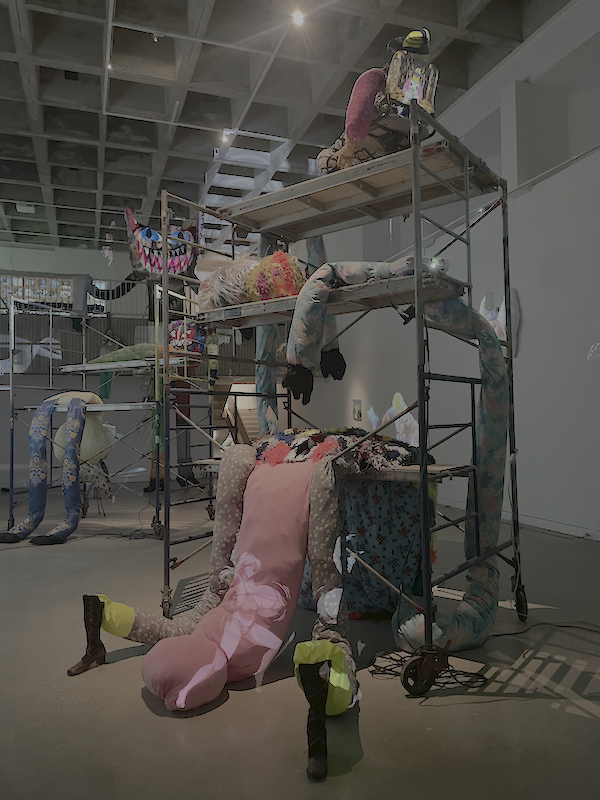
Hannah Epstein, Plato’s Goon Cave, 2026, installation view
Niche internet subcultures have been receiving a kind of mainstream attention previously unthinkable in recent months. As the vernacular of online life seeps into newspaper profiles, politics, and teenage slang, curiosity has grown about how the dark powers of the internet are changing us. One such memorable ethnography was Daniel Kolitz’s 2025 Harper’s Magazine investigation into gooning: an internet-based community devoted to marathon masturbatory sessions while watching fast-paced porn edits in “goon caves” – bedroom corners optimally arranged for this intensified brand of endlessly delayed self-gratification.
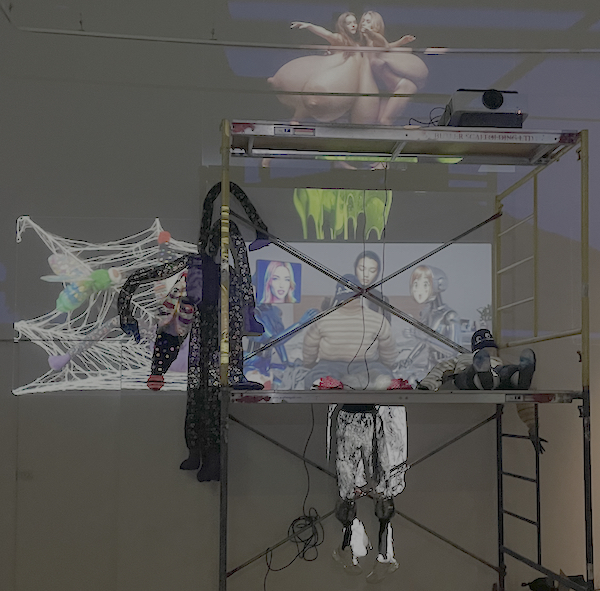
Hannah Epstein, Plato’s Goon Cave, 2026, installation view
Hannah Epstein’s exhibition Plato’s Goon Cave, currently on display at Mount Saint Vincent University Art Gallery, hyperbolizes the goon cave to fantastical ends, meditating on this site and its implications for the current media landscape. The artist swaps the banal domestic features of a goon cave – ergonomic office chair, LED strip lights, anime bobbleheads, lotion – for an impish reimagining to suit her satiric take on digitized life. As I made my way through MSVU’s hallways and entered the gallery, a stimulated delight washed over me, the kind induced by the neon glimmer of a traveling carnival. Around me was a stunted version of Plato’s allegory: here, Epstein’s goons – largescale anthropomorphic plush characters made from various textiles – remain in the depths of the darkened gallery, purposefully bound to their digitally-mediated simulation.
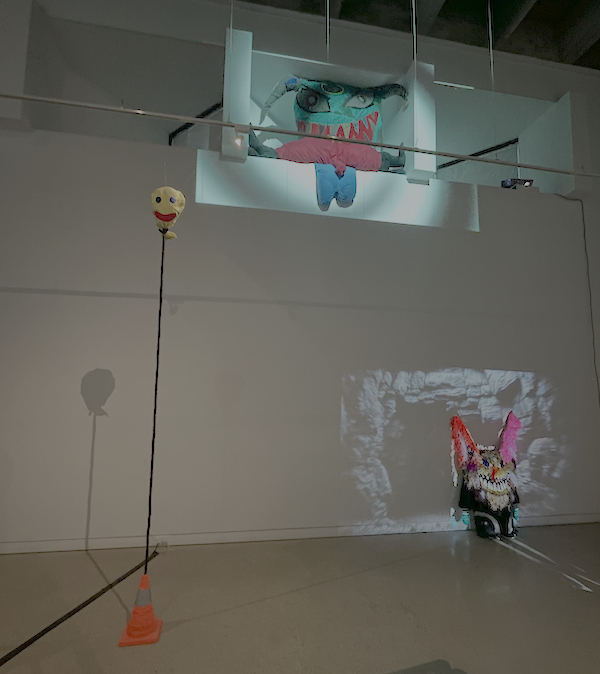
Hannah Epstein, Plato’s Goon Cave, 2026, installation view
The sheer mass of art Epstein has created for her exhibition engulfs you. Sculptures straddle scaffolding towers, peer from window ledges, and grin from underneath stairwells. The goons are illuminated by the glow of projections to create illusory environments around or doppelgangers on top of the work. The latter simulacra stuffies engage in a range of the kind of eerily alluring devilment we’ve become accustomed to seeing from AI-generated content. One creature, made from stuffed animals vacuum wrapped in plastic bags to make limbs, sat slumped on the floor as an animated twin cowered over it, ravaging its soft innards on a loop. Perpendicular to this corporeal mutilation, a navy, multilegged octopus directed my gaze down a transfixing, spider-spun tunnel. The projections grab and hold your attention almost unwillingly while simultaneously obscuring the physical works by simply being more luminous. The dark lighting required for projection adds to this obfuscation, which reads as a defeated admission to the enthralling effects of screens in a room full of objects.
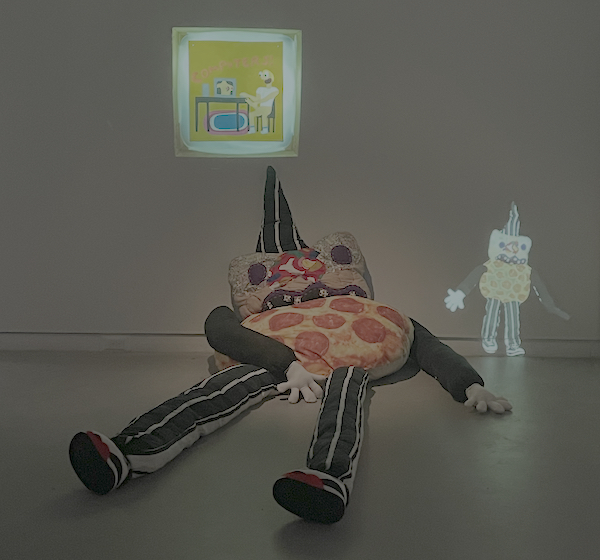
Hannah Epstein, Plato’s Goon Cave, 2026, installation view
While the show’s digital palimpsest exhilarates, I sought refuge in the works less greedy to hold my attention. At the very back of the gallery, a small felt composition of a seated masturbator, penis in hand, gazing into a boob-filled screen stood still amongst the noise. Above him, emblazoned in curvy orange fabric was written, “Computers!” It serves as a concluding remark on our primordial hunger for escape and, most of all, how sad satiating that hunger looks. As I peered out from the loft back across the gallery, I got a clearer view of the top of the scaffolding units and noticed another seated goon, this one towering above all the others. It seemed like the prisoner closest to wanting to escape the cave, but unsure of its decision to stay. I looked up at it once more while leaving and noticed the small VR headset strapped to its face. It could have taken them off, but the concrete ceiling above was pretty drab.
Hannah Epstein: Plato’s Goon Cave continues until May 17.
MSVU Art Gallery: https://www.msvuart.ca/
The gallery is accessible.
Liam O’Brien is an artist living in Kjipuktuk/Halifax. He is currently studying architecture at Dalhousie University.