Black Summer ’91 at Fonderie Darling
By oualie frost
Curated by historical guide Rito Joseph, Black Summer ’91 is an interdisciplinary dive into a particular period of Montreal’s political past. Straddling the line between art and museum exhibition, it educates while reflecting on a lesser known moment in our local Black history – one marked by cultural awareness, police brutality, and resulting political action.
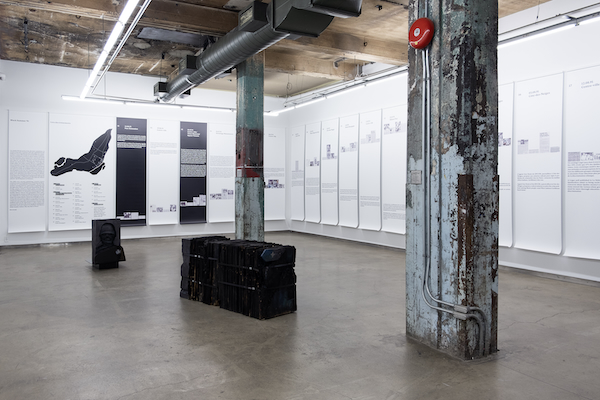
Black Summer ’91 at Fonderie Darling, 2024, exhibition view (photo: Simon S. Belleau)
Occupying two rooms at Fonderie Darling, the exhibition first opens into a brightly lit space where artworks reside surrounded by several black and white panels hanging from the walls. Serving as a timeline of the summer months of 1991, the panels demarcate notable events from cultural celebrations to racially charged attacks. Four black panels each represent a Black man killed by the Montreal police.
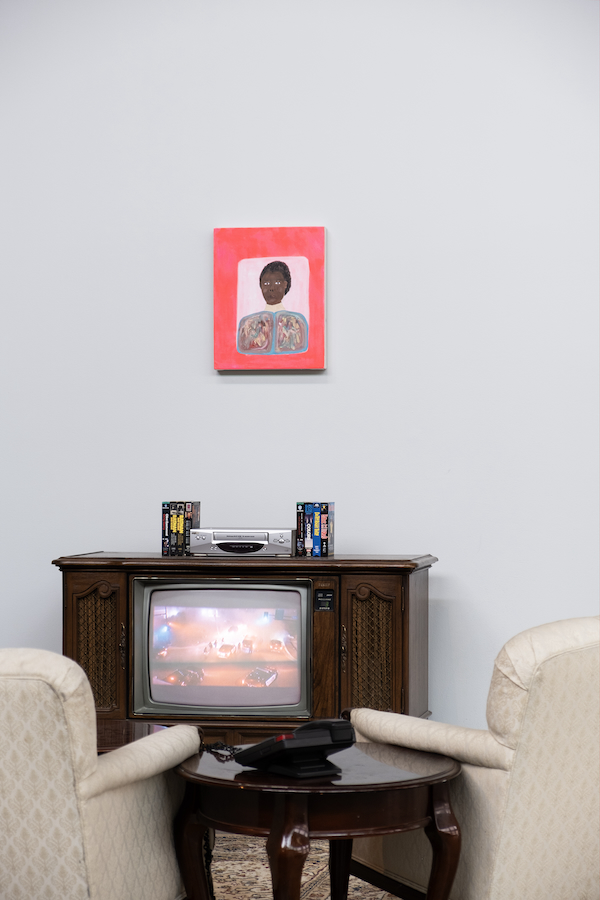
Black Summer ’91 at Fonderie Darling, 2024, exhibition view (photo: Simon S. Belleau)
The works occupying the second room largely possess archival qualities. In the center, an old Volkswagen taxicab sits, playing hits from the 1990s, with an iconic beaded seat cover on the driver’s cushion. Adjacent is an installation of a living room with couches and an end table facing a vintage cabinet television. Footage lifted from old broadcasts about racism and police brutality plays on loop. These pieces call back to Joseph’s own personal history and memories, as well as the broader cultural context. Cab driving, a frequent career choice for Afro-Caribbean immigrants including Joseph’s father, was also a site of racially charged discrimination. There is something immediately familiar about this exhibition that adds to the very Black feeling Black Summer ’91 evokes. Despite not being alive at the time, I feel my connection to the works and the era deepened by the comforting resemblance to my own specifically Afro-Caribbean experiences.
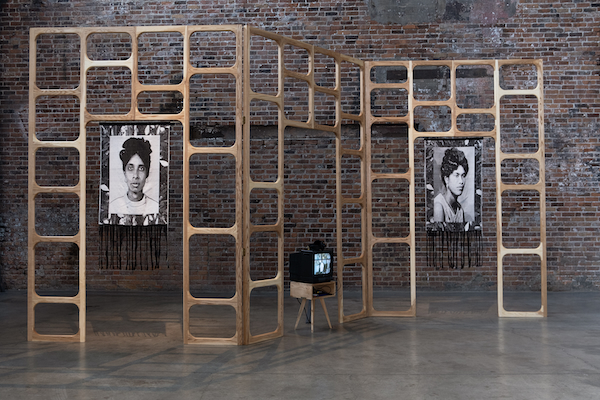
Michaëlle Sergile, Lè m sot Ayiti, 2024, installation view (photo: Simon S. Belleau)
Michaëlle Sergile’s Lè m sot Ayiti pays homage to Black women and the work immigrant Black women do to construct lives in new countries. Wood structures reminiscent of retro room dividers or scaffolding are built around two woven portraits of silent but confident women. They depict the first two women in Sergile’s family to come to Canada.
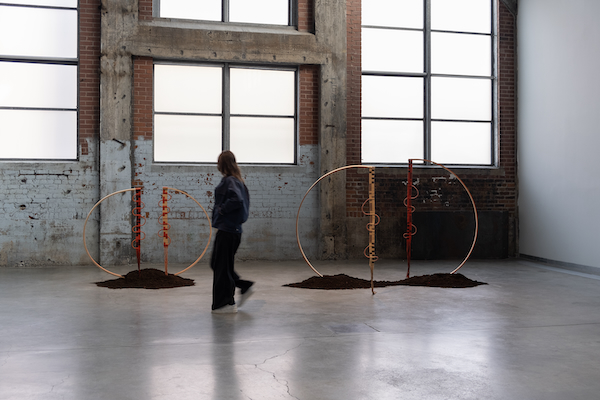
Shaya Ishaq, Elegy for a matriarch whose spirit pulses through soil and rises with the sun, eternally I and II, 2024, installation view (photo: Simon S. Belleau)
Breaking somewhat from the more obvious archival elements, Shaya Ishaq’s Elegy for a matriarch whose spirit pulses through soil and rises with the sun, eternally I and II serves as a kind of mourning ritual for the artist and, as shown in the precarious balance through which the pieces suspend themselves, a reminder of the fragile line between life and death. Their use of weaving (a craft Ishaq shared with their now deceased grandmother) highlights the value of preserving heritage and what can be learned through looking towards that which came before us.
One leaves the gallery better informed on the city’s history. (Did you know Hocelaga used to be a KKK hotbed? I didn’t.) But the value of the exhibition can extend beyond that. Black Summer ’91 comes during what could also be deemed a pivotal moment in Montreal’s political history. The past several months have seen a great increase in activist action in Montreal (largely pro-Palestinian) and a corresponding uptick in police violence and repression – something I have experienced firsthand and repeatedly. Mere hours before writing this, I was shoved around by riot police. The parallels between Black Summer ’91 and the current climate are striking. It is easy to see what has changed, yet how much hasn’t.
Black Summer ’91 continues until August 18.
Fonderie Darling: https://fonderiedarling.org/en/
The gallery is accessible.
oualie frost is a casual artist, writer, and activist currently based in Tiohti:áke/Mooniyang (Montréal) whose writing centers primarily around the art and experiences of Black, mixed-Black, and other racialized people, as well as loose cultural critique. They are a former founding member of the Afros in the City media collective, with writing published on various platforms, including Akimblog, the Rozsa Foundation, and Canadian Art.