Abbas Akhavan at the Belkin Art Gallery, Vancouver
By Ogheneofegor Obuwoma

Abbas Akhavan, Studio, 2025, installation view (photo: Rachel Topham Photography)
One Hundred Years, Abbas Akhavan’s exhibition of new works at the Belkin Art Gallery, encourages visitors to question the potential of the gallery space through visual and bodily interactions. As I explored the maze-like installation, I felt invited into spaces usually hidden—akin to accidentally wandering backstage long before a concert begins. The Montreal/Berlin-based artist who will be representing Canada at next year’s Venice Biennial draws our attention to suspended time through stories and held moments. The exhibition presents a unique and challenging experience that, according to the gallery handout, blurs the boundaries between “stage, set, gameboard, studio, and gallery.”
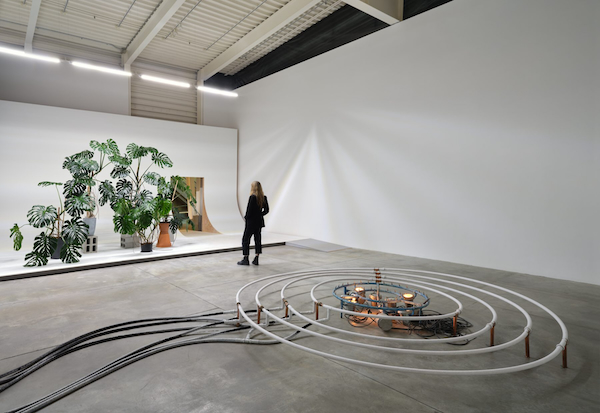
Abbas Akhavan, Studio, 2025, and spring, 2021/2025, installation view (photo: Rachel Topham Photography)
The coiled water fountain pipework of spring (2021/25) is seen directly ahead as you pass through a portal-like entrance leading onto what feels like a stage. The scene is set outside conventional space and time—it’s almost confusing at first glance—with monstera plants occupying the right side of the stage set against a curved backdrop. The coils look wet and frozen as if held so by a spell. A mechanical hum fills the gallery and, following some large cables, I discover in an adjacent space the source of the sound: a freezer that powers the frozen fountain. The spell falls apart through this unfolding of the exhibition in unexpected ways.

Abbas Akhavan, One Hundred Years, 2025, Zoo, 2025, and Untitled, 2025, installation view (photo: Rachel Topham Photography)
Also in this space, a lopsided multi-tiered cake is supported by an unremarkable stick. A single candle is lit on the first day I visited and three on my next visit. A mirror placed opposite the cake offers the staging within an easily observable frame. Akhavan’s ongoing interest in spaces and objects of hostility and hospitality is strongly present here. Low light and the labyrinthine qualities hold the viewer within an unwelcoming yet potent space of possibility. Seeing the industrial-style freezer alongside the cake is a bit of a contradiction; out in the open, the unit feels like an artwork in its own right. Their proximity emphasizes this effect. One Hundred Years (2025) is inspired by Disney’s Sleeping Beauty and recalls a sleeping Aurora (also known as Briar-Rose in the Grimm Brothers’ tale). The work sits within the realm of the dreamlike: the cake devoid of human presence, possibly assembled for a celebration that has been forgotten or suspended in time.
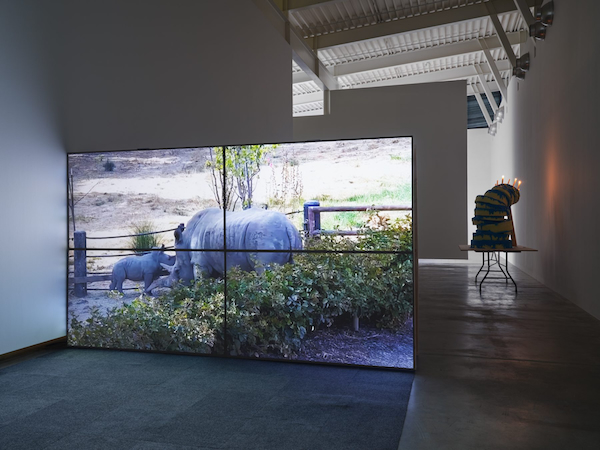
Abbas Akhavan, Zoo, 2025, and One Hundred Years, 2025, installation view (photo: Rachel Topham Photography)
Themes of the natural world extend beyond the initial monstera plants through controlled or enclosed spaces. In Zoo (2025), a surveillance-like setup of TVs displays live streams of animals in zoos or natural pastures, offering another staged space within the exhibition. In the adjacent room, LOOP (2023/25) is a more conventional fountain in which water slowly and meditatively moves through a rocky structure that is staged for observation against a constructed chroma-key green stage. This backdrop completely offsets our expectations of an outside world that might accompany a natural fountain. Instead, it feels like a call to continue the work within our imagination.
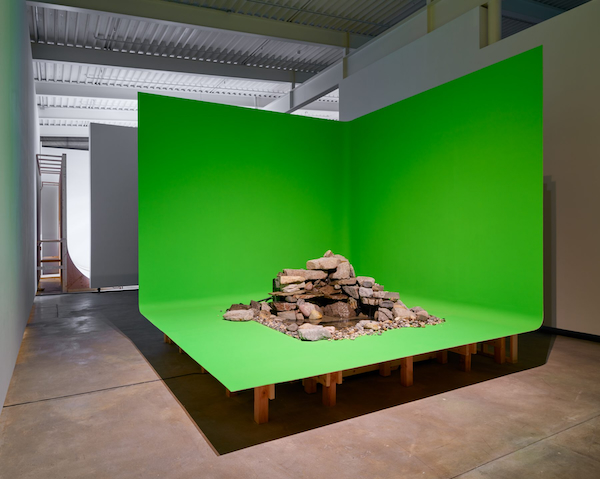
Abbas Akhavan, LOOP, 2025, installation view (photo: Rachel Topham Photography)
Everything seems eerily peaceful even as I notice the stuffed owl and fox from Akhavan’s 2017 Fatigues series hidden behind the green screen walls, lying between life and death. There is a feeling that something is amiss, that things are not where you would expect them to be. At the other end of the gallery, a lone badger, also frozen in a life-like way through taxidermy, elliptically ends the exhibition. The screen outside the gallery offers no explanation, just a picture of a stage curtain layout (according to the handout, this image changes daily). There is nothing more and nowhere to go, and I am left with a vague feeling of uncertainty or the nagging sensation that I have missed something along my journey.
Abbas Akhavan: One Hundred Years continues until December 7.
The Morries and Helen Belkin Art Gallery: belkin.ubc.ca
The gallery is accessible.
Ogheneofegor Obuwoma is a Nigerian filmmaker, storyteller, and artist with a BFA in film and communications from Simon Fraser University. Her work explores “the personal” in relationship to her larger community and the cultural experience of being Nigerian. She is interested in African futurism and the ways we access the spirit.