Stephanie Fortin at the Grimsby Public Art Gallery
By Stephanie Vegh
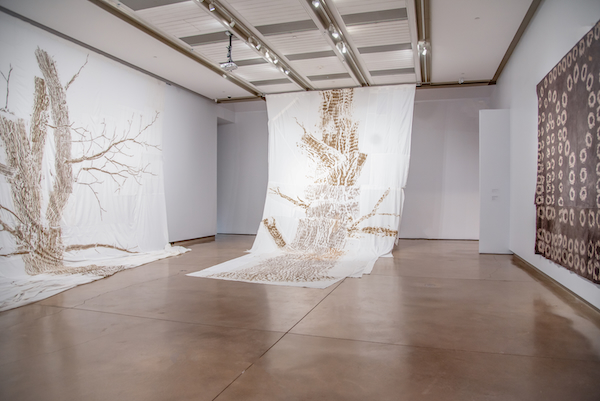
Stephanie Fortin, Field Notes, 2025-2026, installation view (photo: Ollie Lauricella)
Stephanie Fortin’s Field Notes is an autopsy, a reconstruction of decaying creatures, an archive, and a memorial. Curated by Alexandra Hartstone as a hushed assembly of three patchworked prints on thrifted cotton, this exhibition at the Grimsby Public Art Gallery is the result of a wider collaboration between artist and trees, mediated through the forces of time and climate.
Two of the three monumental prints depict trees so vast that they disappear off the edges of the white cotton draped from floor to ceiling, emphasizing the relative smallness of even this high-ceilinged space, the better to honour the tree’s grandeur. I might be forgiven for thinking that both prints depict the same tree – an uncontainable giant broken in two – but Fortin’s titles identify these as two distinct species downed at the University of Guelph Arboretum: a non-native poplar, and a black walnut “planted by animals.” (I immediately suspect squirrel.)
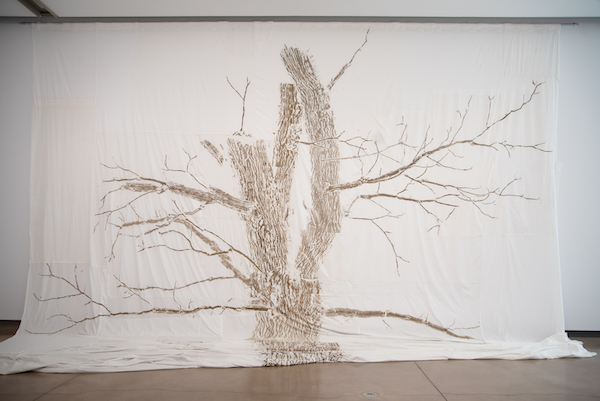
Stephanie Fortin, Poplar 1972-2023, 2023, reclaimed cotton, organic cotton thread, foraged black walnut husks, rust-derived iron (photo: Ollie Lauricella)
Black walnut also contributes its husks as a pigment, combined with rust-derived iron to create the ink used to pull highly detailed impressions from the bark of these trees – an undertaking conducted in situ at the Arboretum. The dye soaks into the second-hand cotton sheets like bloodstains with the splashy, energetic quality of tire tracks that have veered off a snowy road. Hung away from the wall, Black Walnut 1992-2024 invites the viewer to wander behind the canopy of the draped tree. From this angle, pigment glows through fabric and reflects a ghostly tree into the polished concrete below.
The salvaged cotton panels are strongly stitched together to bear the physical and psychic weight of the tree, which stretches and puddles along the floor like a bridal train. A few faint traces of pencilled numbers and letters at the edges of some seams nod to the systemic logic needed to catalogue and re-assemble these fragmented prints into an accurate whole. Despite this archivist’s seemingly scientific hand, a looser lyricism prevails here. The finer branches of Poplar 1972-2023 are appliqued in curving shapes over a foundation of patched gridwork that is made defiantly informal by virtue of the varied sizes and proportions of reclaimed cotton sheets.
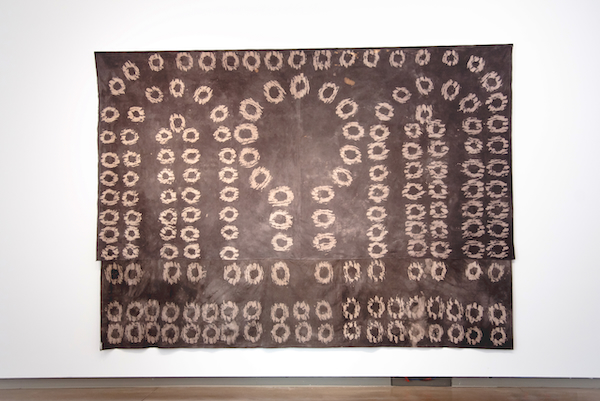
Stephanie Fortin, Home, 2024, dye-removal print, reclaimed cotton, organic cotton thread, foraged sumac, citric acid, rust-derived iron (photo: Ollie Lauricella)
Home stands apart as a darker, more constrained dye-removal print of repeated shapes lifted from woodpeckers’ feeding cavities in an Eastern Hemlock tree. The resulting pattern of circular forms, etched by citric acid from a dusky sumac foundation, creates what Fortin describes as “imperfect suburban formations.” What the artist calls imperfect may in fact be the balance and near-mystic symmetry of this composition, which lacks the strange twists and turns, the labyrinth of calculated misdirection that characterizes the Canadian suburbs.
Instead, this arrangement of circular forms in rows and arches recalls the floor plans of medieval cathedrals showing the placement of the many columns needed to support these vast spaces of worship. When we liken a walk in the woods to being in a cathedral, Fortin steps in here to remind us that the trees came first, and will likely survive us all.
Stephanie Fortin: Field Notes continues until February 24.
Grimsby Public Art Gallery: https://www.grimsby.ca/art-gallery
The gallery is accessible.
Stephanie Vegh is a Hamilton-based artist, writer, and arts worker focused on communications and advocacy. Her drawings, installations, and book-based works investigate cyclical histories and human impacts on the natural world. She can be followed on Instagram @stephanievegh