Wally Dion: a thousand tiny prayers
Curated by Blair Fornwald
School of Art Gallery, University of Manitoba
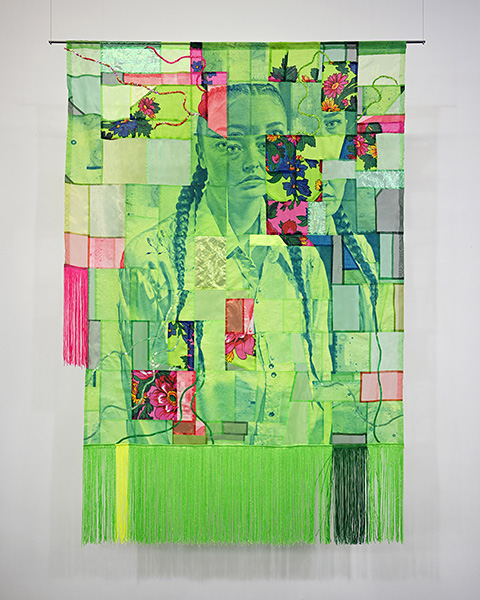
Wally Dion, i’ve got something on my mind, 2024, fabric, gampi paper (konnyaku/momigami treated), ink, sequins, fringe, steel rod. Photo courtesy of the artist.
a thousand tiny prayers
November 6, 2025 – February 14, 2026
School of Art Gallery, University of Manitoba, Winnipeg
umanitoba.ca/art/thousand-tiny-prayers
The artworks in Wally Dion’s exhibition, a thousand tiny prayers, address the related practices of plaiting and stitching as repetitive, generative processes that produce something stronger and more resilient than their composite parts. Many strands of hair can be plaited into sturdy braids. Small scraps of fabric can be stitched together to create a beautiful, functional quilt or blanket. Our communities and ecosystems are similarly composed of individuals and discrete elements that exist within a complex network of relations, stronger and more resilient because of the interdependencies and connections that bind them together.
Dion works in series, but these series often blend or bleed into one another: a series of gossamer-light, semi-translucent star blankets honour discrete elements of the tall grass prairie biome: grasses and wildflowers, the pollinators that propagate them, the bison that graze on them, and the elements that perpetuate the cycles of growth, destruction, and regeneration. Seen together, through one another, Dion’s quilts speak to the rich biodiversity of the Prairie landscape and the delicate, harmonious balance necessary to sustain it.
A related series features a repeated image of an Indigenous person whose hair is worn in two tight braids, the kind often seen on boxers or mixed martial artists. This hairstyle is protective, keeping hair out of the fighter’s eyes and preventing it from being pulled out during a fight. Braids also carry cultural significance; for many Indigenous people, long hair, often braided, symbolizes strength, spirit, wisdom, care, and a connection to ancestors, the Creator, and the Earth. And as young children, particularly boys, would have their hair cut short as part of the assimilationist project of residential schools (a violence not unheard of today), long hair is also a symbol of Indigenous resistance to colonial oppression. Dion explores the significance of braids through composite portraits which combine images of the sitter, printed on delicate but sturdy gampi paper, with patches of neon-hued organza, translucent vinyl, floral print baba/kokum scarves, and fringe accents.
Dion’s recent work expands on these themes to address solidarity with the people of Palestine. Recalling the activist expression, “they thought they could bury us, but they didn’t know we were seeds,” Dion has incorporated roses—both real cut flowers and rose-printed fabric—into his work. Rose motifs, which adorn the scarves that have come to represent solidarity and friendship between Ukrainian and Indigenous communities, are also a symbol of Palestinian resistance, often incorporated into tatreez designs; Dion’s work expresses his deep respect for the courage and resilience of the Palestinian people, linking their struggle for survival and self-determination to countless others; it is a call for empathy, for compassion, and for bravery.
Vibrantly colorful, airy, and luminescent, the works in a thousand tiny prayers envision a more just, equitable, harmonious, and sustainable world, one that can only be realized collectively.
About the Artist
Wally Dion (b. 1976, Saskatoon, Saskatchewan) is a visual artist living and working in Binghamton, New York. A member of Yellow Quill First Nation (Saulteaux), Dion holds a BFA from the University of Saskatchewan and an MFA from the Rhode Island School of Design. His work contributes to broader conversations on identity and power and reflects a pan-American Indigenous struggle for cultural, economic, and political recognition.
Dion has exhibited extensively across Canada and the U.S., with solo exhibitions at College Art Galleries (University of Saskatchewan), Boise Art Museum, Urban Shaman Gallery, Ottawa Art Gallery, Art Gallery of Southwestern Manitoba, Grunt Gallery, and the MacKenzie Art Gallery. His works are held in the public collections of SK Arts, the Canadian Museum of Civilization, the Canada Council Art Bank, the Aboriginal Art Centre, Foreign Affairs and International Trade Canada, the MacKenzie Art Gallery, Remai Modern, the Portland Art Museum, and the Autry Museum of the American West.
About the School of Art Gallery
The School of Art Gallery at the University of Manitoba supports research, education, and the presentation of contemporary and historical art. Through exhibitions, publications, and public programs, the Gallery fosters critical dialogue and creative exchange among artists, scholars, and communities in Manitoba and beyond.
Land Acknowledgement
The University of Manitoba is located on the original lands of the Anishinaabeg, Ininiwak, Anisininewuk, Dakota Oyate, Dene, and Inuit, and on the National Homeland of the Red River Métis. We recognize the enduring relationships established through Treaty and commit to supporting Indigenous excellence, Reconciliation, and meaningful change grounded in respect and reciprocity.

School of Art Gallery, University of Manitoba
255 ARTlab, 180 Dafoe Road
Winnipeg, MB R3T 2N2
gallery@umanitoba.ca
204-474-9322
umanitoba.ca/art/gallery
Instagram: @SchoolOfArt_UM
Related Content
Katherine Takpannie: Every Now and Then I Get a Feeling
Grant Heaps: Where I Sit and Put on My Shoes