Sora Park at Struts Gallery, Sackville
By Dave Dyment
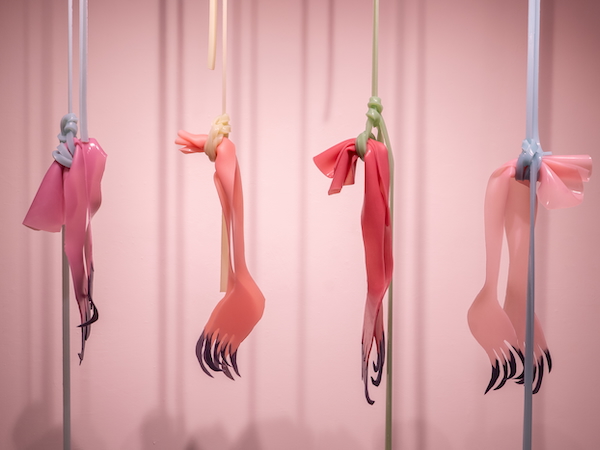
Sora Park, I love dogs (detail), 2025, installation view
During last year’s presidential debate, Donald Trump angrily exclaimed “They’re eating the dogs”, amplifying an already discredited story designed to demonize Haitian immigrants. The shameless stunt was part of an age-old political playbook to rile up racist sentiment and foster political division. Conservatives gleefully took to Twitter with the hashtag #ObamaDogRecipes after a passage from his memoir was unearthed in which he recounts trying dog meat as a child in Indonesia. Examples included “Beagles with cream cheese”, “Pugs in a Blanket”, and “Chicken Poodle Soup.” North Americans apparently find the idea of eating dogs (unlike pigs, cows, and chickens) so reprehensible that last summer Robert F. Kennedy Jr. had to declare, “I wouldn’t eat a human, I wouldn’t eat a monkey, and I wouldn’t eat a dog!” Apart from equating the consumption of canines with cannibalism, it’s worth noting that in the same interview Kennedy declined to deny a sexual assault accusation.
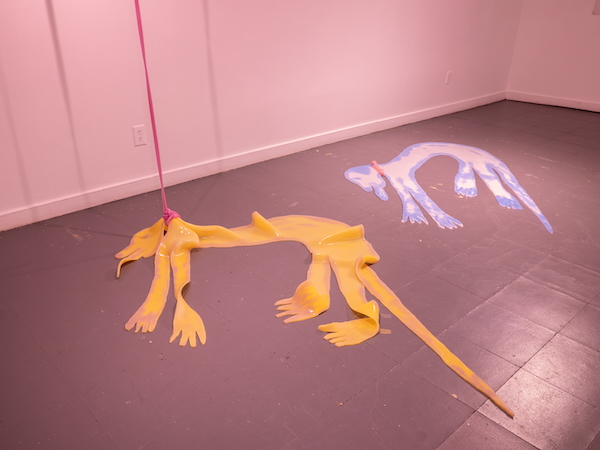
Sora Park, I love dogs (detail), 2025, installation view
Man’s best friend on the menu is an easy wedge-issue, stoking nativist fears and suggesting that our values are incompatible with those from backward and barbaric countries. It’s pervasive in the culture, from the ubiquity of “wok the dog” jokes to a Californian restaurant forced to close last year after an image of a pit bull tied up at an unrelated home next door led to an online harassment campaign that lasted six months. Korean-Canadian artist Sora Park has heard the phrase “but Koreans eat dogs” countless times, often after expressing affection for her own two beloved pets. During an artist talk at the opening of her Struts Gallery exhibition I love dogs, Park began by dispelling a number of widespread myths.
Most scholars maintain there is scant evidence to suggest that dog meat has ever been a key part of the Korean diet, and statistics indicate sweeping cultural change in the last three decades. A 2022 poll of South Koreans indicated that 85.5% of respondents do not eat the animal, and that one in four Korean households owns a pet dog. Last year the country’s National Assembly unanimously passed a law banning the production and sale of dog meat.
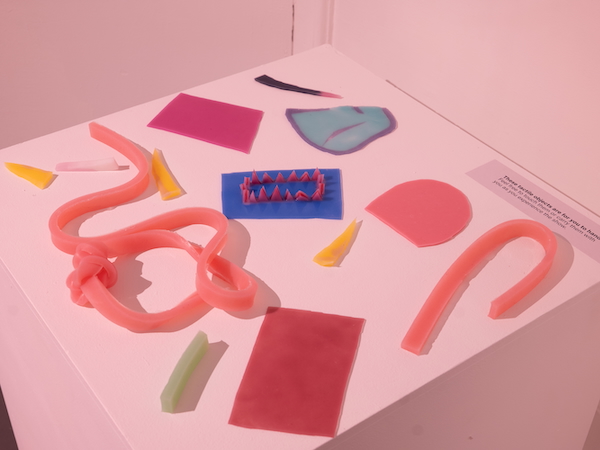
Sora Park, I love dogs (detail), 2025, installation view
I love dogs explores how pets have been “weaponized to reinforce racial stereotypes and perpetuate discrimination, particularly against Asian communities.” The exhibition consists of hanging and floor-based sculptural works that alternate between tender and ominous. Each piece is made of pastel-coloured silicone used to different effect: from pink animal-shaped flesh-like forms with distinctly long claws that hang from the ceiling with a visceral lifeless drape, to playfully colourful floor works that evoke pet-care and toys. Similarly, the gallery is cast in diffuse pink lighting which alternates between reading as menacing or as a warm tender glow.
With this new body of work, Park continues to mine how her identity as a Korean-Canadian is shaped and continuously transformed by her experience of diaspora. Immigrant communities are often forced to reconcile their own lived experience with the prevalent perspectives and biases of their adopted homeland. This level of conscious reflection is rarely reciprocated.
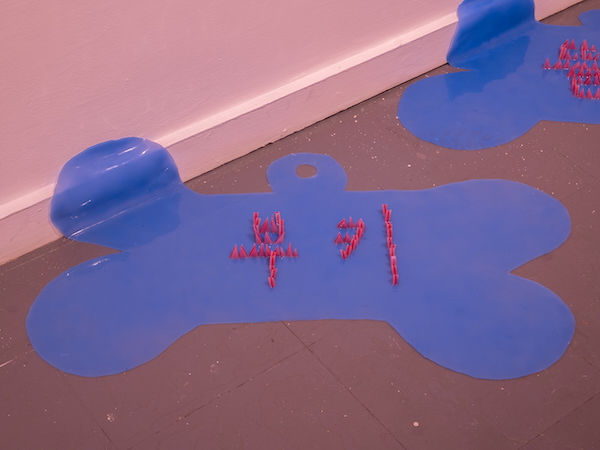
Sora Park, I love dogs (detail), 2025, installation view
The US is second only to Hong Kong in terms of per capita meat consumption and has a shameful legacy of factory farming and animal cruelty. But it maintains the strongly held conviction that it sets the standards for civilization. The ostensible highroad of not eating companion animals is undercut by the contempt Western culture has for the culinary habits of other countries. Frogs, snails, bats, rats, grasshoppers, and reptiles rarely serve as our pets, but their consumption still elicits scorn.
During the 1888 presidential election, Grover Cleveland’s campaign published trading cards depicting cartoon images of Chinese immigrants eating rats. Chinese workers were thought to be a threat to American jobs, and Cleveland hoped to paint his opponent as pro-Chinese, and thus anti-American. Us vs them strategies continue to pay political dividends.

Sora Park, I love dogs (detail), 2025, installation view
Park tackles the impact this racism has on identity formation, reflecting the struggle to see how others view her in contrast with her own experiences, while finding glimpses of tenderness and humour to counter the inherent absurdity.
Sora Park: I love dogs continues until August 26.
Struts Gallery: https://www.strutsgallery.ca/
The gallery is partially accessible.
Dave Dyment is an artist, curator, and writer based in Sackville.