Racquel Rowe at Forest City Gallery, London
By Kim Neudorf

Racquel Rowe, Landscapes in Motion, The sea could swallow them, 2025, video still
In Racquel Rowe’s The Centre of the World Was the Beach, six small TV monitors, displayed in a loose grid within an elaborate wood cabinet, glow in the darkened Forest City Gallery space. A pink and green floral couch, floral-patterned rug, lamp, and coffee table create conditions for comfortable viewing. Each monitor features a specific landscape, body of water, or close-up of plant life. Goats graze a field surrounded by houses. A crowd of people blends in with colourful sails and umbrellas on a beach. Another beach scene follows the swirling tide slowly surrounding large island-like rocks. A group of figures swim and dive from a boat. A camera slowly explores bright pink, purple, red, orange, and yellow flowers and banana plants. The sound of waves creates a constant soundtrack, its origins unclear. More layers of sound: a flapping or knocking of wind turbulence through a recording device, faint voices, a flute. The sound of wind and water remains steady, rising and falling like breath.

Racquel Rowe, The Centre of the World Was the Beach, 2025, video installation (photo: Teresa Rangel)
Following the sequence of each video takes time. Attention is caught and thrown across multiple screens. The quality of old CRT monitors adds a layer of texture to each video, the low resolution exaggerating colour and turning images into grainy abstractions. As the camera zooms in or appears to freeze, viewers are invited into unexplained close scrutiny, as if searching for detail or evidence. A slow exploration of the leaves, petals, and gnarled surfaces of flowers and banana plants suggests a careful search by touch.
When the video footage loops, closer viewing reveals further rhythms within rhythms, or worlds within worlds. Between the rocks of a blue-tinted beach, multiple eddies and pools flow in and around each other. A close-up of waves unfurls from left to right, as if playing a scale across a keyboard. Each curl and ripple suggests another tempo or frequency – discernable only through close attention and attunement, inner islands of water embedded within an ever-changing landscape.
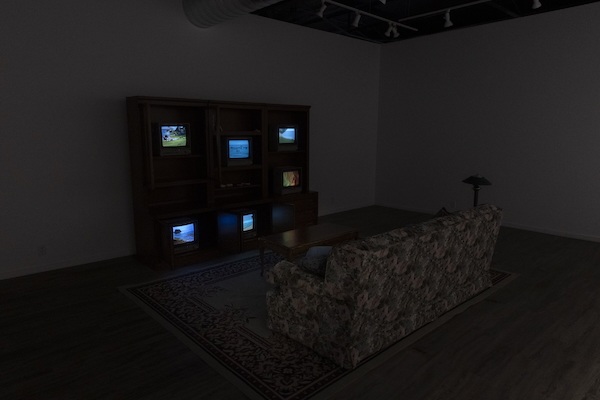
Racquel Rowe, The Centre of the World Was the Beach, 2025, video installation (photo: Teresa Rangel)
In this dark space for viewing, the glow of the TV monitors resembles the ambiance of a grid of pet shop aquariums or surveillance screens focused on competing channels. The glass doors of the cabinet have been left open, at points reflecting nearby monitor screens by mirroring or doubling them. These reflections can only be seen indirectly and from certain skewed perspectives, like parallel worlds accessed through peripheral postures.
Rowe’s videos move through these various landscapes and soundscapes as a way to explore “histories, ideas and artistic expressions” of the Caribbean diaspora, partly based on footage connected to the artist’s childhood home. Viewers are invited to gaze, search, and wander from screen to screen, from a vantage point of cozy distance, while pulled and directed by images and sounds which shape, form, and affect the conditions of viewing by their own insistent weather. Water, a repeated subject in the videos, is connected in an accompanying exhibition text to the constant movement of diaspora, or interpreted as a constant transformational force that, from a distance, can become or be read as an abstraction.
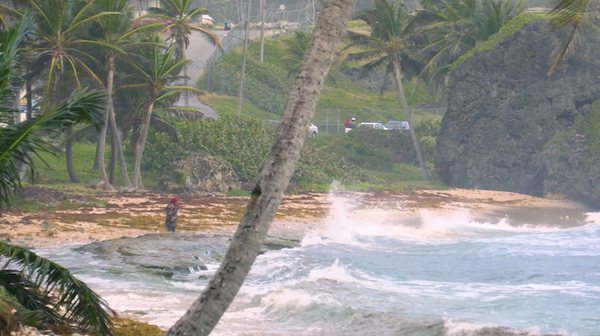
Racquel Rowe, Landscapes in Motion, The sea could swallow them, 2025, video still
It’s this abstraction that Rowe plays with deliberately, creating points at which viewers might “drift away from the images on the screen” and become lost. For Rowe, getting lost allows access to “portals” or “transport systems.” In Dionne Brand’s A Map to the Door of No Return, which Rowe cites as an inspiration, doors are entries to psychic spaces – accessed when return home becomes inaccessible or when home itself is nameless. This namelessness becomes a “rupture in history” and “geography.” A rupture can be a door to places of continual “creation,” or beyond “belonging or unbelonging” to an original home.
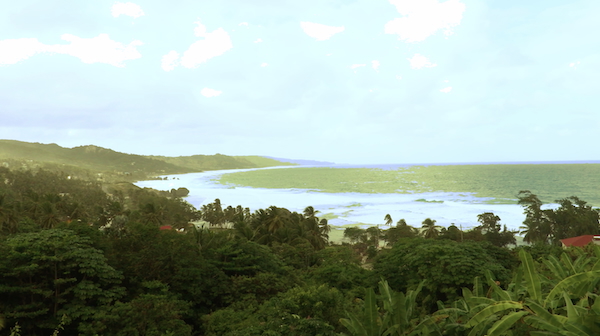
Racquel Rowe, Landscapes in Motion, The sea could swallow them, 2025, video still
Bodies of water are also described by Brand as self-sufficient worlds and entities that are continually arriving, carrying, and “taking” – if not indifferent, then unfazed by “whatever unhappiness or raptures” are brought to or are happening around them. The idea and experience of accessing origins – origins built up of what is taken and brought and transformed by bodies of water – becomes centered within the sea. Compared to news of the world from external sources, the sea contains its own unending broadcast of and about itself. For Rowe, this abstract broadcast of and about origins is echoed in the way her footage locates, freezes, and fragments images of “home.” When I asked the artist about an almost imperceptible collection of white stones and bone-shaped objects placed on a shelf below one of the monitors, she referred to this placement as adding “texture and nuance to the dark.” These objects, collected during her travels, are “like markers of time, erosion and movement,” or the results of a process of transformation momentarily taking form.
Racquel Rowe: The Centre of the World Was the Beach continues until March 8.
Forest City Gallery: https://www.forestcitygallery.com/
The gallery is accessible.
Kim Neudorf is an artist and writer based in London (ON). His writing and paintings have appeared most recently at The Next Contemporary, Toronto; Harkawik, New York; Embassy Cultural House, London, ON; Support project space, London, ON; DNA Gallery, London, ON; Paul Petro, Toronto; Franz Kaka, Toronto; Forest City Gallery, London, ON; Modern Fuel Artist-Run Centre, Kingston; Evans Contemporary Gallery, Peterborough; and Susan Hobbs Gallery, Toronto.