Wendy Wallace: Falling Water
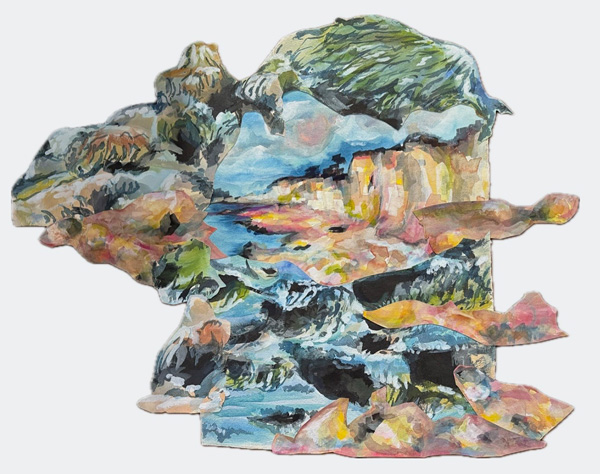
Wendy Wallace, Falling Water, 2026, Watercolour, ink and gouache on handmade cotton paper. 41 x 47 inches. Tradition Transformed, Orillia Museum of History and Art.
Wendy Wallace: Falling Water
Featured in Tradition Transformed 2026, Orillia Museum of History and Art
September 26, 2026 – January 16, 2027
Falling Water reflects the spirit of Tradition Transformed, an exhibition at the Orillia Museum of History and Art, established in recognition of Franklin Carmichael, renowned Canadian landscape artist and member of the Group of Seven, who was born in Orillia. Inspired by Northern Ontario’s distinctive landscapes, Carmichael captured their character through painting and watercolour. Building on this legacy, Wallace reinterprets the Canadian landscape through her own experiences, photographic observations, and exploration of an environment in continual transformation.
Bringing together two paintings of the Lake Ontario shoreline, Falling Water merges the cliffs and water’s edge into a single, compressed landscape. Wind, rain, fluctuating lake levels, and erosion continually reshape the shoreline, challenging the idea of landscape as fixed or timeless. By combining multiple perspectives, Wallace moves beyond direct observation to explore landscape as a lived experience shaped by natural forces, human perception, memory, and time.
The cliffs along Lake Ontario also evoke a parallel with the White Cliffs of Dover, a landscape deeply associated with British identity and the threat of invasion during the Second World War. For Wallace, this connection carries a contemporary resonance. As a Canadian living on the north shore of Lake Ontario, she is conscious of the unease created by the perceived threat from the United States. This awareness brings new significance to the familiar shoreline and to the expansive body of water that both connects and defines national boundaries. The landscape becomes more than a natural feature; it represents a threshold between security and uncertainty, proximity and separation, belonging and vulnerability.
Through this parallel, Wallace explores how landscapes acquire meaning through the histories, anxieties, and experiences of those who inhabit them. The cliffs endure, yet their forms are continually reshaped by erosion, just as the meanings attached to a place shift with changing circumstances. In Falling Water, the shoreline becomes both subject and metaphor, reflecting the fragile relationship between land, identity, and the forces that shape our sense of belonging.
Photography is integral to Wallace’s painting process. Drawing from her observations of places and spaces throughout southern, central, and eastern Ontario, she constructs compositions that transform experiential reality into layered interpretations of landscape. Her paintings reveal narratives shaped by memory, history, human presence, and the natural environment, bringing forward the emotional and cultural dimensions of the relationship between people and the land. By merging photographic observation with memory and interpretation, Wallace reconsiders the Canadian landscape tradition through a contemporary lens, where familiar places become sites of reflection on change, history, and belonging.
Orillia Museum of Art & History
30 Peter Street South
Orillia, ON L3V 5A9
orilliamuseum.org
Related Content
Geoffrey James – Ancient and Modern: Selected Panoramas