The Art Gallery Problem
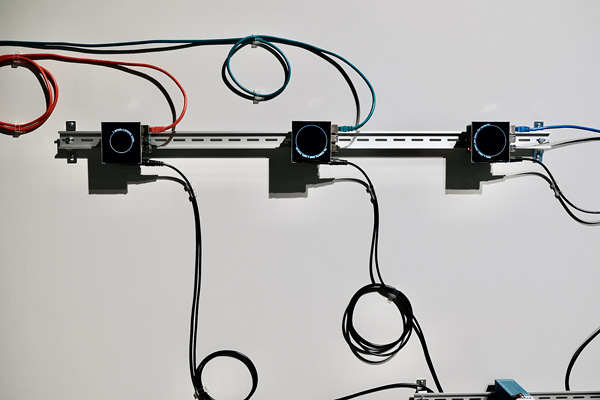
Matt Nish-Lapidus, Request for Comment (RFC), 2022. Archival TCP/IP specification documents, DIN rail, industrial power supplies, LCD screens, Raspberry Pi’s, ethernet router, cable, artist-written software. Courtesy the artist.
The Art Gallery Problem
January 8 – March 5, 2025
Blackwood Gallery, University of Toronto Mississauga
With a public installation on campus (February 26 – March 5)
Artists: Nikita Gale, Maïder Fortuné & Annie MacDonell, Matt Nish-Lapidus, Karthik Pandian, Paolo Patelli & Giuditta Vendrame, Jeremy Toussaint-Baptiste
Program Contributors: Naisargi N. Davé, Mike Forcia, Sneha Mandhan, Robyn Maynard, Karthik Pandian, Paolo Patelli, Scott Sorli, Jeremy Toussaint-Baptiste
Curator: Fraser McCallum
The “art gallery problem” is a well-known math problem with a simple premise: what is the minimum number of guards or surveillance cameras necessary to observe an entire gallery? Across different layouts and floorplans, the art gallery problem challenges math students to achieve full surveillance of a space using the minimum labour or technology. The problem is not put to use by major museums and galleries, despite replicating their standard practices for monitoring facilities. Even so, it remains a dominant understanding of art’s presentation.
This exhibition appropriates the art gallery problem as a framework to consider how objects and bodies are put to work in galleries and museums. The “problem” is in fact not singular: there is far more to the presentation of art than the securitization of objects; there are problems of narrative, representation, hegemony, and access to knowledge.
The art gallery problem highlights a set of underlying assumptions that animate museums and galleries, including surveillance, labour, visuality, law, and ownership. As significant human labour and technologies are mobilized for the preservation and display of objects, it bears asking: Do norms of exhibition and display serve audiences and galleries alike? What are the alternatives to reification, permanence, ownership, and surveillance? What are other ways for living with objects?
Read the full curatorial essay on the Blackwood’s website.

Jeremy Toussaint-Baptiste, Y’all Don’t Wanna Hear Me (You Just Wanna Dance) performed at Art Papers Live, Atlanta, GA, 2022. Courtesy the artist.
Programs
The Art Gallery Problem is accompanied by performances, screenings, and discussions that extend and elaborate works in the exhibition, and expand and complicate the curatorial premise. Public programs engage with institutional spaces adjacent to galleries—atriums, “crush” spaces, theatres, lecture halls—which are designed for similar ends of observation and optimization. Through programs, additional facets of the “problem” will come into view—including its sociopolitical implications beyond the arts alone.
Hollow Bones: Screening and Conversation
Thursday, January 23, 2025, 7–9pm
Innis Town Hall Cinema, 2 Sussex Ave, Toronto
Pandian’s Forsythia cycle is a multifaceted project which originated in the 2020 uprising in Minneapolis when activists toppled the city’s Christopher Columbus monument. This screening features new films from Forsythia, followed by a conversation between the artist and Mike Forcia (Bad River Anishinaabe), an American Indian Movement activist who collaborates closely with Pandian.
On Both Sides of the River
Discussion with Karthik Pandian and Naisargi N. Davé.
Friday, January 24, 12pm
Collaborative Digital Research Space, Maanjiwe Nendamowinan 3230, University of Toronto Mississauga
Anoka is a word in Dakota (“on both sides of the river”), Ojibwe (anokii; “working waters”), and Sanskrit (anokha; “unique”) that offers grounds for considering relations to place and community, which first arose in Pandian’s work from its use as a Minnesota place name. This discussion will address modes of collaboration across difference, drawing on Pandian’s long-term project the Forsythia cycle and Davé’s studies of social movements, intimacy, and desire.
Y’All Don’t Wanna Hear Me (You Just Wanna Dance)
Performance by Jeremy Toussaint-Baptiste followed by a discussion with Robyn Maynard.
Thursday, February 6, 12–2pm
Meet at Blackwood Gallery, 140 Kaneff Centre. Performance concludes at CCT Atrium, lower level CCT.
In Y’all Don’t Wanna Hear Me (You Just Wanna Dance), Toussaint-Baptiste uses a Long-Range Acoustic Device against its intended purpose of crowd dispersal, alternatively presenting it as a technology that might unite and even guide a crowd through sound. The performance culminates with a collective dance, guided by the directional sound of the speaker.
Friction Atlas: Discussion
Saturday, March 1, 12–2pm
CCT Atrium, University of Toronto Mississauga
Alongside a weeklong presentation of Paolo Patelli and Giuditta Vendrame’s Friction Atlas in the CCT Atrium (February 26 – March 5), Patelli will discuss this new iteration of the artwork in conversation with architects and urbanists Sneha Mandhan and Scott Sorli.
All programs are free and open to the public. Please register to attend using Eventbrite.
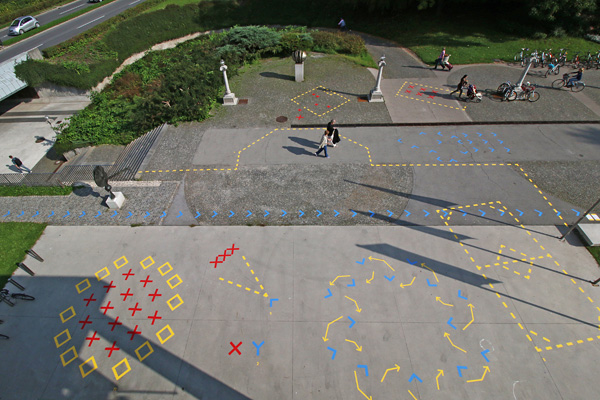
Paolo Patelli & Giuditta Vendrame, Friction Atlas. Installation view at BIO50 Design Biennale, Ljubljana, 2014. Courtesy the artists.
Acknowledgments
The Blackwood gratefully acknowledges the support of the University of Toronto Mississauga, Canada Council for the Arts, the Ontario Arts Council, Jackman Humanities Institute, Instituta Italiano di Cultura, and Mondriaan Fund.
Support for programming is provided by Black at UTM, the Centre for South Asian Critical Humanities at UTM, and the Cinema Studies Institute at the University of Toronto.
Proudly sponsored by U of T affinity partners, Manulife and TD Insurance. Discover the benefits of affinity products!

The Blackwood
University of Toronto Mississauga
3359 Mississauga Road
Mississauga, ON L5L 1C6
blackwood.gallery@utoronto.ca
(905) 828-3789
Gallery Hours: Monday–Saturday, 12–5pm, Wednesdays until 8pm
Facebook | Twitter | Instagram
Image Descriptions:
1. Industrial materials that are usually hidden away in server rooms are used to create an exposed closed-loop network linking three small computers.
2. Jeremy Toussaint-Baptiste sits outside on a black hardshell case, speaking into a Long-Range Acoustic Device, connected to a small speaker on the cement ground in front of them. Partly out of frame, remnants of a game of hopscotch are painted in chalk on the ground and performance attendees are seen seated and standing.
3. A large-scale diagram on the cement ground of an outdoor courtyard features dotted lines, arrows, and Xs in bright red, yellow, and blue. People are seen moving through the space, surrounded by various sculptures, vegetation, and a road.


Related Content
Call for Proposals: Artworks for Outdoor Exhibition in Canada’s Capital Region 2026