Shadows of the Past; Art and Legacy of Slavery
Presented by Yekson Museum and Gallery of African Art
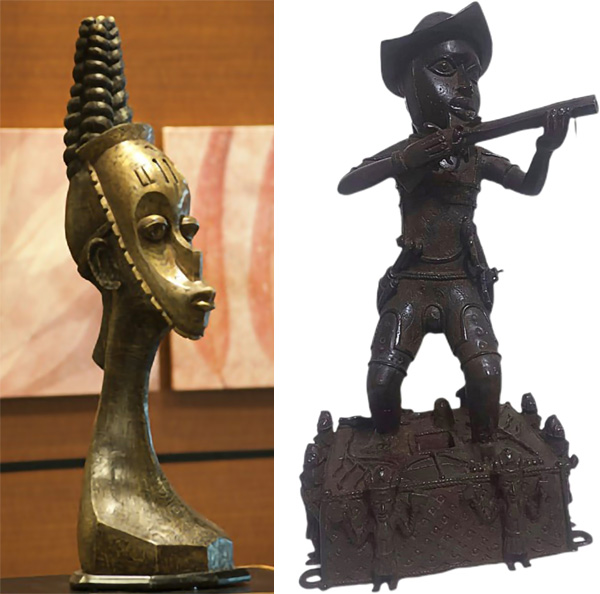
Images (left to right): Felix Ehis Iyekekpolor, Behind the Mask. The Portuguese Soldier (Benin Bronze)
Shadows of the Past; Art and Legacy of Slavery
A Black History Month Juried Art Exhibition
February 12 – 27, 2026
Formal Opening Ceremony: Saturday, February 14, 2026, 2pm
Youngplace, 180 Shaw Street, Toronto, ON
Admission is free
Yekson Museum and Gallery of African Art is pleased to present The Shadows of the Past; Art and Legacy of Slavery, a juried group exhibition featuring an exceptional collection of Benin Bronzes, Trans-Atlantic Slave Trade and abolitionist artifacts, and contemporary artworks.
The Benin Bronzes are remarkable artifacts that depict the rich civilization of the ancient Benin Empire. These masterpieces reflect the significance of the artistry, culture, and history of the Benin Kingdom. Over 2000 Benin Bronzes were looted during the invasion of 1897 by the British Empire, and today, these pieces of art are housed in major museums across the globe.
Featured Artwork:
Behind The Mask by Felix Ehis Iyekekpolor
This piece depicts a figure with a long neck and a face covered with a mask. It can be interpreted in many ways, but the title phrase often refers to art that explores identity, hidden aspects of the self, or societal roles. Masks are used as a central metaphor for disguise, transformation, or protection.
“Behind the mask” can imply looking beyond the surface to uncover hidden dangers, secrets, or truths—both positively and negatively.
The interpretation of masks varies greatly by culture. In most African cultures, a being wearing the mask in any spiritual performance must be pure and holy in order to see the manifestation of the spirit. The mask may be ugly, but the person behind it is pure.
The Portuguese Soldier (Benin Bronze)
The Kingdom of Benin, located in present-day Nigeria, experienced significant contact with the Portuguese during the Age of Exploration. Portuguese explorers and traders arrived by sea, bringing luxury goods and establishing trade relationships with the Edo people.
This piece depicts a Portuguese soldier, showcasing the presence and influence of Europeans in the Benin court.
Beyond mere representation, the bronzes hold deeper symbolic meaning. The bronzes served as a way to record and celebrate important historical events and interactions between the Edo people and the Portuguese. They demonstrate the complex relationship between the two cultures, encompassing trade, diplomacy, and even military alliances.
The Punitive Expedition carried out by British forces in 1897 led to the removal of thousands of bronzes from the Benin Palace.
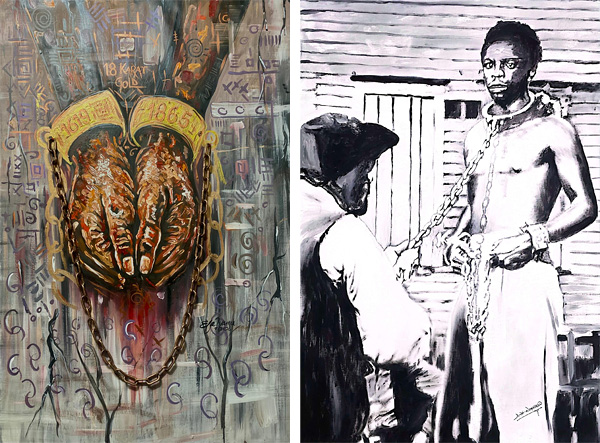
Images (left to right): Efe Iyamu, Bound, Yet Remembering Freedom. Aibi Woghihen, Prisoner of Conscience.
Bound, Yet Remembering Freedom by Efe Iyamu
“They chained the hands, not the calling. Bound in body, unbroken in spirit. What God sealed; chains could not erase.”
Between 1619 and 1865, African men, women, and children were forcibly bound and reduced to labor, yet never stripped of their humanity. This work centers the hands—the first to be chained, the first to toil, and the first to pray. Scarred and restrained, they remain open, holding memory rather than surrender.
The chains speak to systems built to dominate and erase. The gold at the wrists speaks to an older truth: intrinsic worth that existed before enslavement and survived it. Gold here is not ornament—it is testimony. This painting honors survival as resistance, remembrance as power, and faith as a quiet inheritance. History bound the body, but legacy carried the soul forward.
Prisoner of Conscience by Aibi Woghihen
This art piece depicts a poignant scene at the point of no return, as a young boy stands beside his captor, frozen at the threshold of a life of bondage.
About Yekson Museum and Gallery of African Art
Yekson Museum and Gallery of African Art, a not-for-profit organization in North America, is dedicated to being a beacon of cultural excellence that works to attract millions of visitors annually over time. They will be collecting works of art ranging from cutting-edge contemporary art to significant works by Africans/Black artists across the globe, and cultural primitive masterpieces. Yekson Museum and Gallery of African Art presents wide-ranging exhibitions and programs, including solo exhibitions and acquisitions by diverse and underrepresented Black artists from around the world.
Yekson Museum and Gallery of African Art inspires future generations to appreciate, preserve, promote, and celebrate African and Black heritage. It serves as a research centre for educational institutions across the globe, where diverse African and Black cultures converge, fostering education, history, empathy, understanding, and a shared human experience.
Yekson Museum believes in the power of art and history to connect people and communities. Their exhibits and programs are designed to engage visitors of all ages and backgrounds, encouraging a deeper understanding of the rich tapestry of African and Black cultures. Through their collections, they aim to highlight the contributions and stories that have shaped our world, inspiring a global community to embrace diversity and inclusivity.

Yekson Museum and Gallery of African Art
ymgaa.org
info@ymgaa.org
416-305-4750
Facebook: Yekson Museum and Gallery
X/Twitter: @YeksonMuseum
Related Content