Olga Abeleva & Nadya Isabella: Desire Paths
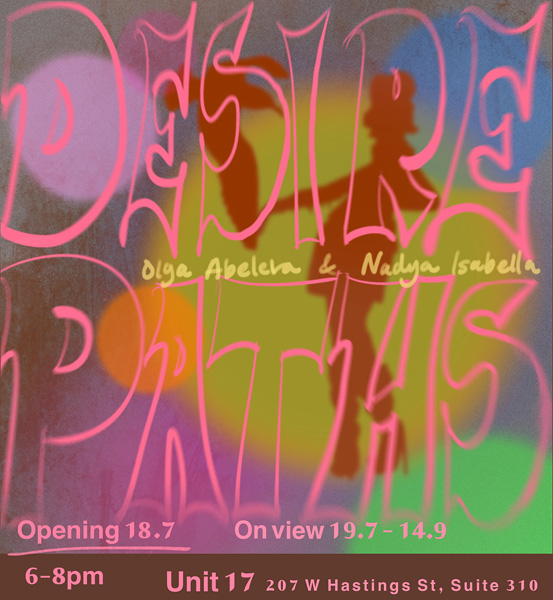
Desire Paths
Olga Abeleva & Nadya Isabella
July 19 – September 7, 2024
Opening Reception: July 18, 2024, 6 – 8 pm
Unit 17, Vancouver
One time I glanced in a barber shop window half-sunken below street level on St. Laurent, and caught sight of two men chasing a giant parrot under green fluorescent light, a tornado of moustaches, cigarettes, and feathers swirling around a third man sitting patiently in the barber chair, mid-haircut.
I thought to myself, “My luck is looking up!”
The serendipitous encounter felt like I had seen into an alternate reality that had momentarily slipped into mine precisely at the moment of my looking. The uncanny scenes unfolding in the paintings in Desire Paths are similarly unconcerned with the world outside of them. They exist in nondescript time and place and are constructed through fateful glances and double takes. Rites of passage, coincidence, luck, and misfortune are captured in sentimental strokes.
I imagine that the two men are still chasing the bird in an endless loop in that barber shop, despite the accelerating world outside its dirty windows, much the same as I imagine the bottle eternally spinning in Olga Abeleva’s painting Spin the Bottle, ripe with the tension of anticipation. The characters are stuck in the moment right before resolution, each one projecting their own desires and fears onto the outcome of the bottle’s spin.
Nadya Isabella’s paintings uncover concurrent realities superimposed onto a familiar landscape. The drama lies in the consequent narratives formed by shadows, imprints, and reflections. No plane of reality is favoured more than the other, they just reveal different stories happening at the same time. In Waves Crashing a heart drawn in the sand is shattered by the shadow of a bird’s wing, inverting the image from a postcard-like archetype to a foreboding omen.
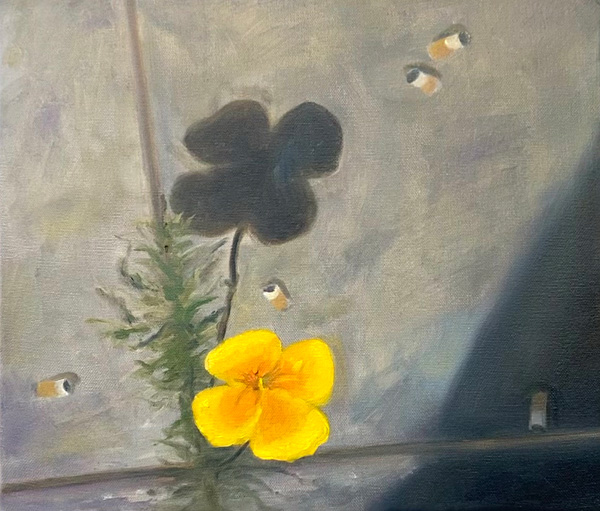
© Nadya Isabella, Winter Aconite, 2024. Oil on canvas, 12 x 14 inches. Courtesy of Unit 17
They celebrate and meditate on the mundane, and are a visual representation of the sentiment found in “live love laugh” style typographic home decor. The cliché phrases inscribed in cursive on throw pillows, mugs and framed “wall art” are incantations of the masses that the aesthetically advanced can only engage with ironically, lest they reveal they in any way identify with the trite affect behind them and be reduced to the status of human, all flesh and desperation. Pedestrian desire is desire nonetheless, and the power in Isabella’s paintings is the way they dignify these moments of wistful yearning, endowing them with a degree of sublimity.
Both artists’ paintings depict moments the natural world intersects with manufactured objects and symbols to manifest, mold, steer, and circumvent destiny: a flower growing through a sidewalk crack casting a shadow of a four-leaf clover, a boot print causing a lovers’ embrace between roses, a fountain full of tossed coins, a heart etched in the sand, a bottle spun. Rites and rituals performed with the detritus of capitalism allow us the delusion of control of our own destinies. In the shadows we willfully misread our fortunes.
Painting is one of the few remaining mediums that can really play in the shadows and exercise our imaginations, which are experiencing atrophy from overexposure to artificially generated images. There is danger in naming the magic behind the shadows, because even that magic can be stripped of its powers through reductive thinking. The shadow play found in the paintings is materialized in a large metal cutout of a figure picking up a coin, placed strategically (perhaps manipulatively) near a doorway, forcing the viewer to choose their own path through the exhibition.
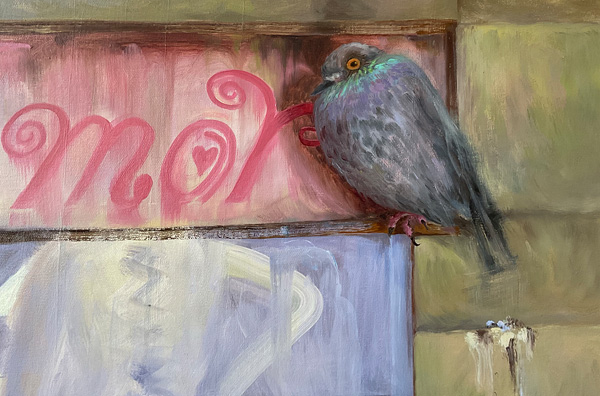
© Olga Abeleva, Psyche & Amor (detail), 2024. Oil on canvas, 36 x 48 inches. Courtesy of Unit 17
After looking at these paintings for a while, I blew my nose into a kleenex and it was all black. I looked at my hands and under my nails there were little grey-green crescent moons of the substance that coats scratch and win prizes. My tongue was metallic and I felt as if I was under a spotlight, sweat and oil mixing on my forehead and dripping down my face. My toes were wet wood. There’s a certain humidity to these works that’s palpable. The air feels thick with exhaust and exhale, a dewey grime accumulating in the thick grooves of the brush strokes.
In Three Fates at a Truck Stop the distinction between organic and synthetic is blurry, as the three figures of Greek mythology, who are said to guide individuals through a predetermined path through life, perform routine maintenance on a car of which they themselves are constituent parts. The maintenance is performed with an ecstatic reverence reserved for objects of worship, the water anointing the hood of the car, flowing down into a puddle on the asphalt, the asphalt that absorbs the holy water like an ocean. The car and the fates are intertwined into a single being of machine and mythology: limbs protrude from the car and become its appendages, the hose from the gasoline pump wraps around one of the fate’s legs, slowly devouring destiny. Even a piece of gum on the bottom of a shoe binds the figures to the edge of the canvas, to our world of things and paintings.
A desire path is exactly that: a path created purely out of desire and instinct, formed by the footsteps of a series of individuals whose only communication is through the trampled grass. A path they walk despite or in spite of the logical path offered, or forced onto them. It is a manifestation of the incalculable; a desire shared with other humans, something we didn’t know we shared, and no one predicted we would share. It is a universal, intrinsic desire that makes us feel both unique for making our own decision and so plainly common as the many others who share our compulsion.
The work in Desire Paths capture moments of chance and randomness that possess an illogical harmony that is impossible to predict. In our highly monitored existence where all our behaviours are transformed into data and analytics, the indeterminable is magical.
Exhibition text by Katayoon Yousefbigloo
Unit 17
207 West Hastings Street, Suite 310 (Buzz 596)
Vancouver, BC V6B 1H7
www.unit17.org
info@unit17.org
Instagram @unit17_org
Venue is fully accessible
Related Content
Katherine Takpannie: Every Now and Then I Get a Feeling
Grant Heaps: Where I Sit and Put on My Shoes