Nicholas Crombach: Xenolithic
Art Mûr
Nicholas Crombach
Nicholas Crombach: Xenolithic
March 14 – April 25, 2026
Opening Reception: March 14, 2026, 3 – 5pm
Art Mûr, Montreal
www.artmur.com
Text by Gabriel Girard
Translated by Valeria Márquez Reynoso
Nicholas Crombach’s exhibition Xenolithic presents a sculptural and material reflection on the forms of coexistence between natural materials and those produced by human activity. Using a formal vocabulary borrowed from both geology and museum displays, the artist composes assemblages in which objects are never considered in isolation, but always conceived in relation to one another, suspended in a balance that is both fragile and controlled.
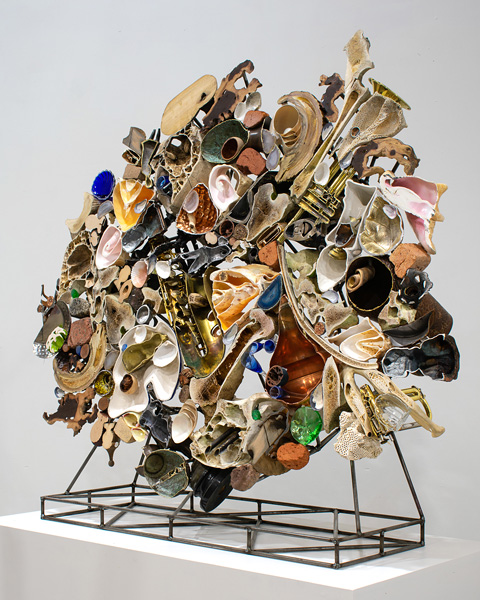
The sculptures presented in the exhibition are made up of found elements—bones, shells, glass, ceramics, among a vast number of materials—cut in such a way as to reveal their internal structure. In Cross Section I (2024), supported by a steel frame, the fragments seem to float in space, held in constant tension between stability and precariousness. The gaze moves between the exposed surfaces, the voids and the supporting structures, revealing an interest in what connects the elements as much as in what composes them.
Nicholas Crombach
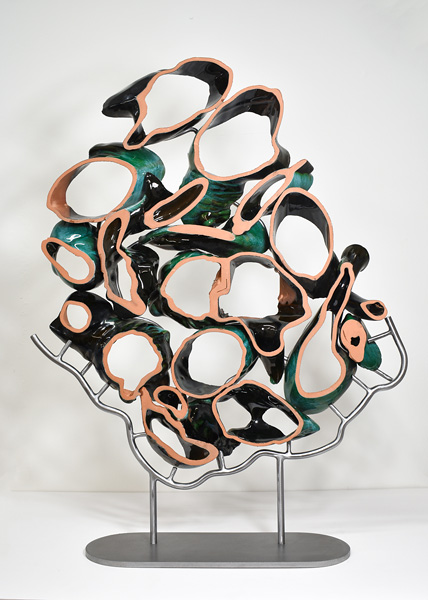
The aesthetics of the works evoke natural history and museum collections but can also bring to mind the geological layers formed by waste on a global scale. Without ever presenting themselves as strictly scientific objects, Crombach’s sculptures borrow certain visual codes specific to these classification systems in order to shift their uses. The cross-sections and two-dimensional appearance of certain works suggest a logic of order, while revealing the randomness and cultural construction that underlie any attempt to organize the material world. Other pieces, such as Cross Section V (2025), establish a more direct link with everyday objects, evoking, for example, the reflective surface of a bedroom mirror. In a way, the exhibition invites the public to observe carefully as they move around, demonstrating that these objects take on meaning as much through their very materiality as through the relationship they establish with the body and the gaze over time.
Nicholas Crombach
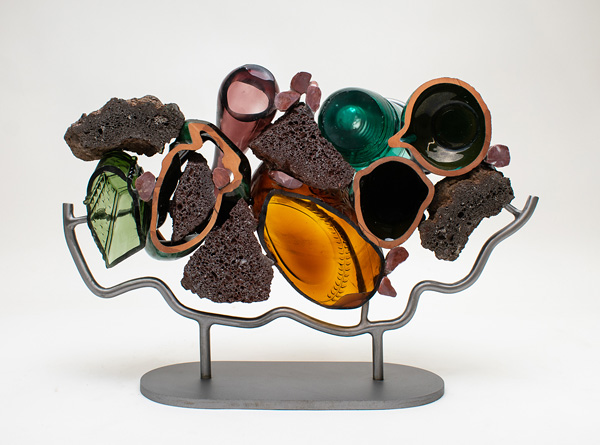
This approach resonates particularly strongly in contemporary debates on materiality and our relationship with the Earth, as well as with resources and the vestiges of human activity. Crombach’s assemblages can thus be seen as emerging geological forms, born of a world where the distinctions between nature and culture are becoming increasingly blurred. In this sense, Xenolithic enters into dialogue with the current reflections of theorist Jussi Parikka, for whom technological, industrial and natural materials are now part of the same terrestrial history, inscribed in long and intertwined temporalities. Through compositions that are both light and structurally strong, the artist suspends materials in order to reveal the different temporalities that coexist on Earth.
In the form of three-dimensional collages, the sculptures become a convergence of time and matter, where each fragment retains traces of its origin while being transformed by its association with other elements. Materiality is not seen here as a simple support, but as an active force, capable of producing meaning, resisting fixity and suggesting new readings of our current era. Thus, these works do not merely document the world; they offer an alternative stratigraphy, made up of juxtapositions, fractures and unexpected arrangements.
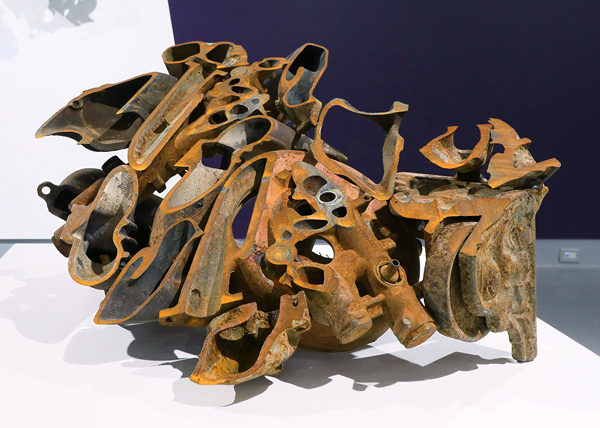
Nicholas Crombach, Xenolithic, 2025. © Latcham Art Centre. Photo: Molly Steels
About the Artist
Nicholas Crombach is an artist based in Kingston, Ontario. His practice engages the aesthetic frameworks of natural history collections, museological display, and the motifs of historical fine and decorative arts. He disrupts these established conventions through a use of unexpected materials, details, and gestures to create contemporary confrontations. Grounded in a sustained inquiry into materiality and process, Crombach’s work constructs visual dialogues that recontextualize the familiar, interrogate systems of perception, and foreground the entangled relationship between nature and culture.
About Art Mûr
Established in 1996, Art Mûr is celebrating its 30th year in business as one of Canada’s largest commercial art galleries.
Art Mûr
5826 rue St-Hubert
Montréal, QC H2S 2L7
www.artmur.com
artmur.com/en/contact
Facebook @galerie.art.mur
Instagram @artmur
Bluesky @artmur.bsky.social
Accessibility:
Art Mûr has ground-level entry with a wheelchair-accessible elevator to the three floors of exhibition space.
Related Content
Images Festival Announces 39th Edition: Metabolizing Moving Images
Call for Submissions: 2027 Exhibitions at City of Toronto Cultural Centres & Galleries