Jill Price – From There to Here: Walking for Tomorrow
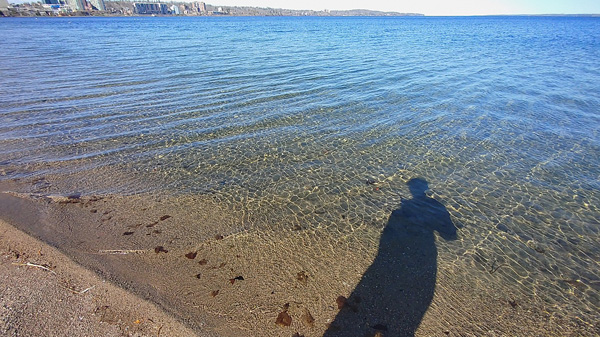
Photo courtesy of the artist.
From There to Here: Walking for Tomorrow
Jill Price
June 28 – October 26, 2025
MacLaren Art Centre, Barrie, ON
More information
Working through her methodology of UN/making—a critical assemblage of methods that help usher in ethics of care and repair within the visual arts, this timely project by Dr. Jill Price draws on histories of maintenance art and walking as creative practice. Initiated during a walking residency led by Sarah Cullen and Simon Pope at the Gibraltar Centre for the Arts, Price’s central project Wht-trSH—a museological display of pale garbage—stems from her interest in new materialism as written about by Dr. Jane Bennett in her book Vibrant Matter.
Mostly retrieved from Toronto beaches as well as from the sandy shorelines of Simcoe County, Price’s assemblage makes connections to the power of the white cube, Kasmir Malevich’s infamous white-on-white paintings, early Euro-colonial practices of museum formation, as well to how the insidious introduction of plastics echoes the horrible “gifting” of flour, salt, sugar, lard, and dairy to Indigenous communities when forced on to reserves by North American governments in the 1940’s.
Collaborating with local communities to gather plastics, debris, and other forms of human-made objects from lakeside public spaces, Price then cleans, sorts, donates, presents, or transforms detritus into meticulous displays and wry assemblages that acknowledge the agency and potential of what has been forgotten or discarded to visualize the slow violence of plastics and other materials that colonize human and more-than-human bodies of Land and Water. Through this decelerated process, she offers a thoughtful un/making of environmental harm while reimagining waste as witness and agent.
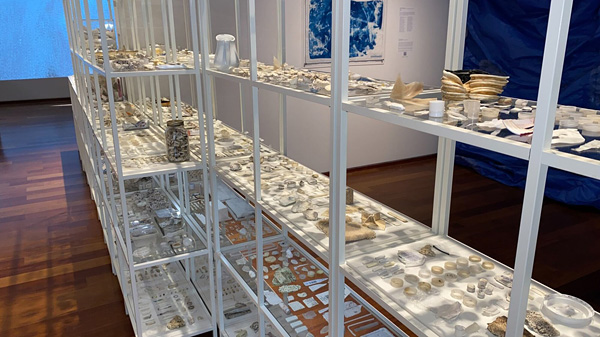
Jill Price, Wht-trSH, 2025, Found objects on reclaimed shelving, 240″ x 70″ x 30″. Photo courtesy of the artist.
As such, plastic waste is foregrounded not only as ecological pollutant, but as cultural residue that documents the entanglements of systemic, governmental and industrial neglect and mass material consumption. Price shares, “Unfortunately, these shelves hold the archaeological finds of the future. It will be rare for future generations to come across and be able to reconstruct a beautiful piece of ceramic or glass.”
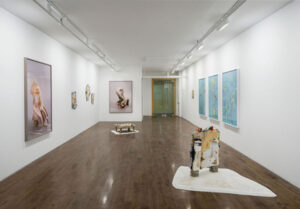
An ecological inquiry that is both immersive and reflexive, Price’s exhibition also features cyanotypes composed from arrangements of trash, a handmade book work, videos documenting the artist’s labour of scouring the beach and cleaning garbage, a large-scale wall installation of a blue boat tarp, a poignant text-based work stitched into a found towel, and a Return to Sender Mail Art Project that invites audiences to participate in community clean-ups and confront businesses still producing and disseminating single use plastics.
Works such as The House That Jack Built—a series of cyanotypes on reclaimed blueprint paper, speak to legacies of construction and collapse. Framed behind repurposed plexiglass, these works ask viewers to consider the costs of what we build and what we discard. To breathe new value into the discarded, Price’s bookwork It Must Have Been the Wind was reconstituted from paper waste found blowing across or peeking up from the sand to speculate on what paper objects might say to those who take their bodies of material and services for granted. To reveal the labour and care that goes into embodying a methodology of un/making, the artist also presents an intimate video of her gently brushing off sand from retrieved paper goods so that she may return the sand to the shore.
Also working from fond memories of growing up on the beaches of Lake Ontario, Price continues to clean public and provincial beaches each week, often inviting the public to participate in shoreline cleanups and waterfront workshops like Keepin’ It Blue—a community cyanotype activity using recovered plastics and to visualize the impact of our material legacy. As such Price’s exhibition, through tactile arrangements, poetic form, and critical process, encourages audiences to reconsider one’s relationships to Land, waste, and responsibility. It proposes that walking—when done with intention—can be a powerful tool of artistic intervention and social transformation that challenges conventional distinctions between service, art and activism.
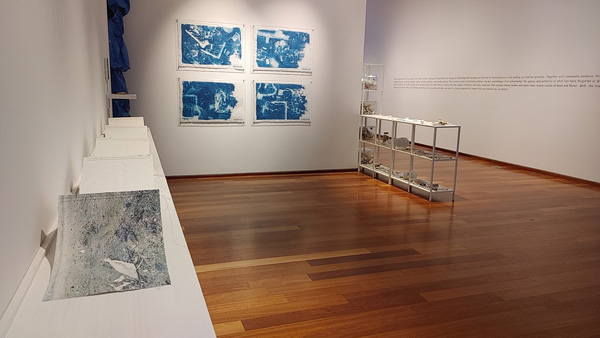
Jill Price, From There to Here: Walking for Tomorrow, 2025, installation shot. Photo courtesy of the artist.
About the Artist
Dr. Jill Price is an award-winning interdisciplinary creative who contributes to a growing discourse on art’s potential to enact ecological and ethical transformation. Grateful to be living on the traditional territory of the Anishinaabe peoples in Barrie, Ontario, Price holds an MFA in Interdisciplinary Art Media and Design from OCAD University and completed a research-creation PhD in Cultural Studies at Queen’s University. Her scholarly publications include essays and chapters in journals and edited volumes, addressing topics like textile activism, museum practices, and the role of art in environmental justice.
Price’s work has been supported by grants from Social Sciences and Humanities Research Council (SSHRC), City of Barrie, Ontario Arts Council, Michael Smith Foreign Study Bursary, and Queen’s University among others.
A professionally trained Visual Arts Specialist with the Ontario Teachers Federation, Price has taught at the post-secondary level since 2014 and served on various academic committees, including the Curriculum and Research-Creation Committees at Queen’s University.
In her curatorial practice, Price has worked within the private and public sector and currently serves as the Assistant Curator and Collections Manager at Royal Victoria Health Centre.
jillpricestudios.ca
UN/making Network on Eventbrite
Instagram @jillpricestudios | @unmakingnetwork
For more information on the exhibition and related programming, visit maclarenart.com.
MacLaren Art Centre
37 Mulcaster Street
Barrie, ON L4M 3M2
Tuesday – Sunday, Admission by Donation
Exhibition Support:

Image Descriptions:
1) A shadow of a person walking on the beach reflected in shallow water of the shoreline.
2) A display of found white objects on a tall series of white and glass shelving units. Lit from above the higher shelves of white trash casts shadows on the shelves of white garbage below.
3) A gallery with 4 large cyanotypes on one wall, shelving units filled with white objects as if they were in a museum, a handmade accordion book work on a long wall shelf, and hand-painted text on the far wall.
Related Content