Groundwork
ALANA BARTOL, ILEANA HERNANDEZ CAMACHO, TSĒMĀ IGHARAS
CURATED BY VALÉRIE FRAPPIER
Spring/Summer 2021
In a 2013 interview with Naomi Klein, Michi Saagiig Nishnaabeg scholar Leanne Betasamosake Simpson explains that extractivism is not just the physical process of extracting natural resources, specifically on Indigenous lands, but that it is also a mindset. Simpson defines the term in the following way: “The act of extraction removes all of the relationships that give whatever is being extracted meaning. Extracting is taking. Actually, extracting is stealing—it is taking without consent, without thought, care or even knowledge of the impacts that extraction has on the other living things in that environment.”1 Later in the interview, Simpson then turns to the alternative of an extractive mindset, which she describes as being centered in relationships. “The alternative is deep reciprocity. It’s respect, it’s relationship, it’s responsibility, and it’s local.”
Working from Simpson’s definitions as a starting point, this exhibition considers how extractivism operates as a physical process underpinned by a pervasive colonial-capitalist mindset towards land use. By intersecting strands of ecology, geology, and performance theory, Groundwork seeks to grapple with the psychology of extractivism and foregrounds embodied performance as a method to bring focus to its alternatives. Within the scope of Canada’s geography, artists Alana Bartol, Ileana Hernandez Camacho and Tsēmā Igharas employ site-specific performance to question and imagine beyond the colonial-capitalist structures that largely shape humanity’s relationship with the environment.
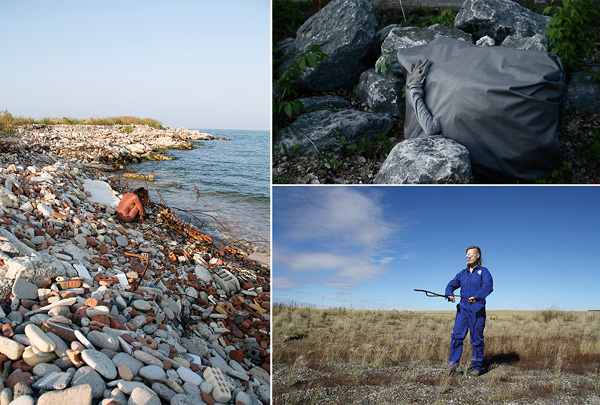
Groundwork also cites performance scholar Laura Levin’s theorizing of camouflage as a political performance practice in its centering of camouflage strategies. Such strategies critically probe the politics surrounding land use and the constructed binary between the human and the non-human. In her 2014 book Performing Ground, Levin writes that camouflage, used as a political practice, “is as much about revealing as concealing,” as it equally “highlights the non-human site as itself a performing entity, reminding us that the communication between self and setting is rarely unidirectional.” Bartol, Hernandez Camacho and Tsēmā each make use of a camouflage/infiltration strategy in their respective works to build reciprocal relationships with their environments and unsettle the status quo of extractive logics. This reciprocal approach is articulated through the deep attunement they cultivate with their respective locations. Lens-based documentation of the artists’ site-specific interventions, displayed alongside performance remnants such as the garments and tools used during these actions, together transmit dispatches from each artists’ location.
Click here to learn more information about Groundwork, the curator and featured artists.
Groundwork is a Featured Exhibition in the 25th Edition of the Scotiabank CONTACT Photography Festival, the largest annual photography festival globally, with exhibitions and events taking place in May 2021 in greater Toronto.
1. Leanne Betasamosake Simpson in “Dancing the World into Being: A Conversation with Idle No More’s Leanne Simpson,” YES! Magazine, March 6, 2013.
Images, left: Tsēmā Igharas, (Re)Naturalize No. 1 (Brick), 2015–16. Photo by Jonathan Igharas. Courtesy of the artist.
Top right: Ileana Hernandez Camacho, Corps roca, 2018–ongoing. Documentation of performance, as part of a residency at Verticale–centre d’artistes, Laval, Quebec. Courtesy of the artist.
Bottom right: Alana Bartol, Dowser, 2016. Documentation of performance at orphan well site in Three Hills, Alberta. Photo by Karin McGinn. Courtesy of the artist.
LOCATION and ACCESSIBILITY INFORMATION
Critical Distance is located in Suite 302 at Artscape Youngplace, 180 Shaw Street between Dundas and Queen Street in Toronto’s Queen West neighbourhood. Google Map. Artscape Youngplace and Critical Distance are fully accessible by Ontario standards, with a wheelchair ramp at the 180 Shaw Street doors, an elevator servicing every floor, and a fully accessible washroom on every level. The nearby 63 Ossington bus on the TTC is wheelchair accessible. All work in the exhibition will be captioned and have audio description. All events will have ASL interpretation. If you have any questions about this, please do not hesitate to contact us at emily@criticaldistance.ca.
VISITING INFORMATION / COVID-19 POLICY:
Visits are by appointment only. Dates and hours of operation are subject to provincial guidelines; exhibition will run for a minimum of 6 weeks. Visit our website at www.criticaldistance.ca or email us at info@criticaldistance.ca for more details and updates.

Critical Distance Centre for Curators (CDCC) is a not-for-profit gallery, publisher, and professional network devoted to the support and advancement of curatorial inquiry in Toronto, Canada, and beyond. With a focus on critically-engaged, collaborative, and cross-disciplinary practices, underrepresented artists and art forms, and community outreach and education in art and exhibition-making, Critical Distance is an open platform for diverse curatorial perspectives, and a forum for the exchange of ideas on curating as a way to connect, engage, and inform people and publics across cultures, disciplines, geographies, and generations.
# # #
CRITICAL DISTANCE CENTRE FOR CURATORS (CDCC)
180 Shaw Street, Suite 302 (3rd Floor at Artscape Youngplace) | Toronto, ON | M6J 2W5 | Canada
info@criticaldistance.ca | www.criticaldistance.ca
Related Content
Call for Proposals: Artworks for Outdoor Exhibition in Canada’s Capital Region 2026