GOETHE FILMS: World on a Wire – Cinema as Quantum Experiment
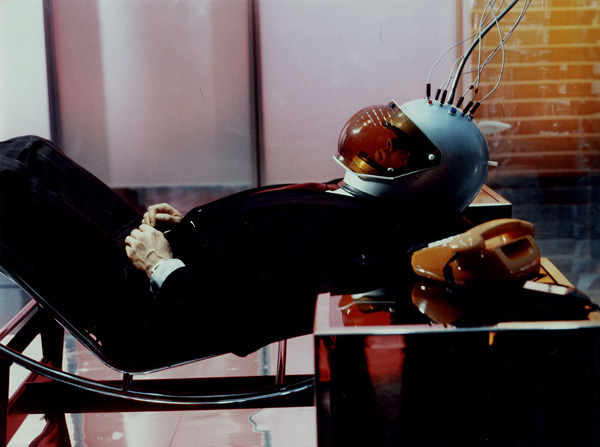
World on a Wire, Fassbinder c WDR courtesy Criterion
GOETHE FILMS: World on a Wire – Cinema as Quantum Experiment
Presented by the Goethe-Institut
March 3 + 5 + 10, 2026
TIFF Lightbox, Toronto
For more information, visit goethe.de/toronto/events.
For tickets, visit TIFF.
Perhaps more so than in the middle of the Cold War, when Rainer Werner Fassbinder created his sci-fi drama World on a Wire, we find ourselves in a moment that seems volatile and highly charged.
Globally converging crises challenge our individual perception, collective sense-making and planetary survival. Reality seems increasingly unstable—digital simulations blur with lived experience, scientific advancements challenge our basic assumptions about existence, and cinema proves itself to be both radical diagnostic tool and healing practice.
Three genre films from the height of New German Cinema to today offer opportunities to step outside consensus reality, not to escape but to navigate communal uncertainty. In World on a Wire (1973), Fassbinder uses nested simulations to question the human mind itself. The protagonists in Wim Wenders’ epic sci-fi thriller Until the End of the World (1991) search for connection after a world-changing catastrophe, with the help of a device that can visualize dreams. Timm Kröger’s metaphysical mystery The Universal Theory (2023) plays out in the shadow of the Alps, where a young physicist attends a scientific congress devoted to the study of quantum mechanics, only to find himself drawn into a spiral of paranoia and conspiracy.
Each film positions the viewer as participant in the construction of alternate worlds. From cosmic perspective to intimate presence, this is cinema as quantum experiment—where the act of observation changes both observer and observed, creating space for new thoughts and dreams (or nightmares).
The Program:
March 3, 2026, 6:30pm
World on a Wire (Germany 1973, 212 minutes)
by Rainer Werner Fassbinder, starring Klaus Löwitsch, Mascha Rabben, Karl-Heinz Vosgerau, Ivan Desny, Barbara Valentin, Günter Lamprecht, Margit Carstensen, Ulli Lommel, Ingrid Caven, Rainer Langhans, Werner Schroeter, and others
Based on the 1964 novel Simulacron-3 by Daniel F. Galouye
Preceded by the TV trailer
World on a Wire is a gloriously paranoid, boundlessly inventive take on the future from then 27-year-old German wunderkind RWF, blending influences from Kubrick, Vonnegut, and P. K. Dick. Originally made as a TV serial, this rediscovered three-and-a-half-hour labyrinth is a satiric and surreal look at the world of tomorrow from one of cinema’s kinkiest geniuses, with the help of a who’s who cast. In his only foray into science fiction, Fassbinder explores corporate conspiracy and technological disturbance in an artificial world and time.
March 5, 2026, 6:30pm
Until the End of the World (Germany/France/Australia 1991, 1994 Director’s Cut, 2014 4K restoration, 287 min)
by Wim Wenders, starring Solveig Dommartin, William Hurt, Sam Neill, Jeanne Moreau, Max von Sydow, and others
Preceded by a video introduction by Wenders
Conceived as the ultimate road movie, Wenders’ sci-fi epic follows Claire as she pursues a mysterious stranger possessing a device that can make the blind see and bring dreams to life. With an eclectic soundtrack from Can to R.E.M., and Robby Müller’s cinematography, this adventure takes its heroes to the ends of the earth and into the depths of their own souls. Presented in its triumphantly restored director’s cut, Until the End of the World is a prescient meditation on cinema’s digital future and our relationship with images.
March 10, 2026, 6:30pm
The Universal Theory (Germany, Austria, Switzerland, 2023, 118 min)
by Timm Kröger, starring Jan Bülow, Olivia Ross, Hanns Zischler, David Bennent, Imogen Kogge, and others
In The Universal Theory, quantum mechanics becomes the cinematic approach: Parallel worlds aren’t just theory but viscerally present. Set against the intellectual fever of a 1962 physics conference in the Swiss Alps, this haunting noir thriller channels Hitchcock’s Vertigo and Lynch’s uncanny dread to explore how observation collapses possibility into catastrophe. As doctoral student Johannes witnesses reality fracture around a mysterious jazz pianist and mounting Cold War paranoia, the film becomes a contemplation on scientific hubris, geopolitical apocalypse, and the dissolution of singular truth. Shot in lush black-and-white that evokes both postwar German cinema and the stark uncertainty of quantum states, Kröger crafts what might be called “Schrödinger’s film noir”—a work that exists in multiple genres simultaneously until the viewer’s gaze forces it into one devastating outcome.
- In competition for the Golden Lion at the 80th Venice International Film Festival
- Venice Film Festival 2023 Winner Bisato d’Oro Best Film & Golden Lion Nominee
- German Film Awards 2024 for Best Cinematography, Best Production, Best Visual Effects
Part of the program (re)Open Minds: Adapting to the Future
Presented by the Goethe-Institut Toronto
Curated by Jutta Brendemühl & Sanjay Khanna
Under the auspices of Prof. Gesche Joost, President of the Goethe-Institut

Program & Media Contact:
Jutta Brendemühl
Program Curator
Goethe-Institut Toronto
jutta.brendemuehl@goethe.de
Instagram @GoetheInstitut_Toronto
Facebook @GoetheToronto
YouTube @GoetheToronto
Related Content
Revealing the Structure: Censorship and Discrimination

Spring 2026 Exhibitions at The Robert McLaughlin Gallery