Eun Ho Lee: Aesthetics of Circulation

Cycle—Water and Fire, 162 x 260.8 x 3 cm. Ink, mineral pigments, and traditional Asian pigments on Hanji (Korean traditional paper)
Eun Ho Lee: Aesthetics of Circulation
April 12 – May 5, 2025
Hanbyukwon Art Museum, Seoul
Artist Statement
The theme of my work is “Cycle of Life.” This theme conveys the idea that all living beings in nature undergo creation, growth, aging, and extinction, but their essence is carried on to the next generation, continuing the cycle. The main title “Cycle” is accompanied by subtitles such as “Brightness and Darkness,” “Water and Fire,” and “Spring, Summer, Autumn, Winter.” These words may appear to be opposing concepts, but they reflect the natural cycle of life.
The images that make up my work include elements from nature, humans, and artifacts created by humans. I believe that humans are also among nature’s beings and are themselves cyclical. As one such being, I pursue visual pleasure through various compositions that express the emotions of joy, anger, sorrow, and pleasure I have felt within the principles of birth, aging, sickness, and death.

Cycle—Spring, 162 x 130.4 x 3 cm. Mineral pigments, and traditional Asian pigments on Hanji (Korean traditional paper)
The main materials of my work are Hanji (Korean paper), Chinese ink, and traditional oriental pigments. The reason for this is the coincidence and freedom of expression inherent in oriental traditional materials. The absorbent nature of Hanji allows for spontaneous effects and delicate blurring. Rather than expressing everything according to my intention, the effects created by the meeting of Hanji, ink, and pigments bring the joy of discovering the unknown. In works where my materials, emotions, and intentions converge, I feel as if I discover another self within me. I write nature-inspired poetry or meaningful phrases in Korean with ink on Hanji.
When I write quickly while holding my breath to prevent the ink from blurring on the Hanji, the immersion and tension focus my scattered thoughts. Upon this calligraphic ground, I layer and compose various images. Over the spontaneous brushwork, I paint envisioned forms with traditional pigments mixed with glue, emphasizing line. I believe this working method—where chance and intention are woven together—resonates with the tapestry of our lives.
The work Cycle—Water and Fire features large fish and the image of fire painted over calligraphy written in ink. The content of the calligraphy is a Korean nature poem I love. Within the form of the large fish, I have drawn small fish and plants. Fish must have water to live. Humans, too, need water. In this sense, the fish can be seen as both nature and humanity. On the right side of the composition, I depicted fire. Fire, too, is indispensable for human survival. The work Cycle—Water and Fire seeks to convey reverence for nature. It expresses an awareness of the frailty of human existence and a desire to yield to the order of nature.

Cycle—Summer, 162 x 130.4 x 3 cm. Mineral pigments, and traditional Asian pigments on Hanji (Korean traditional paper)
The works in the Spring, Summer, Autumn, Winter series express the cycle of the seasons.
The work Cycle—Spring depicts spring, when new shoots sprout and flowers bloom. In the mountains and fields of Korea, forsythia and azalea are the first to announce the arrival of spring. Therefore, I used the yellow of forsythia, the pink of azalea, and the light green of new shoots as background colors, and drew images of nature and artifacts in lines on top of them. This signifies human society living in harmony with nature.
Cycle—Summer was inspired by the cool, clear underwater scenery that relieves the heat of midsummer. The blue and clear sea colors were expressed with the spreading effect of Hanji to evoke a sense of transparency. On top of that, I drew images of plants adapting to the waves and, using lines, connected clock hands and numbers to signify the finiteness of human life. While an individual’s life is finite, nature repeats birth and death.
The work Cycle—Autumn features withered plants, the sun, and the moon on a background of autumnal colors stained by the turning leaves. After the season of abundance and fruition passes, all plants lose their leaves and await extinction. However, the sun and moon that shine upon those plants still await the birth of the next life.
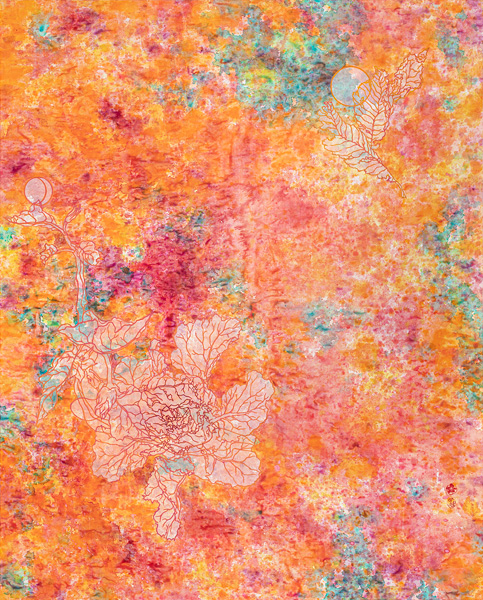
Cycle—Autumn, 162 x 130.4 x 3 cm. Ink, Mineral pigments, and traditional Asian pigments on Hanji (Korean traditional paper)
“If you know your destination, you will never lose your way.”
Knowing the final destination of life makes me think that the current life is precious
“Living each moment of life in my own way.”
It is difficult in reality, but I want to express ‘my own way’ at least in my works
Website | Email | Instagram | YouTube
Hanbyukwon Art Museum
83, Samcheong-ro, Jongno-gu, Seoul, Republic of Korea
Related Content