counterfoil
Centre for Culture and Technology
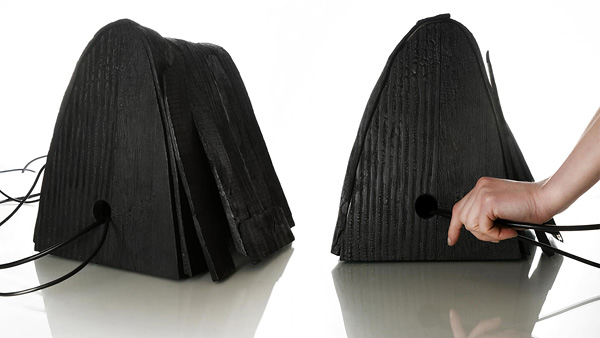
Sarah Holloway, Oak Wifi Router (2025), steambent oak, wifi router, courtesy of the artist.
counterfoil
Sarah Holloway | Matt Nish-Lapidus | Everest Pipkin | Véronique Sunatori & SK Maston (Vyk Productions)
Curated by Talia Golland
October 9 – November 30, 2026
Opening Reception: Friday, October 9, 6–8pm
Centre for Culture and Technology at the University of Toronto
The Centre for Culture and Technology presents counterfoil, a group exhibition featuring Sarah Holloway, Matt Nish-Lapidus, Everest Pipkin, and Véronique Sunatori & SK Maston (Vyk Productions). Curated by Talia Golland, this project responds to the Centre’s 2026–2027 programming theme of “Convivial Computing,” which highlights aesthetic, technical, cultural, and social practices that foster ways of living and doing differently against the backdrop of the radical monopoly of networked, always-on, always-on-us computational technologies.
The exhibition’s title comes from philosopher Ivan Illich, who in his 1973 book Tools for Conviviality proposed the concept of “counterfoil research”: an analytical framework used to “clarify and dramatize the relationship of people to their tools.” Multimedia installations by artists Holloway, Nish-Lapidus, Pipkin, and Sunatori & Maston (Vyk Productions) offer speculative and creative reconfigurations of computational devices, communication infrastructures, and networked technologies. Encountered within staged tableaus and slow-crafted from salvaged tech detritus, natural materials, and basic code, these archaeologies of imagined futures tell stories of small-scale agency within and beyond the socio-technological present’s seemingly foreclosed horizon.
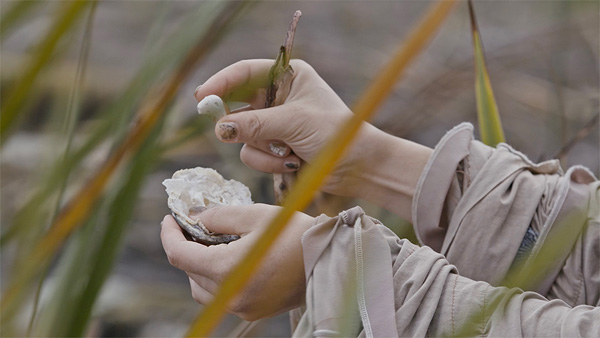
Véronique Sunatori & SK Maston (Vyk Productions), Trashure: Bottle is a Cocoon (2024), HD video still, courtesy of the artists.
Related Programming:
Opening Reception
Friday, October 9, 6–9pm
Artist Talk with Véronique Sunatori & SK Maston
Monday, October 19, 6–8pm
Artist Talk with Matt Nish–Lapidus
Thursday, November 12, 6–8pm
Closing Reception
Monday, November 30, 6–8pm
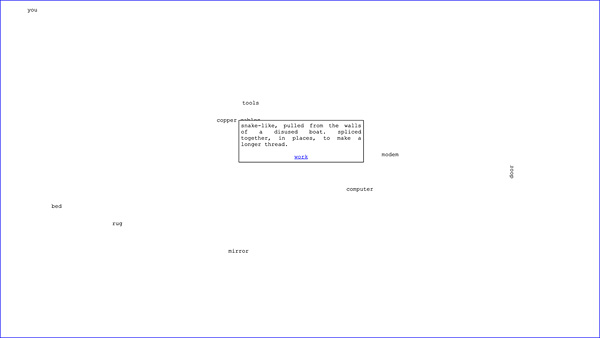
Everest Pipkin, Driftmine Satellite (2023), maintenance text adventure game, website screenshot, courtesy of the artist.
About the Artists
Sarah Holloway approaches technology through the lens of craft, searching for new metaphors for technology. Her objects ground computation in the history of craft, exposing the labor and physicality hidden beneath sleek, polished tech products. She holds a BFA in Furniture Design from Rhode Island School of Design (RISD) and is currently pursuing a MDes in Narratives at the Harvard Graduate School of Design.
Matt Nish-Lapidus is an artist and musician based in Tkaronto/Toronto. Matt’s varied practice probes the myth that computers should be useful rather than beautiful through examining contemporary technoculture, its histories, and its impacts on society, people, and his own life. His work results in diverse outputs including publications, recordings, installations, performances, software, and objects. Matt has performed and exhibited locally and internationally including MOCA (Toronto), The Power Plant (Toronto), INDEX Biennial (Braga), ACUD Macht Neu (Berlin), Electric Eclectics (Meaford), InterAccess (Toronto), ZKM (Karlsruhe), and more, including many DIY community spaces. He holds a H.BFA in New Media from Toronto Metropolitan University and a Master of Visual Studies in Studio Art from The University of Toronto. You can find Matt online and away-from-keyboard under various aliases and collaborations including emenel, New Tendencies, and <blink>.
Everest Pipkin is a game developer, artist, and educator who works in games and software tools across the handmade web–as well as on paper through books, zines and drawings. They hold a BFA from the University of Texas at Austin and an MFA in Studio Art from Carnegie Mellon University. They currently teach game design at the Pratt Institute. They believe the internet is a public good, and the post office should operate it.
Véronique Sunatori is a multidisciplinary visual artist, maker and fabricator, living and working in Tkaronto, Canada. Her work explores memory, material continuity, and embodied storytelling through ceramics, sculpture and installation. Her research interests include care-based methodologies, diasporic poetics, and the reparative gestures of craft. Sunatori holds a BFA from Concordia University and an MFA in Visual Art from York University.
SK Maston is a multidisciplinary visual artist. Their work explores alternative forms of knowledge found in the vantage point of animals such as insects, single-celled organisms, domestic horses, birds and rodents. Working across painting, ceramics, performance, and installation, Maston considers how different beings perceive, inhabit, and move through shared environments. Maston holds an MFA in Visual Art from York University.
Vyk Productions originates from XVK (三喜), an artist collective featuring Sunatori, Maston, and formerly Xuan Ye. XVK’s body of work, combining images, video, performance, and sculptural objects, has previously examined the capitalist exploitation and fertilization prevalent in the idol industry. Vyk Productions marks a shift from XVK’s earlier pop icon identities to a newly cultivated collective persona, Vyk, portrayed alternately by Sunatori and Maston in the 2024 short film Trashure: Bottle is a Cocoon. Set in a post-COVID environment, Vyk’s world addresses sustainability, the Anthropocene, eco-theory, food scarcity, the climate crisis, species extinction, and socio-technical imaginaries linked to Toronto’s shoreline.
About the Centre for Culture and Technology
The Centre for Culture & Technology is dedicated to theoretical, aesthetic, and critical inquiry into the impacts of contemporary media on our interconnected world. This project is informed by the Centre’s location in the Coach House, a multi-use heritage building that was once Canadian media theorist Marshall McLuhan’s office and salon on the University of Toronto campus. The Centre draws inspiration from McLuhan’s humanistic intellectual and institutional legacy, continuing his stated goal of “investigation into the psychic and social consequences of technologies.”
The Centre promotes the study of media aesthetics in an expanded sense, examining the ways technological media shape contemporary experience by elaborating its histories, its problems, its infrastructures, and its politics. Offering both a setting and a framework, the Centre provides space and programming for scholars working in humanistic media studies across the three campuses of the University of Toronto and in the GTA. The Centre also supports the production of and conversation about contemporary media art, fostering aesthetic experimentation as a mode of inquiry.

Centre for Culture and Technology at the University of Toronto
39A Queens Park Crescent East
Toronto, ON M5S 2C3
www.cultureandtech.utoronto.ca
cultureandtech@utoronto.ca
Instagram @uoftculturetech
Gallery Hours:
Wednesdays: 2–6pm
Fridays: 12–6pm
Saturdays: 12–4pm
Sundays: 12–4pm
Accessibility:
The Centre for Culture & Technology is partially accessible. For more information, visit the website.
Related Content
Call for Curatorial Proposals: Canada Council’s 70th Anniversary Exhibition
LAMAS: Latin American Media Arts Symposium 2026

Isabelle Hayeur featured in Black Sun – Oil and Contemporary Art