Carrie Perreault: We Must (still) Love and Support One Another
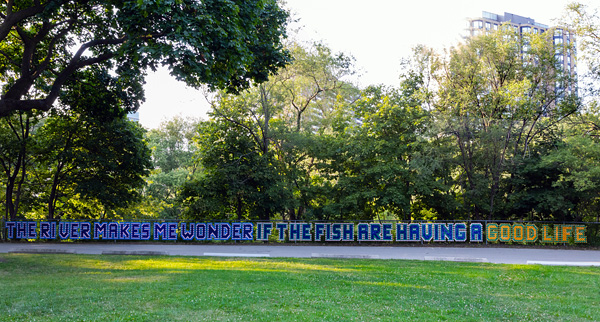
Carrie Perreault, Installation view, We Must Love and Support One Another, 2026, Site-specific installation, 36″ x 2568″ Photo: MP Guillot
We Must (still) Love and Support One Another
A Weston Community Public Art Project
Installation on view through November 22, 2026
Raymore Park, 93 Raymore Drive, Etobicoke, ON M9P 1W8
We Must (still) Love and Support One Another is a 214-foot-long text-based installation currently on view in Raymore Park, in Toronto’s Weston neighbourhood. Embedded in the chain-link fence alongside the Humber River, the artwork features the words of neighbourhood resident Hanad: “The river makes me wonder if the fish are having a good life.” The text is repeated in Spanish—“El río me hace preguntarme si los peces están teniendo una buena vida”—reflecting two of the many languages spoken in the community.
The installation emerged from three weekends of community art-making workshops in the park. Neighbours, park users, friends, and passersby gathered under the trees to make signs, share stories, and think about the place around them. Participants considered what they love about Weston, what the Humber River gives to the community, and what it means to be a good neighbour. The resulting signs and banners became a portrait of a place and the people who care for it.
The project returned to Raymore Park for a second year, following Sister Corita Kent’s Art Department Rules instruction to: “Find a place you trust and then try trusting it for a while.” The return was less about repetition than staying with a place long enough for something else to become visible. Familiar faces returned, new neighbours joined, conversations continued, and the Humber River moved more insistently into the work.
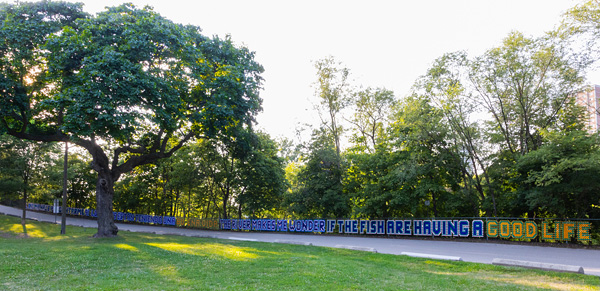
Carrie Perreault, Installation view, We Must Love and Support One Another, 2026, Site-specific installation, 36″ x 2568″ Photo: MP Guillot
That shift feels important. The river is not scenery here. It shapes the landscape and gives people a place to walk, sit, gather, watch, pray, and return to. One of the young participants, Hanad, wondered whether the fish were having a good life—a funny, tender, and surprisingly expansive question about what care might look like beyond ourselves.
Returning again this year also allowed the project to become part of the social life of the park. Relationships continued, new ones formed, and the site became more than a backdrop; it became one of the project’s materials. The work grows through repeated encounters with the river, neighbours, passersby, and non-human regulars—snakes, coyotes, cardinals, and others moving through the park with us. We Must Love and Support One Another is as much about paying attention as making an artwork: noticing who and what is already here, and what can happen when people keep returning to the same place together.
Carrie Perreault, a long-time resident of Weston, developed We Must Love and Support One Another as an ongoing community-based project rooted in the neighbourhood and Raymore Park. The work brings together workshop facilitation, public art, making as a collective action, and a sustained interest in how people form relationships with place, with one another, and with the everyday spaces they move through.
The 2026 edition was supported by Amana (AJ) Park and Victory Anthony-Nted, who assisted with the community workshops and installation, helping create a welcoming space for participants to make, talk, and contribute.
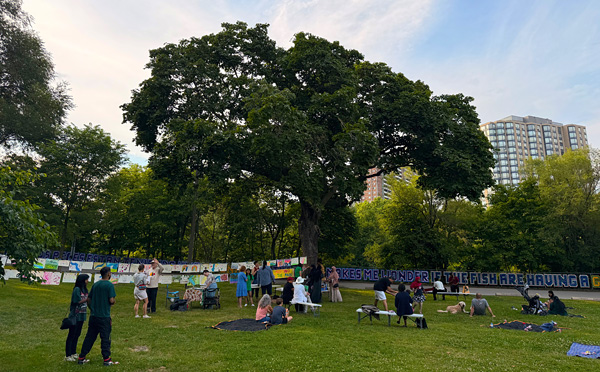
Carrie Perreault, Community installation celebration, We Must Love and Support One Another, 2026, Site-specific installation, 36″ x 2568″ Photo: Mario Rivas
About the Artists
Carrie Perreault is a multidisciplinary artist working across sculpture, installation, publishing, performance, and socially engaged practice. Her work considers how people live with one another: how care is expressed, how labour is made visible, how memory settles into objects and places, and how ordinary gestures can carry political weight. Recent exhibitions include Pacing the House at the University of Waterloo Art Gallery and period of adjustment at the NAC, accompanied by essays by Sky Goodden and Lucy R. Lippard.
She is the editor of The Artist Cookbook, with Volumes 3 and 4 forthcoming. Current projects include The Secret Life of Machines, a large-scale performance in development involving articulating boom lifts, and Between Fields, a collaborative project connecting migrant farmworkers in Niagara with traditional makers in Rajasthan, India.
Amana Park (AJ) is an art practitioner who uses creativity as a gateway to promote collective healing. Each practice branches from the root of her poetry: authenticity and vulnerability. She is also a poet for Poesy Canada, creating on-the-spot typewriter poetry for strangers as a way to sustain human connection and the beauty of handmade keepsakes.
Victory Anthony-Nted is a Toronto-based Nigerian multidisciplinary artist whose practice centres on portraiture and identity. Through a trauma-informed lens, she facilitates art-based wellness workshops that use creative expression to foster connection, healing, and community.
About Weston
Raymore Park sits along the Humber River, on land long home to the Anishinaabeg, Haudenosaunee, Wendat, and Mississaugas of the Credit. The area carries layered histories of movement, migration, and resilience.
The project acknowledges that the park remains Indigenous land, honours the continued presence of Indigenous Peoples, and is grateful for the opportunity to gather here and consider how communities care for this place—and one another. Today, people from many lands call Weston home and come to the river with that same spirit.
Image Descriptions:
1. Colourful plastic letters on a chain-link fence read, “THE RIVER MAKES ME WONDER IF THE FISH ARE HAVING A GOOD LIFE.”
2. A bilingual text installation runs along a chain-link fence. It reads, in Spanish, “EL RÍO ME HACE PREGUNTARME SI LOS PECES ESTÁN TENIENDO UNA BUENA VIDA,” followed by the English translation.
3. People gather beneath a large tree in Raymore Park among handmade signs on clotheslines; the bilingual fence installation stretches behind them.
Special thanks to the Raymore Park Nature Stewards and Brian MacLean for their year-round care of the park, which enriched this project and its conversations. Heartfelt thanks to the community for their ongoing enthusiasm and guardianship of the work.

Related Content
Call for Expressions of Interest: James Stevenson Park Legacy Project, Peterborough
Request For Proposals: 2027 Floating Public Art, Waterfront Toronto