CAFKA.25: Field Guide to the Understory
June 7 – July 26, 2025
Kitchener, Waterloo, and Cambridge
Opening Forum: June 7, 2025, 12 – 2pm
Kitchener City Hall, 200 King St W, Kitchener, ON
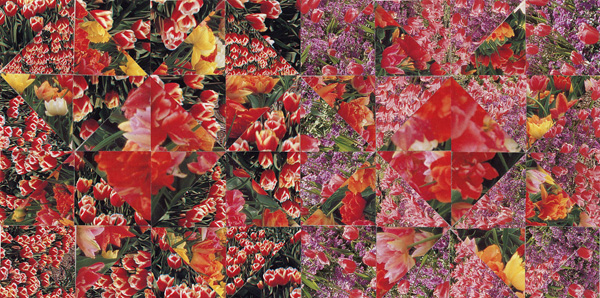
Visual identity for CAFKA.25, created by Ioana Dragomir.
Curatorial Statement
CAFKA.25 draws inspiration from the intricate ecosystems of the forest understory, where life flourishes in the fleeting glow of dappled light and where intricate microhabitats thrive in the shadow of giants.
CAFKA.25 considers the possibilities of an urban understory where, below the tall buildings and executive suites, we see a rich tapestry of entwined narratives and a deep desire for balance and community.
Through the works in the biennial, we are searching for the quiet places where life is nurtured and supported atop stable ground, and our understory serves as a place of shelter and intimate discovery where each artwork presents a bridge between the seen and unseen in everyday life.
CAFKA invites you to become part of the understory, to travel beneath the towering canopy, and become one with the oft-stepped on and easily overlooked.
Curatorial statement written by Lauren Prousky on behalf of the CAFKA Programming Committee, 2023.
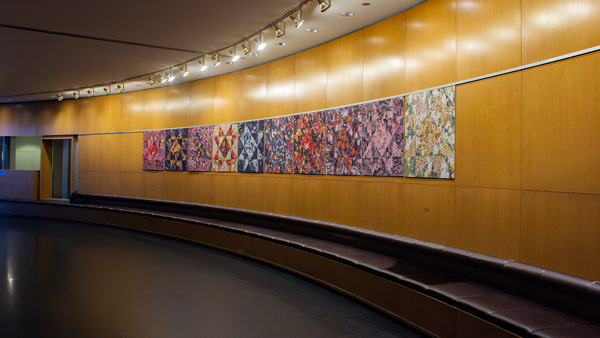
Images from the CAFKA.25 visual identity created by Ioana Dragomir, located in the Rotunda at Kitchener City Hall. Photo by Iqra Majeed.
Artists and Exhibits
Artworks featured in CAFKA.25: Field Guide to the Understory can be found across Waterloo Region from June 7 – July 26, 2025.
This year, CAFKA commissioned artwork from 17 nationally recognized artists and collectives – hailing from Vancouver Island all the way to Halifax.
The CAFKA.25 biennial exhibition features artworks from:
abisola oni | Adam Basanta | Ben Gorodetsky | Brandon Hoax | Don Kwan | FASTWÜRMS | Gabriel Esteban Molina | Jacob Irish | lagomorphhh | Laura Kay Keeling | Miles Rufelds | naakita f.k. | Natasha Lavdovsky | Richelle Forsey + Anna Gaby-Trotz | Roda Medhat | Sophia Oppel | Syrus Marcus Ware
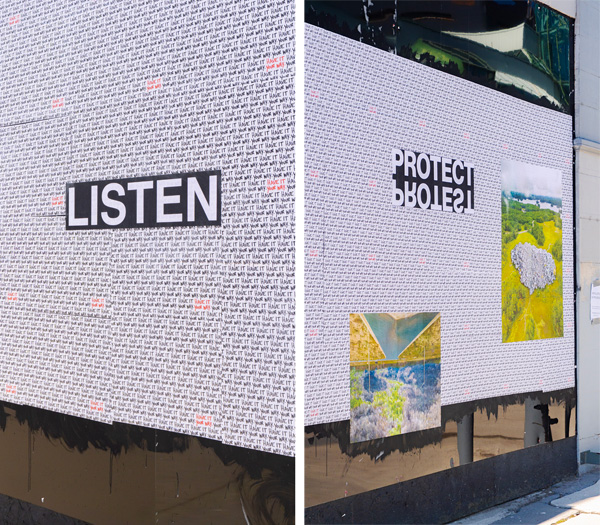
The Landscape is Dead by Richelle Forsey + Anna Gaby-Trotz. Photos by Iqra Majeed.
About CAFKA
CAFKA – Contemporary Art Forum Kitchener + Area takes art outside of the gallery and presents it in public places to foster community connections, record our stories, and enjoy the common spaces we all share.
CAFKA is an artist-run organization, proud to be in our 24th year of operation.
Connect with us:
Instagram @cafkabiennial
Youtube @cafkatv
cafka.org
Contact:
CAFKA – Contemporary Art Forum Kitchener + Area
141 Whitney Pl Studio #7, Kitchener, ON N2G 2X8
outreach@cafka.org
Funders and Supporters
This year’s biennial, and all our work, is made possible through the generosity of our funders, as well as through in-kind, production, and event support.
CAFKA.25 is supported by Canada Council for the Arts, Government of Canada, Ontario Arts Council, Government of Ontario, RTO4, Region of Waterloo, City of Kitchener, City of Waterloo, City of Cambridge, Musagetes, Waterloo Region Community Foundation – The Musagetes Fund, and The Working Centre.
We receive in-kind, production, and event support from The Yeti Cafe, Short Finger Brewing Co., Kultiq, Henry’s Tempeh, Civilian Screen Printing, Westmount Signs and Printing, United Rentals, Espace art actuel, and The Community Edition.
We are grateful for all of the creative, communal, and institutional support that allows us to make art accessible in public space.
Land Acknowledgement
CAFKA acknowledges that we live and work on the traditional territory of the Attawandaron (Neutral), Anishnaabeg, and Haudenosaunee peoples. The Region of Waterloo is situated on Block 2 of the Haldimand Tract, land promised to Six Nations, which includes six miles on each side of the Grand River. The Haudenosaunee Confederacy, also known as the Six Nations of the Grand River, were granted this land to enjoy forever as part of the 1784 Haldimand Treaty with the British, after the Six Nations were dispossessed of their land in Upstate New York following the American Revolution. The Haldimand Tract was reduced to less than five per cent of this original territory in the over 200 years since, primarily through the loss of land to encroaching settlers. The Haudenosaunee Great Law emphasizes collective responsibilities and rights, and with this the principle of the “Dish with One Spoon” – a treaty extended with the Anishinaabe and the British – which stipulated that the land was to be shared equally, collectively and with the utmost attention paid to peaceful relations and the conservation of lands for future generations. As an organization composed of individual artists, arts workers, and community members with diverse backgrounds and histories, it is always our responsibility to learn, acknowledge, respect and uphold the treaties made with Indigenous nations, and respect the right to land and life on unceded territories whose traditional caretakers continue to resist colonial violence today.
Related Content
Call for Proposals: Artworks for Outdoor Exhibition in Canada’s Capital Region 2026