Border Crossings: C a n a d a, Vol. 44 No. 3
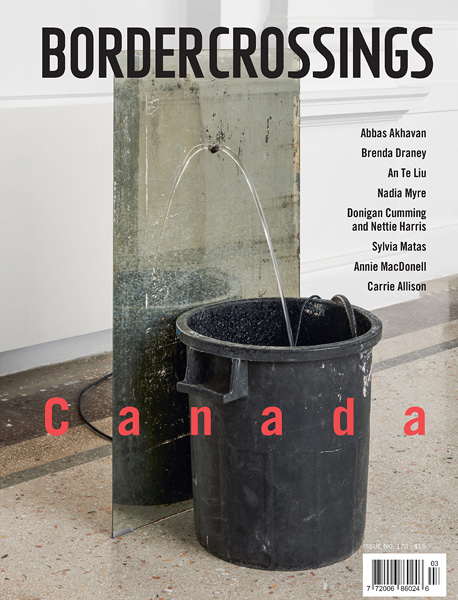
Abbas Akhavan, fountain, 2022, plastic bin, mirror, pond pump, tubing, water, snail mucin serum, Galantamine, 107 x 71 x 51 centimetres. Collection of KADIST, San Francisco. Photo: Ben Westoby. Courtesy Catriona Jeffries, Vancouver.
C a n a d a
Vol. 44 No. 3 / Issue 170
We recognize, and not for the first time, the danger of nationalisms. We also acknowledge that a sense of place, how ever expansive or limited it may be, is something everyone seeks: a home, an identity, a place from which to begin. Who we are is linked with where we are. Canadian literary theorist Northrop Frye, firmly located where he was—in Canada in the mid 20th century—told us that the centre is where you are. Not an egocentric stance but a reminder that moving from the person out is the productive creative beginning. And also a confirming sense that a world can be made anywhere; you make your own centre.
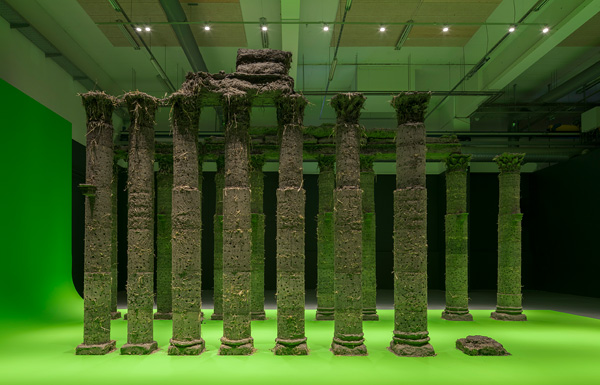
Abbas Akhavan, installation view, “curtain call,” 2023, Copenhagen Contemporary, Denmark. Photo: David Stjernholm. Courtesy Catriona Jeffries, Vancouver. Artwork: curtain call, variations on a folly, 2021/2023, barley straw, subsoil, lightweight Leca, sharp sand, puddle clay, wood, chromakey green paint, pink noise, 390 x 650 x 1230 centimetres.
So, nationalisms. This issue of Border Crossings is proudly titled “ C a n a d a.” I am proud, grateful, fortunate to call Canada home and in what forum are we better able to celebrate nationalism here than in art and culture. The issue begins with an interview with Iranian Canadian artist Abbas Akhavan who is representing Canada this year at the 61st Venice Biennale. Elliptical, profound, understated, whimsical, elusive, enigmatic and at the same time disarmingly direct, Abbas Akhavan is Canada’s essential artist. For him, now, he says, feeling grounded has been “a semblance of domesticity”—where buying a house plant implies a recognition of home. Humility shines.
Two other conversations in this issue—the interview with Cree artist Brenda Draney from the Sawridge First Nation in Alberta and Nadia Myre, a Quebec artist and an Algonquin member of the Kitigan Zibi Anishinabeg First Nation are geographies apart and both linked to their own cultural origins.
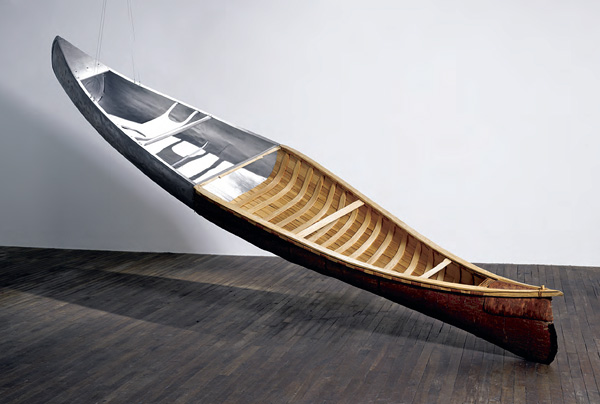
Nadia Myre, History in Two Parts, 2000, birchbark, aluminum, cedar, ash, spruce root, and gum, 91 x 427 x 122 centimetres. Courtesy the artist.
Coming to Canada from Taiwan as a small child with his parents, artist An Te Liu looks to roots in his natal home, transposed, fully integrated and informed by his architectural schooling and practice in Canada and internationally.
Nicely shifting the term, “earthwork” from noun to verb, Canadian curator and writer Michael Davidge opens his article with the told beginnings of Robert Smithson’s subsequent earthworks, the dystopic novel, Earthworks by Brian W Aldiss. We open the article with the Canadian-located sculptural work Shift by Richard Serra, a work installed in 1972 in a field 30 kilometres north of Toronto. The article goes on to discuss a significant exhibition at the Art Museum at the University of Toronto which looks anew at the subject of earthworks from an Indigenous perspective.
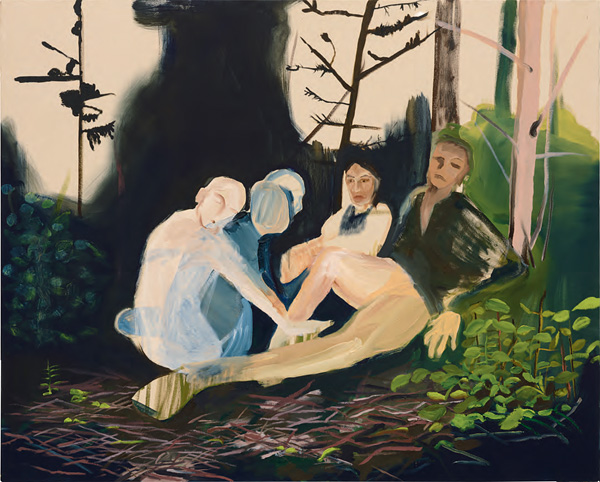
Brenda Draney, Bear Trails, 2022, oil on canvas, 122 x 152 centimetres. Collection of Musée d’art contemporain de Montréal. Photo: Rachel Topham Photography. Courtesy Catriona Jeffries, Vancouver.
Stepping lightly but with thoughtful, careful consideration, Winnipeg-based artist Sylvia Matas’s subtle video works are readily Canadian and broadly poetic. Canada’s vast spaces and sustained and profound experience of the North—think of the piano genius Glenn Gould’s seminal radio documentary, “The Idea of North”—makes this northern country fertile ground for expansive ideas like the ones explored by Canadian artist Annie MacDonell. In the article “Interior Art-Life” writer Rhiannon Vogl describes the work as transcending spatial limitations, seeking other energies, the possibilities in psychedelic experiences and notions of collectivity. Canadian.
In this issue’s presentation of “Pages from the Border Crossings Archives” we asked American-born Canadian artist Donigan Cumming to look again at the early photographic work he did, titled “Pretty Ribbons,” with his friend Nettie Harris, then in her eighth decade. Almost 40 year later, it still holds—in every sense. The issue is rich in its range of reviews, as it always is, and these travel everywhere.
Come to “ C a n a d a.” Read freely. No guards at this Border Crossing.
Subscribe now and receive the new issue
Or
Order a single copy
Vol. 44 No. 3 / Issue 170, C a n a d a
Available now
Canadian Student Subscriptions available now for only $28 per year
Sign up online!
e: info@bordercrossingsmag.com
p: 1.866.825.7165
Related Content

Ottawa Art Gallery Activates the Heart of the City with Major Art Events for Ottawa 200