Body Politics: Art, Protest and the State
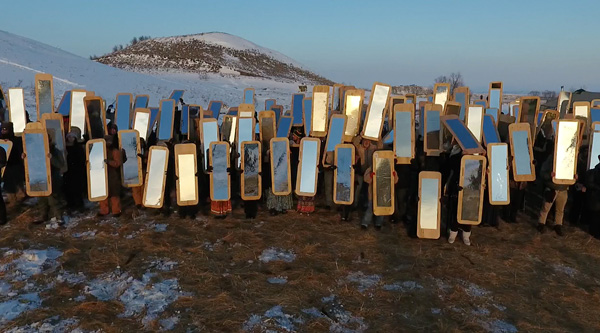
Cannupa Hanska Luger, The Mirror Shield Project, 2016.
Body Politics: Art, Protest and the State
September 26, 2026 – January 23, 2027
SAW, Ottawa
Artists: Ai Weiwei (China), Jelili Atiku (Nigeria), Joseph Beuys (Germany), Risto-Pekka Blom (Finland), Tania Bruguera (Cuba / US), Cassils (Canada / US), Zuleika de Souza (Brazil), Coco Fusco (US), Regina José Galindo (Guatemala), Guillermo Gómez-Peña (Mexico / US) and Gustavo Vázquez (Mexico / US), Marja Helander (Sápmi / Finland), Istvan Kantor (Canada), Claude Latour (Canada), René Leboeuf (Canada), Cannupa Hanska Luger (US), Jacqueline Maingard (South Africa), Luis Manuel Otero Alcántara (Cuba / US), Seelan Palay (Singapore), Pussy Riot (Russia / US), Anthony Ramos (US), Crack Rodriguez (El Salvador), The Unbribables (Rena Rädle, Vladan Jeremić, Tony Maslić and Nikola Radivojević) (Serbia), Ulay (Germany)
Curator: Jason St-Laurent (Ottawa)
Assistant: Curators Hope Hamiton (Ottawa) + Mitia Combelles-Razafimamonjy (Metz, France)
Advisor: Catherine Sicot (La Rochelle, France / Montréal)
Presented by SAW with the support of Amnesty International, with loans generously provided by the Archives gaies du Québec, Louisiana Channel and the Library and Archives of the National Gallery of Canada
Body Politics: Art, Protest and the State brings together 50 years of performance and protest actions by artists confronting government power, law enforcement and state control. Featuring the work of more than twenty artists and collectives from around the world through video documentation, installations, photography and archival materials, this exhibition highlights the enduring power of performance as a tool for resistance, remembrance and political engagement.
Artists featured in the exhibition have faced censorship, harassment, reprisals, arrest or imprisonment as a result of their work, including the widely publicized detentions of Pussy Riot in Russia and Ai Weiwei in China. The exhibition also introduces artists who remain largely unknown in North America, yet whose practices have played an important role in the history of performance art in their countries, among them Seelan Palay in Singapore, Jelili Atiku in Nigeria and Crack Rodriguez in El Salvador. Addressing subjects ranging from Israel’s ongoing genocide against Palestinians to the remembrance of the Tiananmen Square massacre in China, the works presented span a broad spectrum of themes, with an emphasis on human rights, social justice and environmental protection. Across these different histories and political contexts, the exhibition traces the many forms artistic resistance has taken, from provocative individual actions to collective movements and public protest.
A point of departure for this history is Ulay’s 1976 performance, in which the artist stole Carl Spitzweg’s The Poor Poet—reportedly one of Hitler’s favourite paintings—from the Neue Nationalgalerie in Berlin and installed it in the home of a Turkish immigrant family in Kreuzberg, drawing attention to their living conditions and the social inequities they faced.
The exhibition also features a newly commissioned installation by artist Luis Manuel Otero Alcántara, who was recently released from a Cuban prison and sent into exile in the United States. In response to Decree 349—a law designed to suppress dissenting artistic voices—Otero Alcántara emerged as a leading figure of the San Isidro Movement, a collective of artists, journalists and activists advocating for freedom of expression. Members of the movement have faced intimidation, surveillance and repeated detentions. Created in part while Otero Alcántara was incarcerated at the Guanajay maximum-security prison, the commissioned work incorporates a recent audio recording made during his imprisonment, bringing the artist’s voice and an intimate sense of his presence into the exhibition.
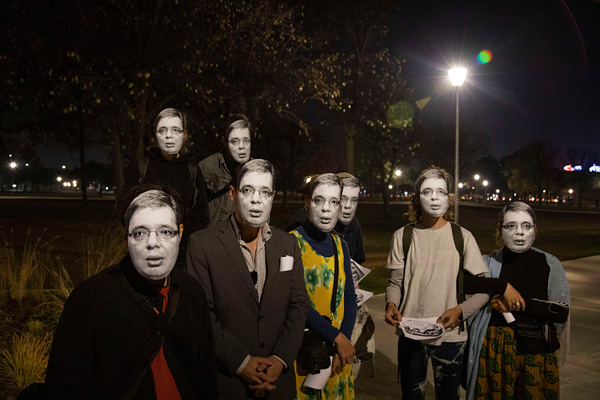
The Unbribables (Rena Rädle, Vladan Jeremić, Tony Maslić and Nikola Radivojević), Becoming VU, 2017. Photo: Igor Pavićević.
A new installation by Cassils is based on their live performance Under Sight, during which they projected into the night sky a selection of 199 terms deemed “suspicious” by the Trump administration—words such as diversity, equity and ethnicity—translated into Morse code. As the artist explains, “It’s a distress signal,” a visual strategy of resistance responding to these continually shifting conditions of heightened censorship and surveillance.
Other highlights in the exhibition include Coco Fusco’s exploration of the groundbreaking street performances of artist JuanSí González, photographs from The Mirror Shield Project by Cannupa Hanska Luger, created in support of Water Protectors at Standing Rock in North Dakota, and Ai Weiwei’s iconic gesture of defiance toward sites of political power in Study of Perspective – Tiananmen Square, 1995–2003. The exhibition also features documentation of Tania Bruguera’s participatory performance Tatlin’s Whisper #6, whose first attempt to stage the work in Havana’s Revolutionary Plaza resulted in her detention by Cuban authorities. Similarly, Pussy Riot’s guerrilla performance Punk Prayer, staged in Moscow’s Cathedral of Christ the Savior, led to the arrest of three members, who were later charged with hooliganism and sentenced to two years in prison.
Body Politics also includes a section exploring how creative, collaborative actions can become powerful forms of dissent. A photographer for ACT UP Montréal in the early 1990s, René Leboeuf documented the group’s mass demonstrations as community members mourned those lost to HIV/AIDS and protested government inaction. Joseph Beuys’ monumental social project, 7000 Eichen (7000 Oaks), began in 1982 with the planting of 7,000 trees alongside basalt stones in Kassel, Germany, and continues to inspire new projects that engage communities in social and environmental change. Jacqueline Maingard’s 1995 documentary revisits a pivotal moment in South African political history. In Dobsonville, Soweto, Black women who had built dwellings on vacant land removed their clothing in a radical act of protest to prevent the demolition of their homes.
Body Politics asks what role art can play when systems of power seek to silence, control or erase dissent. The exhibition demonstrates how performance can give dissent a public form, confront injustice and create space for collective action.
Funders: Canada Council for the Arts, City of Ottawa, Ontario Arts Council, Ontario Trillium Foundation, Ottawa Community Foundation, Government of Canada, Government of Ontario
Partners: Amnesty International, Vtape, Electronic Arts Intermix, Artengine, Pique fall edition
Lenders: Archives gaies du Québec, Louisiana Channel, Library and Archives of the National Gallery of Canada

67, rue Nicholas Street
Ottawa ON K1N 7B9
Canada
T: (613) 236-6181
info@saw-centre.com | info@centre-saw.com
www.saw-centre.com | www.centre-saw.com
Facebook | Instagram
Related Content
Experiencing Nuit Blanche Toronto 2026: In the City and Online
Call for Entry: Colour and Form Society 74th Annual Open Juried Exhibition