Ascending Horizons at McMaster Museum of Art
The new exhibition honours Indigenous women by exploring themes of the sacred feminine and creation. Join us for a public opening reception Thursday, January 30, 5 – 8pm.

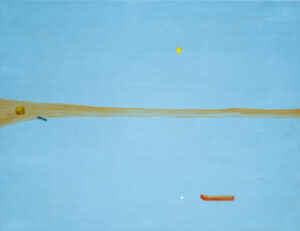
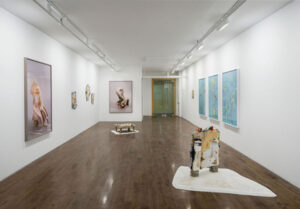
Images (left to right): Detail of work by Charlene Vickers, Judy Anderson, Hannah Claus, Carrie Allison, KC Adams, Marie Watt, Elizabeth Doxtater
Ascending Horizons
Curated by Alex Jacobs-Blum and Kim Anderson
January 8 – June 20, 2025
Opening Reception: Thursday, January 30, 5 – 8pm (remarks at 6pm)
McMaster Museum of Art, Hamilton
This winter, McMaster Museum of Art presents Ascending Horizons, a group exhibition that explores how Indigenous women activate their connection to the natural world and dream of new worlds for future generations. Curated by Hamilton-based artist and curator Alex Jacobs-Blum and Métis scholar and professor Kim Anderson, Ascending Horizons is on display at the M(M)A from January 8 until June 20, 2025. The exhibition brings together work by seven Indigenous women artists including KC Adams, Carrie Allison, Judy Anderson, Hannah Claus, Elizabeth Doxtater, Charlene Vickers, and Marie Watt.
Ascending Horizons is an invitation to consider embodied connections, cycles and seasons of the sacred feminine, connecting women in creation and re-creation. Tethering land, water, the moon and the cosmos to Indigenous women’s bodies, the exhibition honours the sacred cycles of creation and movement, birthing bodies and their grounding in the fertile capacities of earth in relation to the pull of the moon and the sky world.
Through transdisciplinary artistic practices: cornhusking, photography, video, performance, installation, ceramics, beadwork and embroidery, each of the seven artists call upon their own Nations’ thought systems and the knowledge of their Ancestors toward an infinite and regenerative future.
The works illuminate Indigenous worldviews through longstanding material connections, building with and from sand, clay, cedar, corn husks, fur and copper, demonstrating how these connections provide teachings about place-making among human relations and beyond. Further, the works show how adorning the body through tattoos, jingles, or the exquisite clothing of cornhusk dolls can become a means of healing. Material comforts such as blankets, felt, buttons and beads speak to the nurturing presence of women across generations, while the use of reprography film and aluminium remind us that Indigenous practices are continually evolving alongside new materials. This weaving of the past and the future blends ancestral knowledge with contemporary practices, reaffirming the boundless, adaptable and ever-evolving nature of Indigenous creativity.
Ascending Horizons builds on Haudenosaunee and Algonquian teachings to re-envision elements of the natural world – from Earth to Sky – to consider how we navigate between them and reimagine a future alongside the creative capacity of Indigenous women.
For artist biographies, visit museum.mcmaster.ca
Alex Jacobs-Blum is a Gayogo̱hó:nǫʼ (Cayuga) and German visual artist and curator living in Hamilton, ON. Her research focuses on Indigenous futurities and accessing embodied Ancestral Hodinöhsö:ni’ knowledge. The core of her practice and methodology is a strong foundation in community building, fostering relationships, empowering youth, and Indigenizing institutional spaces. Her creative process is rooted in storytelling and challenging hierarchical power structures, seeking to facilitate transformative change infused with love and care. She has curated exhibitions at Hamilton Artist Inc., Supercrawl and the University of Waterloo, Longhouse Labs. Alex is a member of the Bawaadan Collective.
Kim Anderson is a Métis writer, scholar and educator based at the University of Guelph where she is a Professor and Canada Research Chair in Storying Indigenous Relational Futures. Kim’s storied work involves collaboration with curators, multidisciplinary artists, scholars, and activists. In 2019 she co-curated Konnón:kwe, an exhibition for the Guelph Civic Museum that wove together fine art and Indigenous women’s history. Members of this curatorial collective are now creating another exhibition for the Guelph Civic Museum on Where the Rivers Meet, set to open in spring 2026. Kim has published seven books, including a co-produced memoir with Elder and artist Rene Meshake entitled Injichaag, My Soul: Anishinaabe Poetics in Art and Words (University of Manitoba Press, 2019).
Exhibition support provided by the Canada Council for the Arts.

About McMaster Museum of Art
The McMaster Museum of Art is a meeting space for both the University campus and the community situated within the traditional territories of the Mississauga and the Haudenosaunee nations. The M(M)A engages and inspires through arts presentation and promotion, as well as by: growing an awareness of the interconnectivity of the past, present and future; advancing de-colonization; engaging in innovative and imaginative research; dismantling institutional and ideological boundaries; partnering and collaborating with intentionality; diversifying the collection; and building capacity.
McMaster Museum of Art
Alvin A. Lee Building
McMaster University
1280 Main St W
Hamilton, ON L8S 4L6
905.525.9140 x.23241
Website | Instagram | X | Facebook
Hours
Tuesday: 11am – 5pm
Wednesday: 11am – 5pm
Thursday: 11am – 7pm
Friday: 11am – 5pm
Saturday – Monday: Closed
Admission is always free, and everyone is welcome.
For more information please contact:
Elyse Vickers
Communications Officer, McMaster Museum of Art
museum@mcmaster.ca


Related Content
Call for Proposals: Artworks for Outdoor Exhibition in Canada’s Capital Region 2026