Wavy Dimension at the Art Gallery of Alberta
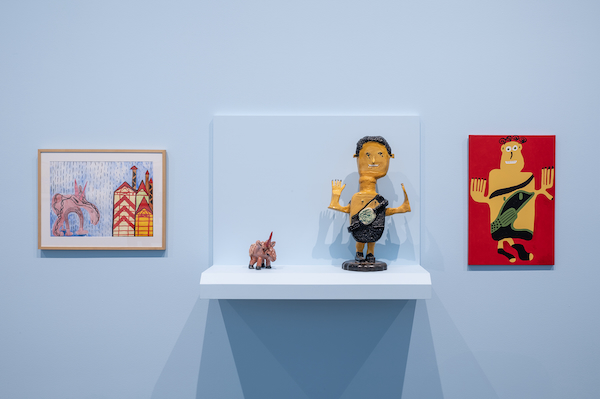
Boyd Dymchuk and Aaron Harvey, Wavy Dimension, 2024, installation view (photo: Charles Cousins; courtesy of the Art Gallery of Alberta)
Boyd Dymchuk and Aaron Harvey are two artists from the Nina Collective, a group of artists with developmental disabilities based out of the Nina Haggerty Centre for the Arts in Edmonton. Their collaborative exhibition, Wavy Dimension, has been on display at the Art Gallery of Alberta since June 15, and it closes on October 6. Shantel Timmerman, another artist in the collective, wrote the catalogue essay for the exhibition. Boyd passed away shortly after the opening of the exhibition, but, with the help of Janice Easton, the Director of Communications & Artistic Outreach at the Nina, Akimblog interviewed Aaron and Shantel to find out more about the exhibition, the work they do, and what galleries can do to make themselves more accessible.
Aaron Harvey
For people who won’t be able to visit the Wavy Dimension exhibition, can you describe what they would see?
Wavy dimensions.
What do wavy dimensions look like?
Like a fiery flame. Like a flame that sticks out at a corner of the blue. And [there are] animals around the whole entire inside [of the gallery]. Paintings, pictures, and sculptures. I did the pictures and sculptures. And Boyd did such a great job on his clay sculptures. He was such a good friend to me.
How did you and Boyd work together to make the exhibition?
Hillary [Mussell, Special Projects Coordinator at the Nina] put us together in a room at the back where the clay is, and we just learned how to do whatever we could and make it better for our exhibition. It was a really nice time that I had with Boyd. He told me that I was doing a good job. I was drawing animals and trees. We were doing good together.
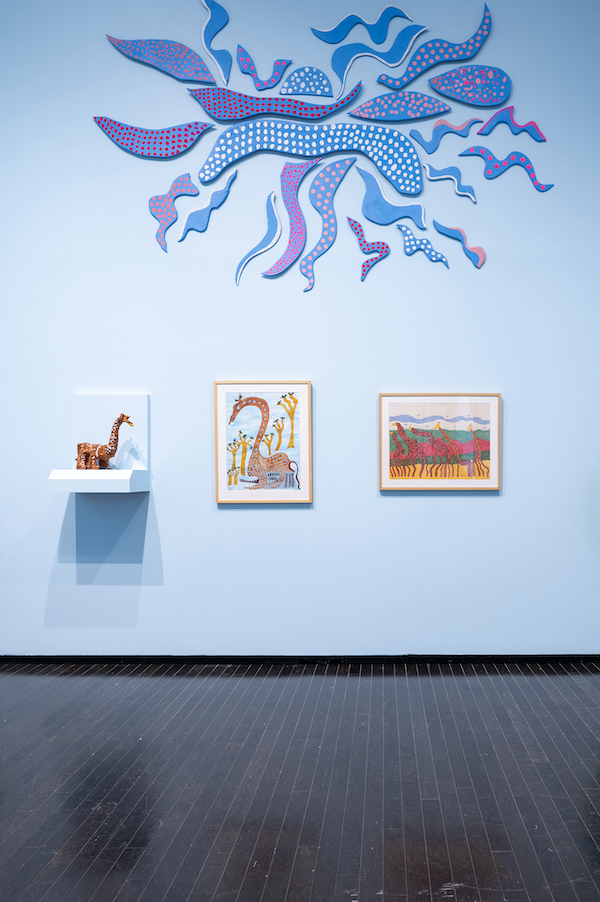
Boyd Dymchuk and Aaron Harvey, Wavy Dimension, 2024, installation view (photo: Charles Cousins; courtesy of the Art Gallery of Alberta)
How did you make the wood pieces?
We were trying to make a wavy dimension on the floor here at Nina. We were trying to figure out how to symbolize the flame of the wavy dimensions, and we actually figured it out. We numbered the back of each piece of wood, then we put them together, and it looked really good, like a puzzle.
Anything else you want to say about working with Boyd?
He was just a great clay worker.
How did you get involved with the Nina?
Someone told me about the Nina Haggerty Centre. Then when I first came here, I really liked it. I liked the place where it was, the doors and everything, the windows. And I thought it was a kind of a cool place to be. Everybody was so nice to me. When I first started here, I worked with pencil crayons and drew pictures of mountains, trees and houses, and lakes and rivers. And boats. At the end of all the years I worked here, it just got better and better.
Why do you think it’s important for galleries like the Art Gallery of Alberta to support artists with developmental disabilities.
It can help them grow and learn how to do art. To help and support their minds, their thinking about what to do next in life.
Can you say more about that?
I want to be good at colors and shapes and designs, to learn how to do better drawings.
What can galleries do to make themselves more accessible for artists with developmental disabilities?
By putting bigger pictures on walls. By doing exhibitions in a room full of pictures like I want to do. I’m setting my goal to do one hundred on black pieces of paper. If I can make it to one hundred of them and then have a room, like this gallery show, and have it somewhere. I’m trying my hardest. If I can do it, I’m pushing myself to do it.
Do you want to talk about Boyd at all? Because he can’t be interviewed, right?
Boyd was a great guy. He was a nice friend.
Anything else you want to share?
I’m just really happy where I am working here.
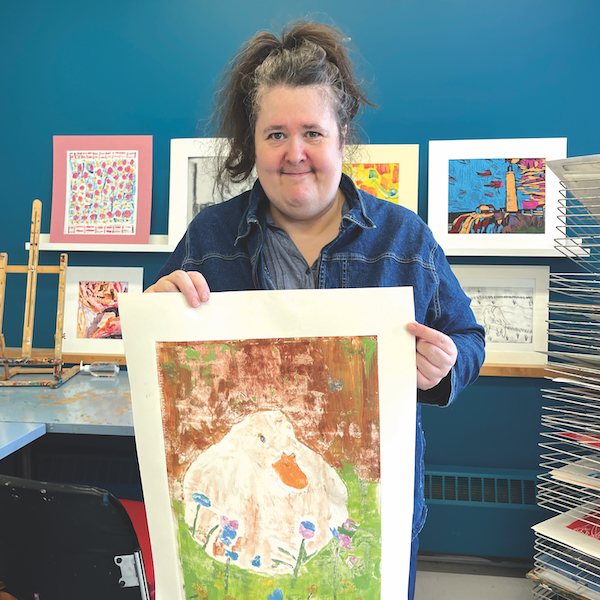
Shantel Timmerman
What inspires you to make art?
It just helps me with my mental health.
Anything more you want to say?
It makes me proud when people like my stuff and say that I’m a really good artist.
What type of art do you do?
I do monoprints. You paint on Plexiglas and then it transfers onto a canvas.
You’re also a writer.
I write poems most often, but I did the book for [Aaron and Boyd] and I enjoyed it.
For people who won’t be able to visit the Wavy Dimension exhibition, can you describe what they would see?
It’s a world that isn’t harmed by people. Animals tend to it with the keeper of the Wavy Dimension.
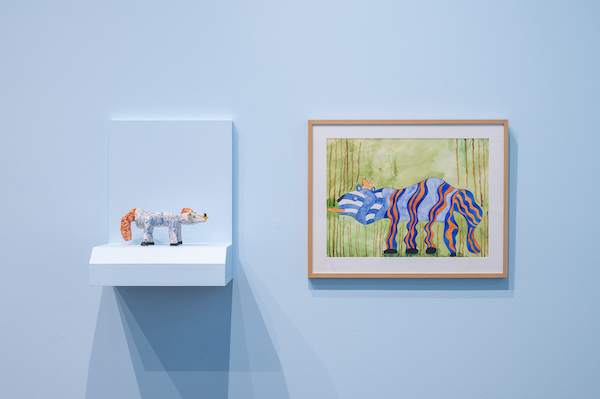
(left to right) Boyd Dymchuk, Donkey, 2023, ceramic; Aaron Harvey, Donkey, 2023, watercolour on paper (photo: Charles Cousins, courtesy of the Art Gallery of Alberta)
How would you just visually describe what’s in there?
A bunch of animals that are united together, even though there are some meat eaters. There are vegetarians, there are people, there are multiple things, but they all live harmoniously together.
What has the response to the exhibition been like?
They’ve had hundreds of people come and see it, and they’ve just loved it.
Has anyone you know said anything to you about it?
My mom said this was the proudest moment for her. Friends and family said they couldn’t believe that this was the timid girl who didn’t want to do anything and now has done an art show with a book.
Can you explain some more about your involvement in the exhibition?
I was approached by an organization called the Nina Haggerty Centre for the Arts, and they asked me to write a book about two artists named Boyd Dymchuck and Aaron Harvey. I started asking questions to see what they wanted out of the book. I went to the curator and talked to her. And I wrote about their exhibition at the Art Gallery of Alberta. It took me two months to write the book. It’s been on display since June.
How did you work with Aaron and Boyd?
I got their points of views and asked what they liked about their art. I found out the colors they wanted for their animals. I also collaborated with them by showing them the book before it was ever edited and asked them if I was allowed to change names and stuff like that. I just got to bond with them and get to know who they were, so then I could put it in the book. It describes not just the art, but the artists.
Can you just summarize what you wrote?
It’s a 1970s disco party with Boyd and Aaron intermingled with their art as they progress through the world of wavy dimensions.
What’s the Nina like? What happens there? And how does it support artists?
It’s like a fun party at all times. You get to do your art, you get to see your friends, and you get to know other people and not just be by yourself. My mom keeps telling me I’m the first artist in the family other than my grandparents. My mom and my brother did art, but they never sold anything. They said that this is an outlet for me to be able to say I have a disability, I’m proud of it, and I can actually put my art somewhere.
Why do you think it’s important for galleries like the Art Gallery of Alberta to support artists with developmental disabilities.
You don’t really see lots of people with disabilities having a position or a place in everyday life. We are very marginalized people. People just push us to the wayside and don’t think we’re really good at things. But we are, and it’s for us to say, “Yes, we can do that.”
What can galleries do to make themselves more accessible for artists with developmental disabilities?
Give people the acceptance that they need. Just accept us in life and in our art and in the ways that we do things.
What does being accepted in a gallery look like for you?
My art being displayed.