Valentin Noujaïm & Carl Trahan at VOX, Montreal
By Liam O’Brien
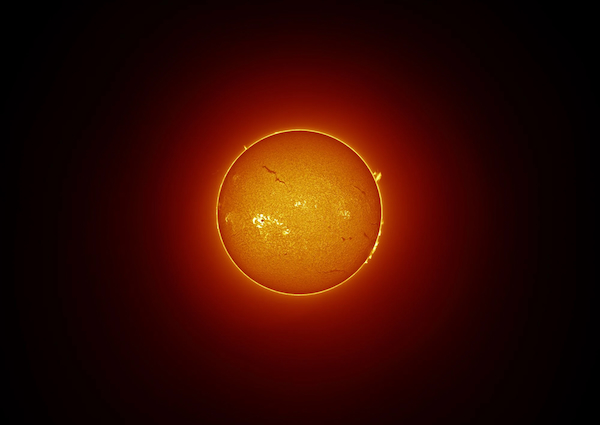
Carl Trahan, What is a Shadow That It Must be Captured?, 2026, photograph of the sun by Michel Brousseau
As my rideshare leaving Montreal sped towards the exit of the Ville Marie tunnel, the underground artificial light gave way to a burst of sun, which reminded me of the visual overlap between the double-header exhibition I had come to town to see. Valentin Noujaïm’s Out of Time and Carl Trahan’s What Is a Shadow That It Must Be Captured?, running concurrently at VOX until November 28th, both end with a doomed explosion of the sun via different subjects of inquiry: the former through a Parisian financial district, the latter through a photograph.
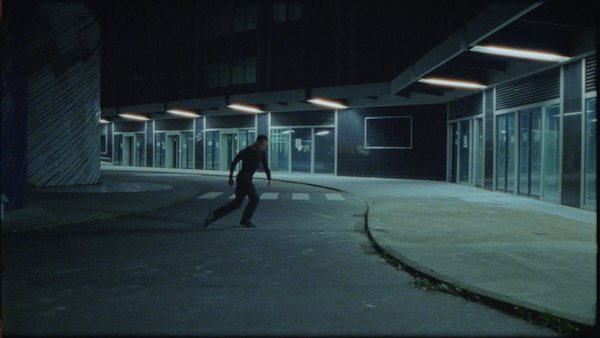
Valentin Noujaïm, Pacific Club, 2023, video
Noujaïm’s half comprises three videos: Pacific Club (2023), To Exist Under Permanent Suspicion (2024), and Demons to Diamonds (2025). The first (and most linear of the bunch) is a documentary-hybrid about the shuttered Pacific Club, razed in the development of La Défense, a financial hub that has been gentrifying the western bookend of Paris’s Axe historique since 1958. The area grew taller over the sixties, seventies, and eighties, and was given a new identity with Johan Otto von Sprekelsen’s Grand Arche, a supersized modernist take on a triumphal arch commissioned by François Mitterand and completed in 1989. Memories of the nightclub’s brief life are narrated by Azedine, a patron who reminisces on the joys of a space for Arab and Black Parisians amidst the sorrows of the heroin and AIDS crises that ravaged Paris’s outer boroughs at the time. Noujaïm’s aesthetic fascination with La Défense is as evident as his social one. His camera lingers with a stalker-like curiosity on the glass facades of skyscrapers, as if waiting for them to answer for their crimes.
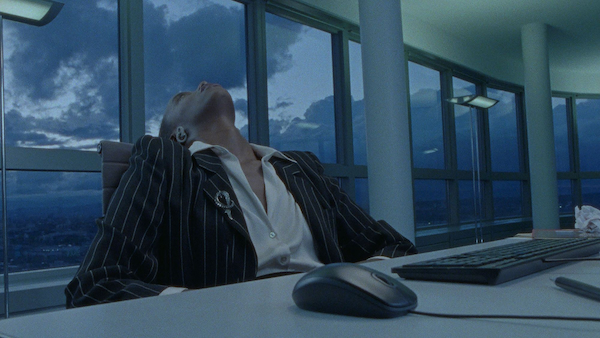
Valentin Noujaïm, To Exist Under Permanent Suspicion, 2024, video
To Exist Under Permanent Suspicion veers from documentary to horror as it tells the story of a young Black architect designing a luxury residential building in the district, who, after her architectural model slips off the screen and into her mouth, becomes possessed by the design’s energies of gentrification and global capitalism. In a final aerial shot, we see the “Atlantic Tower” burning – the name is seemingly an inversion of the subterranean Pacific Club that it may have been built atop, and a reference to the horrors of the Middle Passage that France’s modern economy was founded on.
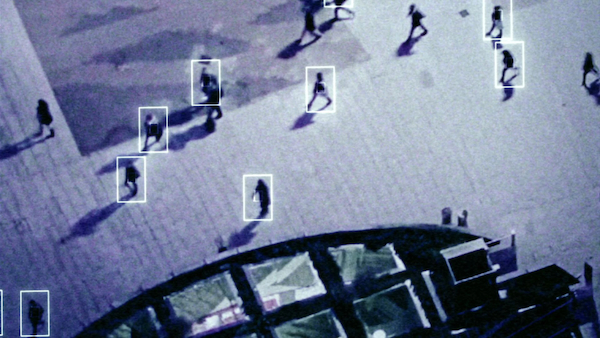
Valentin Noujaïm, Demons to Diamonds, 2025, video
These cathartic fantasies of demolition are developed in Demons to Diamonds, which follows multiple storylines around the district amid a supernatural suicide crisis where every day someone jumps off the Grand Arche to their death at 6:59 PM. The film’s most memorable segment is voiced by the actor Denis Levant while he writhes in a tangle of black cables, channeling his Quasimodo-ness from that other urban French fantasia, Les Amants de Pont Neuf (1991). When an orange sun explodes at the climax and destroys the district, I realized it was the first warm colour I had seen in the past hour of video. And when a flutist plays to citizens sitting amongst the rubble while the credits roll, it suggests collapse as inevitable for La Défense. The fatalism of this finale is fitting for these doomerist times, but I found a throwaway scene towards the middle of the film a more exciting proposition. Two teenagers sit on a bench in a grim plaza. The girl says she doesn’t understand why the boy likes it here. He replies, “It’s a cool escape from Paris.” When they share a kiss, you are reminded that the district itself is ripe for reclamation.
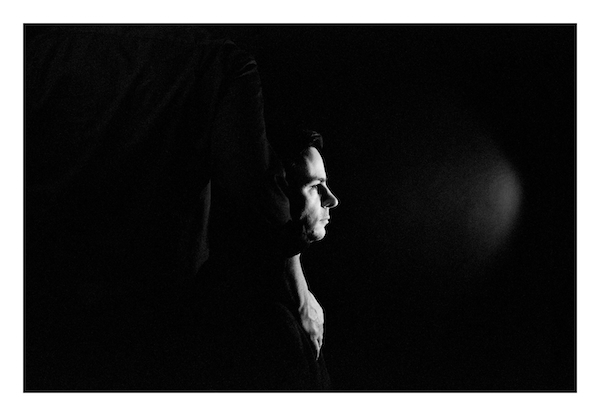
Carl Trahan, Guillaume – face à la lumière avec ma main sur son thorax, 2026, inkjet print on Canson paper
As I wandered from Noujaïm’s section into Trahan’s room, I wondered about the pairing of the two artists. Trahan’s conceptual approach across drawing, photography, and sculpture did not seem to suit Noujaïm’s urban inquiries. His interest in light and darkness has been a recurring theme in several of his exhibitions over the last few years. At VOX, he employs old and new techniques for his investigation into shadows. The bulk of the wallspace is occupied by black and white photographs printed by inkjet on thick paper. The subjects of the photos are manipulated by light in various ways, such as shadows blocking parts of their bodies or double exposures obscuring their faces. The graininess of the photos and the dimples in the paper make them appear like drawings, complimenting Trahan’s poems written in graphite on gray paper placed higher on the wall. They shine in the gallery light, forcing viewers to shift positions to read them all. The short, tightly kerned phrases – such as, La réalité est tirée des surfaces visibles frappées par le soleil / Reality is taken from visible surfaces hit by the sun – act as cautionary warnings to remind viewers what we are seeing may not be what it seems.
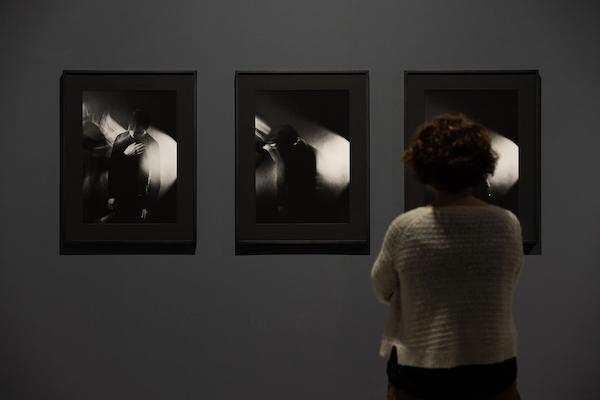
Carl Trahan, What Is a Shadow That It Must Be Captured?, 2026, installation view
On the morning of my visit, the only other people in the gallery were employees staging photos for promotional material. As VOX staff posed in front of the art, pretending to be lost in observation, I dodged their camera and stood before the final work near the exit. A display case holding delicate paper casts of hands and feet sat before a small colour image of the sun. As I looked down upon the coldly lit appendages, a line from Trahan’s video piece comparing photography to “an instantaneous meteorological catastrophe” called to mind the ghostly plaster casts of Pompeii’s citizens frozen in solidified pyroclastic flow. In the 1860s, Italian archeologist Giuseppe Fiorelli developed the technique of pouring plaster into the underground cavities left by decomposed bodies. To see those casts today is to see the last position of a person in their final moments 1,947 years ago. Many have been given names coined from their position and grouping, most famously, “Two Maidens”. DNA analysis from 2024 challenged many of the assumptions about the casts, when the maidens turned out to be men and families turned out to be unrelated. Romantic projections from the present, based on our ideas of family and partnership, are imposed backwards through time on the plaster. Like the casts, like the photographs, the drawings, and the videos, like the gallery attendants, no trace can be trusted.
Valentin Noujaïm: Out of Time continues until November 28.
Carl Trahan: What Is a Shadow That It Must Be Captured? continues until November 28.
VOX: https://centrevox.ca/en
The gallery is accessible.
Liam O’Brien is a writer living in Ottawa.