The Lost Paintings at articule and MAI, Montreal
By oualie frost
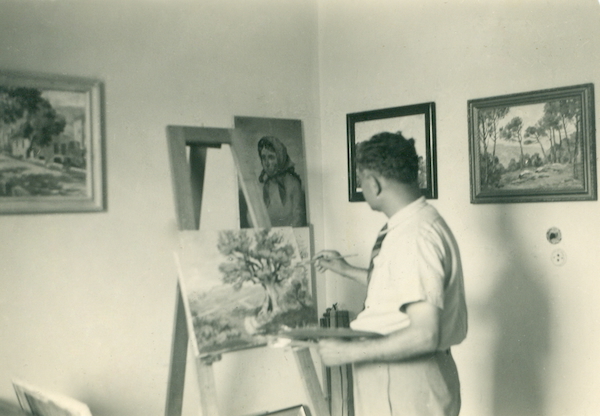
Maroun Tomb (courtesy of the Fouad and May Tomb Foundation for the Arts)
The Lost Paintings: a Prelude to Return, curated by Rula Khoury, Joëlle Tomb, and Haidi Motola, is a multidisciplinary exhibition that is so large it had to be hosted by two galleries—MAI and articule. Consisting of fifty-three artists from across Palestine and its diaspora, the exhibition aims to reimagine and respond to missing works from a 1947 exhibition by Palestinian-Lebanese artist Maroun Tomb that was lost in the destruction of the Nakba. According to the exhibition text, “loss is neither resolved nor concealed but held, examined and reimagined.”
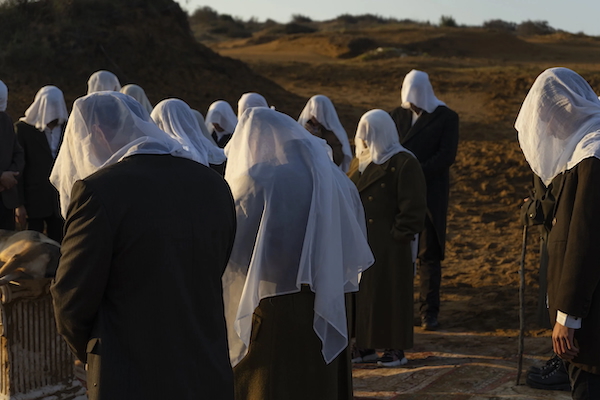
Yara Kassem Mahajena, Dog’s Funeral, 2021, video
Crowded with works on every possible surface, the display MAI is more reminiscent of a museum than an art gallery. The works range in age over decades, and viewers can experience everything from sculpture to painting to virtual reality. Some of the artists focus on Palestinian life or the beauty of the land and culture—what is at threat of being lost—while others speak to the suffering and tragedy experienced since the original Nakba. Yara Kassem Mahajena’s Dog’s Funeral stages the mourning of a dog who, as told from passed-down family stories, refused to leave the family’s village in 1948 and thus became a symbol of resistance against exile. Meanwhile, Lorena Tomb’s pastel work Two Kids draws inspiration from her grandfather Maroun’s surviving works to imagine what could have been witnessed in Palestine before the beginning of its devastation. Through her attempt to reimagine lost works from the parts that remain, Tomb creates an image of what once was and what’s been lost.
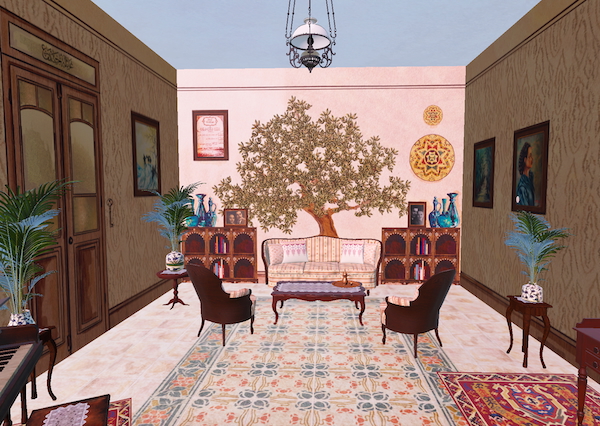
Mado Kelleyan, Stories from my Grandmother’s House, 2024, VR video
Suleiman Mansour’s Native Quarter is, at first glance, a simple watercolour painting showcasing traditional Palestinian architecture. However, it becomes a powerful motif of resistance and claim to one’s land when you learn that the artist was known for rejecting Israeli art supplies in favor of pigments found in and more representative of Palestinian culture and life. At the other end of the technological spectrum, Stories from my Grandmother’s House by Mado Kelleyan is a mix of video and VR that documents the discovery of the extensive history of her Christian family in Haifa. The work speaks of wanting to go there to experience her “heritage as if it was a memory,” but showcases the difficulty of doing that by super-imposing images of Palestine’s past and occupied present from Google Streetview. The artist resorts to using the internet to try to see inside significant locations, and she reconstructs the past through photos and family history. Technology plays a further role through virtual reality, which allows the viewer to be present in both the past and future.
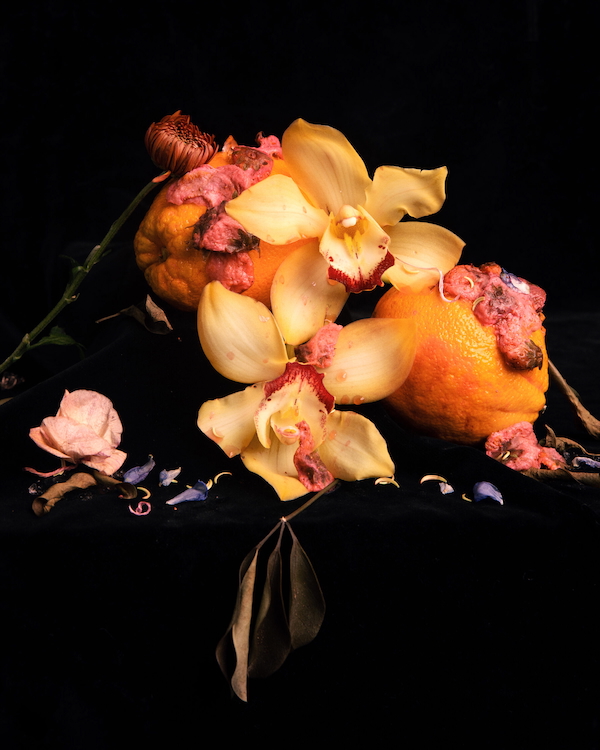
Nora Sayyad, Utopia, 2023, photograph
articule’s part of the exhibition opens with two pieces in their window vitrine before opening into an equally crowded space that seems generally more object and landscape-focused than MAI. Taking inspiration from one of Maroun Tomb’s work titled Still Life, Nora Sayyad’s Utopia uses rotting fruit and flowers to evoke a sense of marred flesh and the loss resulting from colonial violence. Often described as “steadfast” and “resilient,” cacti feature in multiple works including Fouad Tomb’s The Garden and Ola Alkernawi’s Tree of Patience. As the exhibition text explains, “the cactus [symbolizes] strength and the ability to persist through harsh conditions.”
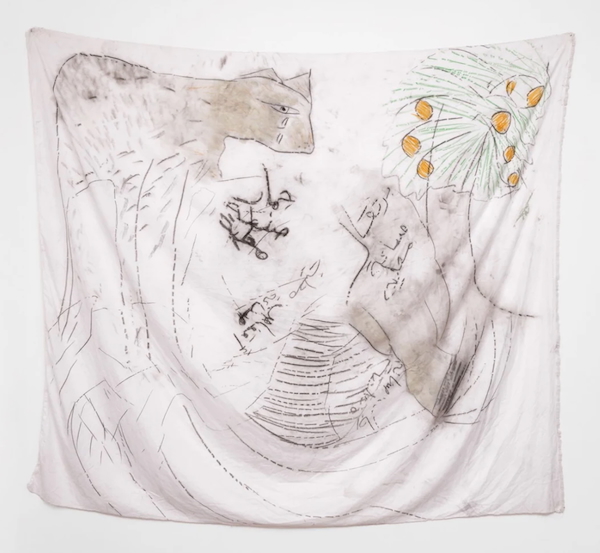
Aysha E Arar, Homemade Donkey, Homemade Oranges and Homemade Cages, What Else?, 2023, charcoal, ballpoint pen, and pastel on kaftan
Simply the titles of multiple works in the exhibition are evocative as well, especially Aysha E Arar’s Homemade Donkey, Homemade Oranges and Homemade Cages, What Else? and Aya Abu Hawash’s Haifa, what a burn left behind? The former is a drawing made on a burial shroud that highlights not just what’s been lost, but also what is left behind.
Overwhelmed by all the art that I witnessed, I am not sure I left with a sense of what Maroun Tomb’s original exhibition would be. The works included in this ambitious and compelling exhibition are responses to what has been lost to imperialist destruction rather than direct recreations of an artist’s past. I doubt that the latter would even be possible, given the immense changes in context since Tomb’s exhibition was destroyed. Regardless, these interpretations are beautiful and clearly of the moment—a moment that has been occurring not just since October 7th 2023, but for decades ongoing. Beyond a simple reminder of what has been lost, The Lost Paintings serves as a love letter to Palestine and a reminder of what could be again.
The Lost Paintings: a Prelude to Return continues until October 4
articule: www.articule.org/en/home
MAI: m-a-i.qc.ca/en
Both galleries are accessible.
oualie frost is a casual artist, writer, and activist currently based in Tiohti:áke/Mooniyang (Montréal) whose writing centers primarily around the art and experiences of Black, mixed-Black, and other racialized people, as well as loose cultural critique. They are a former founding member of the Afros in the City media collective, with writing published on various platforms, including Akimblog, the Rozsa Foundation, and Canadian Art.