Summer Group Exhibitions at MKG127, Olga Korper, Daniel Faria, and Clint Roenisch, Toronto
By Terence Dick
A good group exhibition is like a successful dinner party. There will be familiar faces, but there should also be new people to keep things fresh. You don’t want too much agreement amongst the guests, but they should all share a vibe. It helps if there isn’t one guest of honour who puts everyone else in their shadow, but superstars inevitably stand out. Then again, over the course of an evening, you should make time for each person there; if your host has done their job well, every conversation will be scintillating and leave you wanting to know more (unless they’re a complete bore) about the person you’ve just talked to. August has become the month to host one of these get-togethers for many commercial galleries across the city. It’s a low stakes opportunity to mix things up, bring new artists or curators into the fold, check in with old friends, and clear the way for the main event (generally a high profile solo exhibition) in September. I recently crashed four such parties at MKG127, Olga Korper Gallery, Daniel Faria Gallery, and Clint Roenisch Gallery.
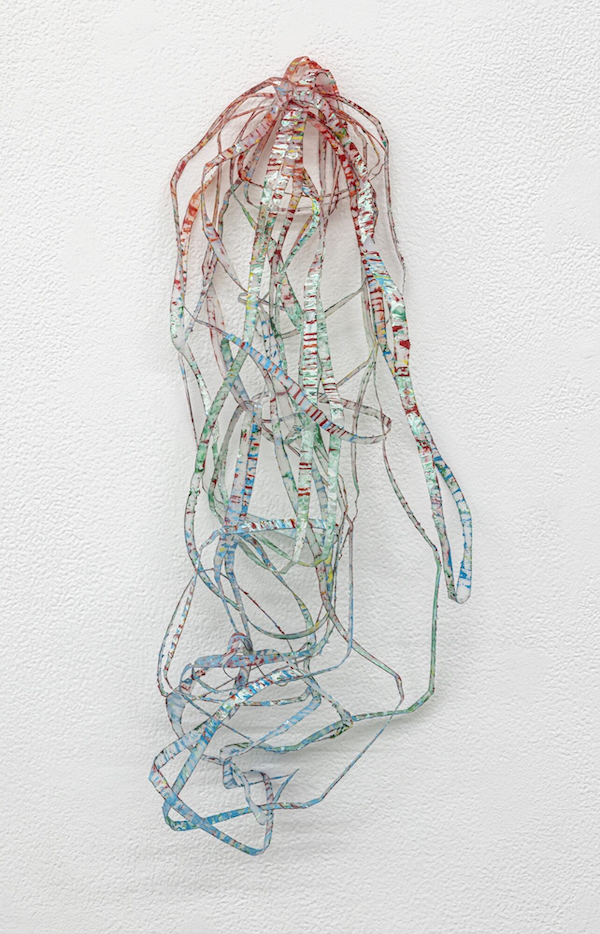
Kai Chan, Bonny, 2020, plastic (yogurt container), oil paint
Re-make/Re-model at MKG127 is an example of a specific kind of dinner gathering: the theme party. It might get its title from a Roxy Music song, but the prescribed aesthetic is less glam and more punk rock (and, yes, I know one influenced the other). Each artist has relied on recovered detritus (hence the title) to craft their work, giving the overall effect of a junk store with particularly creative employees. There is something liberating about this kind of art practice because it does away with refined materials and often plays down schooled technique in favour of a democratic process governed by the familiar directive to just do it (which, before it become the tag line for a corporate monolith of running shoes was an invitation to seize the means of production). That said, some people are better than others at doing it. Liam Crockard uses scrap wood to make objects that lean perhaps too far into the realm of the functional to have their artistry recognized. Josh Callaghan avoids this by incorporating the stylistic variety of discarded sneaks. Jason Lujan repurposes art-related items (such as a Rothko Chapel postcard) for a clearer comment on culture, while Laura Kikauka adds her usual sense of whimsy to her familiar thrift store painting interventions. The highlight though is Kai Chan’s formless, wall-hung sculptures of carefully cut plastic containers that seem to have been double recycled – from food holders to paint receptacles to art objects. Their delicacy stopped me cold.
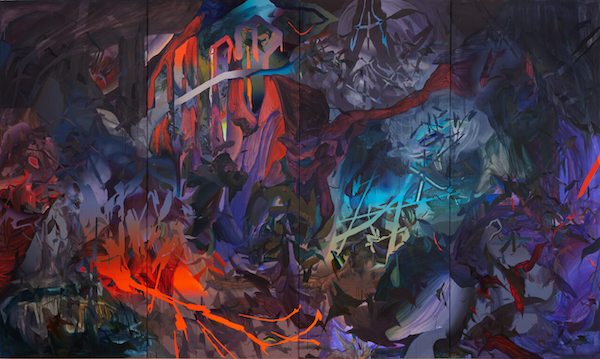
Sarah Tompkins, Now the air is so filled with ghosts / that no one knows how to escape them, 2023, mixed media on canvas
At the other end of the curatorial spectrum is Olga Korper’s straightforwardly titled Summer Group Show that relies for the most part on their stable of artists, but does make space for some special guests. The gallery has developed a sub-category of in-house talent that gravitate to OCD-like processes in their work, which inevitably sets a tone for this collection. Ken Nicol and Kelly Mark are the elders of this kind of thing, but Meaghan Hyckie’s intriguing pencil crayon tessellations and Matt Donovan’s crowd-pleasing Lego constructions also reflect hours of relentless, finicky labour. You could even throw in Luca Soldovieri’s work with household dust and Katherine Curci’s photorealistic depictions of rippling water in charcoal. The big star of the show, however, forgoes her fellows’ obsession with order and goes huge with an explosion of painterly abstraction that elicits parallels to such chaotic elemental forces as molten rock or celestial bodies. Sarah Tompkins’ gigantic Now the air is so filled with ghosts / that no one knows how to escape them fills the gallery’s back wall and makes me want to return with a deck chair so I can sit and gaze at its depths for hours. This might be rude to the other guests, but sometimes the reason for you being where you are is undeniable.
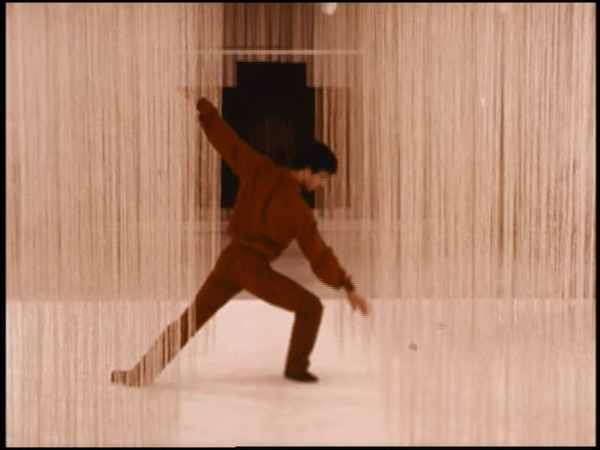
Robyn Brentano and Andrew Horn, Cloud Dance, 1980, 16mm film transferred to video (choreography by Andy De Groat; sculpture by Lenore Tawney; music by Michael Galasso; poetry by Christopher Knowles; reading by Arby Ovanessian)
In Concert at Daniel Faria and curated by Madeleine Taurins is like one of those parties where only couples are invited. The theme is collaboration and the featured artists work, for the most part, in pairs. Some ongoing relationships are clearly declared like the interwoven names of HaeAhn Paul Kwon Kajander and the artistic duo Leisure made up of Meredith Carruthers and Susannah Wesley. Robin Cameron and G. William Webb have been married for a while, but only began to work together recently. Their assemblage Monument to Reproduction makes a verbal as well as a material pun on their shared creation of their child. Claire Greenshaw includes her offspring more directly (as well as some grad students from York University) in the erasure of her landscape drawings. Jenni Crain’s work speaks to the absence of one collaborator: her Minimalist wooden box and frame is missing the musical sculpture by the late Harry Bertoia, which it was made to hold. Lastly, two videos rely on dance as central to collaboration. Katie Lyle and Shelby Wright’s documentation of a performance hints at the coordination of their choreography, but the structure around which they move often obscures their bodies. This is admittedly the point, but it’s lovely to see the unobstructed dance in Robyn Brentano and Andrew Horn’s far more conventional film from 1980 that involves further collaboration with the sculptor Lenore Tawney, composer Michael Galasso, poet Christopher Knowles, and speaker Arby Ovanessian.
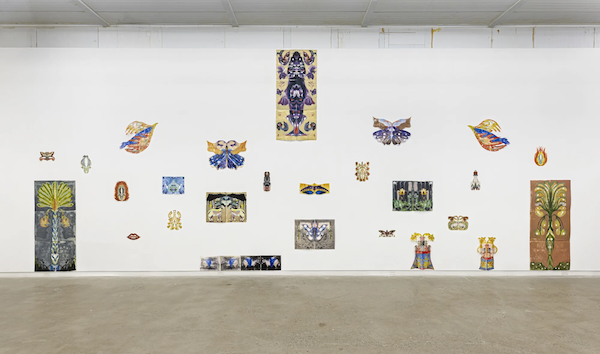
Amanda Boulos, As Far As The Eye Can See, 2023-2024, mixed media on folded papers
Hope Dies Last is the second summer group exhibition at Clint Roenisch following Crossings in June. Clint’s curation is always surprising, especially as he has increasingly brought in work by late, under-recognized artists who open up the past through their sympathetic resonances with the living artists at the gallery. Joseph E. Yoakum’s coloured pencil and ballpoint pen landscape drawings were made in the late 1960s when the American artist was in his seventies. Their clear-eyed depictions of the beauty of monumental rock formations capture the optimism that underlies the curatorial theme of the exhibition. Ali Eyal’s colourful drawings of plants proliferate across a field of repurposed manilla envelopes that cover one wall. Opposite, Amanda Boulos has mounted a joyous collection of work made largely from folding paper over on itself. Her delight in the symmetry of nature and the beauty of colour feels like it comes from a different place and time, but has arrived at just the right moment. Kristan Horton’s large work on paper at the rear of the gallery is harder to love; he’s the guest that requires some more work to pull into the proceedings, but his reputation precedes him.
This is just a taste of the parties in process around the city this month. If you’re looking for more, I’d direct you to the exploration of residue and absences in Wine on the Cuff, Dirt on the Collar at Zalucky Contemporary, the Samuel R. Delaney-inspired Of Doubts and Dreams at Cooper Cole, and the Pride celebration/Will Munro tribute that is Standing Ground III, Mighty and Real at Paul Petro Contemporary Art.
Re-make/Re-model at MKG127 continues until August 17.
Summer Group Exhibition at Olga Korper Gallery continues until August 17.
In Concert at Daniel Faria Gallery continues until August 24.
Hope Dies Last at Clint Roenisch Gallery continues until August 31.
All the galleries are accessible.
Terence Dick is a freelance writer living in Toronto. He is the editor of Akimblog.