Star Witnesses at The Polygon Gallery, North Vancouver
By Ogheneofegor Obuwoma
The Polygon’s summer group exhibition Star Witnesses features eight artists and one collective who use the cosmos as a framework to address social, political, and quotidian issues from both historical and contemporary periods. Charting a celestial network across geography, time, and lineage, works by Daniel Boyd, Vija Celmins, David Horvitz, Bouchra Khalili, Judy Radul, Thomas Ruff, Carrie Mae Weems, Urban Subjects (Sabine Bitter, Jeff Derksen, and Helmut Weber), and Paul Wong follow the stars as a cultural guide to examine society and outer space while raising lines of inquiry on what the heavens might reveal about our time on Earth.
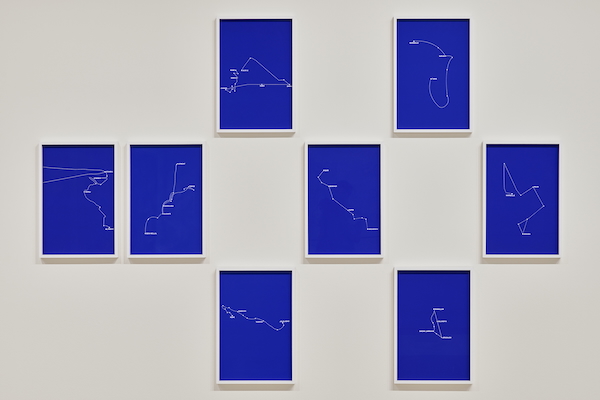
Bouchra Khalili, The Constellations Series, 2011, installation view (photo: Marco Zorzanello; courtesy of the artist and la Biennale di Venezia)
At the gallery’s entrance, Carrie Mae Weems’s The North Star (2022), inspired by her grandfather’s escape from a racist mob in the American South of the Jim Crow era, establishes this fixed point in the night sky as guide, assurance, and companion. This use of celestial observation provides a resonant and necessary political dimension to the exhibition by offering an expansive understanding of witnessing and its conceptualization. Bouchra Khalili’s The Constellation Series (2011) also looks to the past as it traces the journeys of eight immigrants. In Khalili’s work, the places from which her subjects have been displaced and their subsequent journeys are represented on a map that tracks their movements, creating constellations that describe the common migration routes of the region and the intricate commonalities of the migrant experience. The artist holds their stories within these anonymous charts that challenge contemporary migration myths by contrasting them to the documented realities.
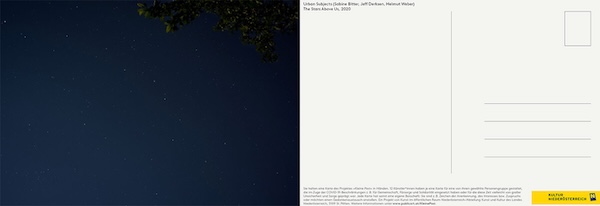
Urban Subjects, The Stars Above Us, 2020, postcard
The artist collective Urban Subjects contributes a newly assembled framed archive of their project The Stars Above Us (2020) featuring a postcard with an image of the sky above an immigrant camp, along with other ephemera from the project. The postcard, which came with a prepaid stamp, was distributed to those in the camp to allow them to send messages to displaced loved ones. In this, the collective uses the vast, endless, and transformative expanse of the sky as a metaphor for hope and means for connection that spans lifetimes and regions. David Horvitz’s For Kiyoko (2017) uses an image of the night sky in a similar way to these postcards. The stars that Horvitz photographed are a portal to his grandmother who was confined to a Japanese-American internment camp during World War II under the same Eastern Colorado skies. His image and the words that accompany it forge a connection between the human and celestial by implying the stars witness us as we witness them.
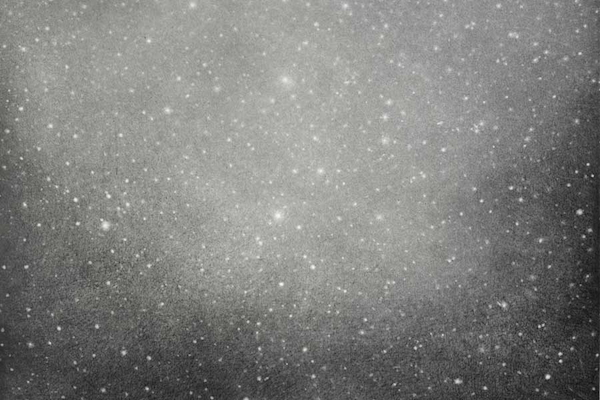
Vija Celmins, Night Sky 3, 2002 (collection of Andy Sylvester)
Vija Celmins’ Comet (1991) and Night Sky 3 (2002) depict the night sky in a style that resembles a photograph. They raise questions about what defines our perceptions of the sky. What do these processes of reciprocal observation hold? Like many of the other works in Star Witnesses, these prints present an unflinching observation of the stars as intrinsic to the exhibition’s themes. Paul Wong’s work is skillfully displayed across multiple locations in the gallery. Parallel Universes (2025) features two small geometric, star-like wooden objects enclosed in a display case that bring us closer to the material and mechanics of outer space travel. The most recent of his works in the exhibition, it emerges from his residency at the AHVA department at UBC. His other works in the exhibition also directly address the stars through film and photography, drawing links between daily life and our relationship with time and the changing cosmos.
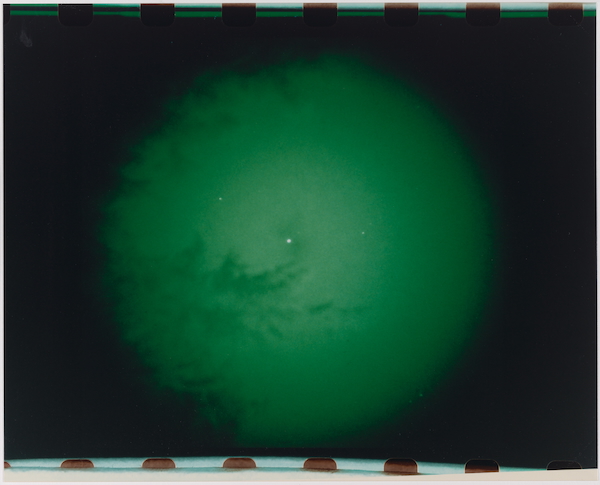
Thomas Ruff, Nacht 12 III, 1992 (courtesy: San Francisco Museum of Modern Art)
German photographer Thomas Ruff is prominently featured in the exhibition because his longstanding fascination with astronomy has led him to reinterpret celestial images, altering or reframing them to consider our perception of photographic images. Employing celestial coordinates, 3D techniques, and a thorough understanding of stars, Ruff stills the images of celestial bodies to allow for detailed examinations. The two moon jars included in the exhibition add an interesting dimension and abstraction to the consideration of the stars. The porcelain one by Park Soo-Jae and the ceramic one attributed to a now unknown artist become symbolic of Korean liberatory hopes. The vessel transitions from a style that gained popularity during the Joseon Dynasty to a symbol of hope for Korean reunification. The stars and their potential might be at work in this ongoing process of witnessing across time.
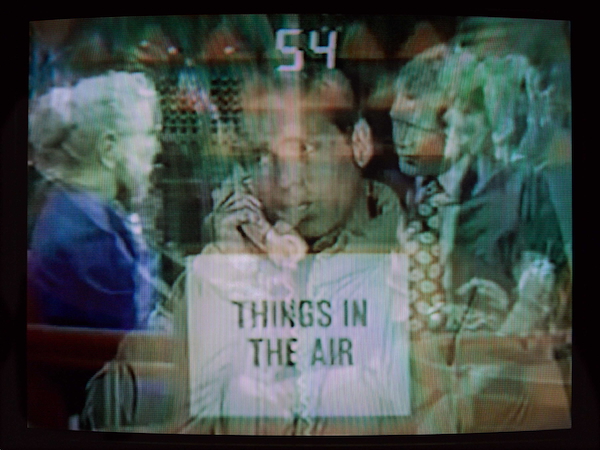
Judy Radul, THIS IS TELEVISION, 2013, video installation (courtesy: Catriona Jeffries, Vancouver)
Positioned in a room on its own, Judy Radul’s installation THIS IS TELEVISION (2013 & 2018) connects us to the human preoccupation with the stars, the moon landing, and telescopic observation. It explores the relationship between observation, broadcasting, and the seemingly cross-cultural fascination of humans engaging with outer space. In the final room of the exhibition, Daniel Boyd’s video installation History is Made at Night (2014) abstracts the night sky into impossibly colourful stars dancing across the screen that turn our compass upon its head – eager to disrupt the Western understanding of time and our situatedness within it.
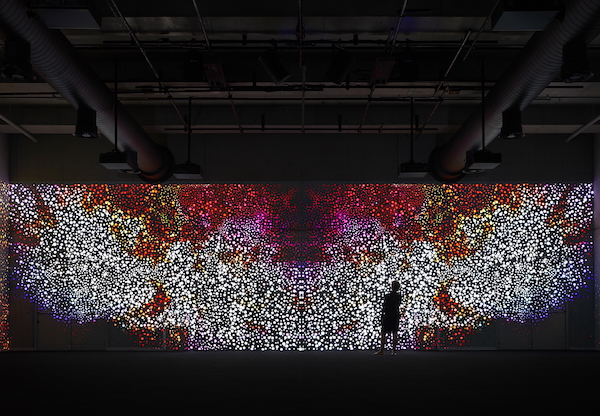
Daniel Boyd, History is Made at Night, 2013, installation view (photo: Zan Wimberley; courtesy of the artist, Carriageworks, and Roslyn Oxley9 Gallery, Sydney)
That we look to the cosmos to explain our place on Earth is no surprise in our unpredictable and ever-expanding universe. Star Witnesses invites the stars as praxis, a location from which we form thought, and a position to engage in art-making, through which history and the future unfold, even as we continue to find new ways to observe and engage.
Star Witnesses continues until September 28.
The Polygon Gallery: https://thepolygon.ca/
The gallery is accessible.
Ogheneofegor Obuwoma is a Nigerian filmmaker, storyteller, and artist with a BFA in film and communications from Simon Fraser University. Her work explores “the personal” in relationship to her larger community and the cultural experience of being Nigerian. She is interested in African futurism and the ways we access the spirit.