Sean Lee on Crip Canada in the UK
A video tour of Crip Canada: A Decade of Political Engagement, Canada Galery at Canada House, London, 2026 (video courtest of Tangled Art + Disability)
On February 20 of this year, Tangled Art + Disability opened Crip Canada: A Decade of Political Engagement at Canada House in London, presented in partnership with the High Commission of Canada in the United Kingdom. Marking the tenth anniversary of Tangled Art Gallery’s founding, the exhibition was the gallery’s first international presentation.
The title Crip Canada holds a productive tension. As disability scholar Kelly Fritsch writes, “to crip is to open with desire for the ways that disability disrupts.” To crip not only art but Canada posed the challenge of representing a decade-long disability arts ecology while telling a world-building story shaped by the artists Tangled has worked alongside. While the title names a national context, it also gestures toward the colonial structures through which disability has been historically produced and managed in this country. Seven artists formed the constellation through which this imperfect story could be told: Persimmon Blackbridge, Peter Owusu-Ansah, Vanessa Dion Fletcher, Michel Dumont, David Bobier (VibraFusionLab), Olivia Brouwer, and Alexander Stuber from BEING Studio. Working across tactile sculpture, vibrotactile installation, performance documentation, Braille painting, and mosaic, their practices reflect disability arts not simply as representation, but as a generative aesthetic and political force.
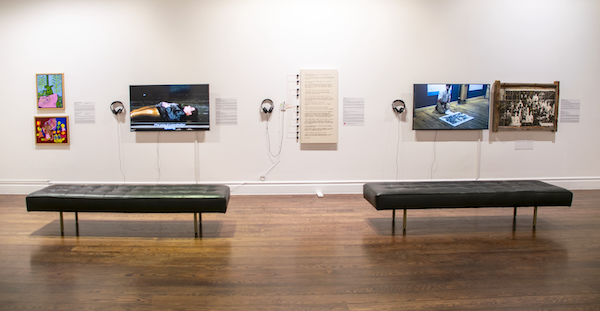
Installation view of Crip Canada: A Decade of Political Engagement, Canada Gallery at Canada House, London, 2026
Rather than a retrospective, the exhibition functions as a snapshot of an evolving field. Many of the works were originally developed at Tangled’s gallery at 401 Richmond in Toronto, where accessible curatorial practices have shaped exhibition-making from the beginning. Since opening as Canada’s first gallery dedicated to Deaf, Mad, and disabled artists, Tangled has operated as what founding Artistic Director Eliza Chandler described as “a site of political engagement,” where accessibility is inseparable from artistic innovation. In Crip Canada, access appeared not as accommodation layered onto exhibitions, but as a cultural practice shaping how artworks are produced and encountered – an approach aligned with Amanda Cachia’s concept of “creative access.”
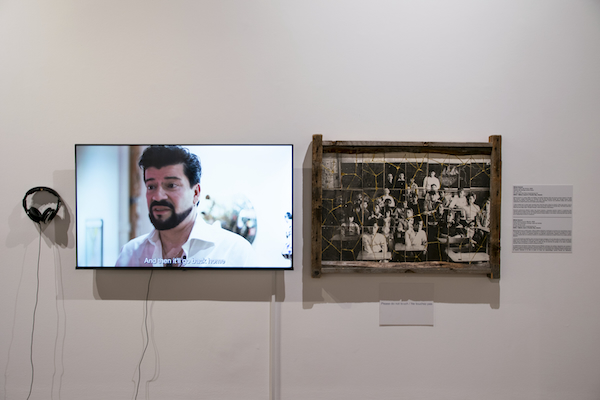
Michel Dumont, Mission Indian Day School, 2020, installation view, Canada Gallery at Canada House, London, 2026
The curatorial challenge was not simply how to select representative artists, but how to compress ten years of disability-led exhibition-making into a single exhibition without flattening the relationships, experiments, and access practices that shaped them. As Canadian disability scholar Catherine Frazee reflects in her preface for Dispatches from Disabled Country, invoking the idea of country in disability culture does not claim territory in the colonial sense, but instead names a shared history, community, and body of knowledge formed through collective experience. In this way, Crip Canada gestures less toward national identity than toward overlapping disability cultures emerging within – and sometimes in resistance to – the structures of the Canadian state.
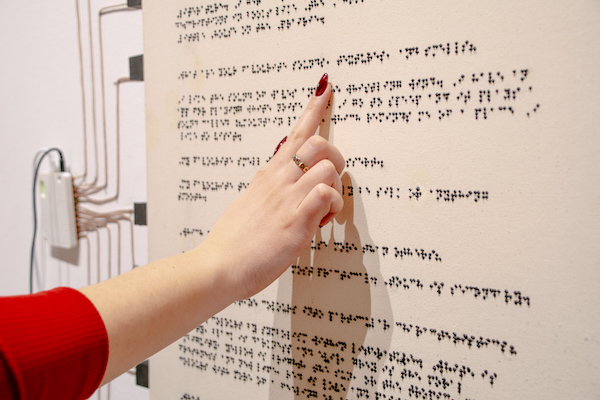
Olivia Brouwer, Soft-Spoken (a conversation with Eric Bourgeois), 2021, detail view (tactile interaction), Canada Gallery at Canada House, London, 2026
Across the exhibition, access operates as a framework for imagining cultural futures otherwise. David Bobier’s Opus of the Underworld, for example, translates underwater sound into vibration through responsive objects and a vibrotactile pillow, inviting audiences to experience sound physically rather than aurally. Olivia Brouwer’s Soft-Spoken shifts the hierarchy of the senses by presenting an interview transcript entirely in Braille alongside audio recordings activated by touch. Persimmon Blackbridge’s soft touch extends a decades-long exploration of tactile sculpture that helped establish touch as an aesthetic language within Tangled’s early exhibitions. Together, these works demonstrate how accessibility technologies can also function as artistic media.
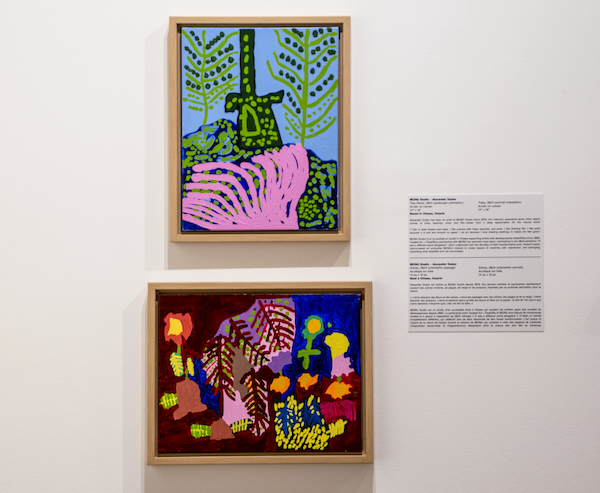
Alexander Stuber, Tree Plants and Trees, 2024, installation view, Canada Gallery at Canada House, London, 2026
These works also reflect disability arts as a collective practice shaped by community relationships. Alexander Stuber’s paintings from BEING Studio point to the importance of long-term accessible studio environments in supporting artists labelled with intellectual disabilities, while Peter Owusu-Ansah’s colour-based compositions foreground Deaf visual language as a mode of communication rather than translation.
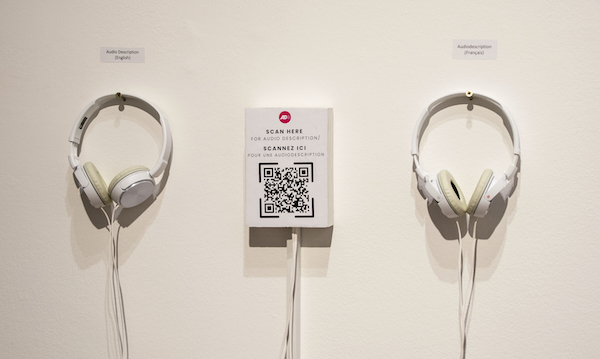
Audio Description station for Crip Canada: A Decade of Political Engagement, Canada Gallery at Canada House, London, 2026
Other works in the exhibition situate disability arts within the broader histories of colonialism that helped produce disability as a category in the first place. Vanessa Dion Fletcher’s Finding Language engages directly with the colonial structure of translation through a Delaware–English dictionary to expose how language regulates Indigenous and neurodiverse bodies at once. Michel Dumont’s Mission Indian Day School reconstructs a classroom photograph from his mother’s Indian Day School experience through shattered ceramic tiles repaired using kintsugi, transforming breakage into a material practice of remembrance and survivance. These works reflect a central tenet of disability arts conversations in Canada over the past decade: that ableism cannot be disentangled from settler colonialism, capitalism, anti-Black racism, and the ongoing production of debility through state structures.
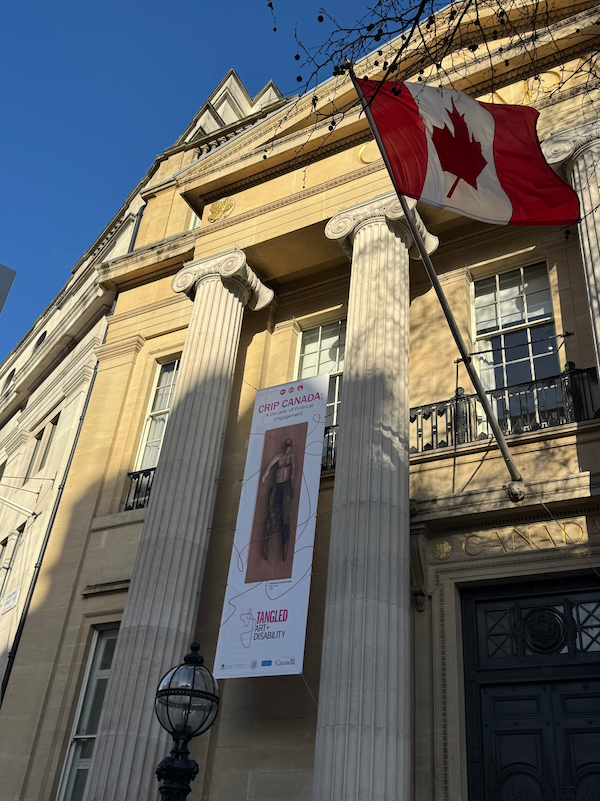
Banner for Crip Canada: A Decade of Political Engagement installed on the façade of Canada House, London, 2026
At Tangled, we have long worked toward disabled futures by orienting ourselves toward what we describe as a “crip horizon” – a politics of futurity indebted to José Esteban Muñoz’s writing on queer utopia and Alison Kafer’s call for crip futurity. Rather than a fixed destination, the crip horizon names an ongoing effort to imagine cultural institutions differently through disability knowledge, interdependence, and collective care.
In bringing Crip Canada to London, the exhibition extends that horizon outward. It offers not a definitive account of disability arts in Canada, but an invitation to encounter disability culture as an evolving field shaped by experimentation, access aesthetics, and interdependence.
Sean Lee (he/they) is the Director of Programming at Tangled Art + Disability. For over a decade, Sean has contributed to national and international conversations on disability arts, access aesthetics, and disability-led curatorial practice through exhibitions, public programming, teaching, and mentorship. At Tangled, he leads exhibition development, strategic partnerships, and institutional initiatives that position disability arts as a site of cultural innovation and civic engagement. He has also contributed writing to publications including Curating Access: Disability Art Activism and Creative Accommodation and Living Disability. He regularly advises artists, curators, and institutions on accessibility and disability-led cultural practice.