ROSEMARY Gallery
The Canadian art landscape is ever-changing. Places + Spaces keeps you informed of established and up-and-coming exhibition venues across the country including museums, galleries, artist-run centres, and more. This month, we hear from Jaimie Isaac and Suzanne Morrisette, co-directors and founders of ROSEMARY Gallery.
What is the history and mandate of your gallery?
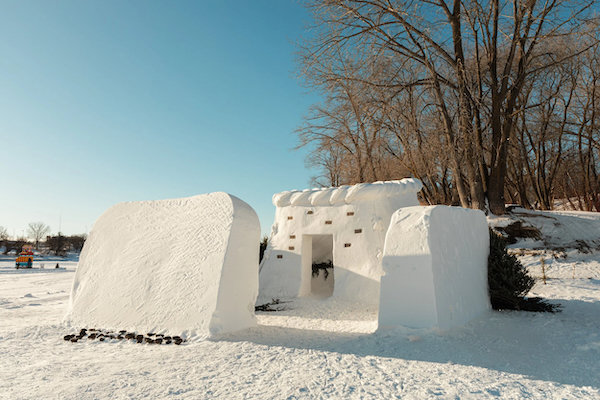
ROSEMARY Gallery, ROSEMARY SKOOL, 2025, site specific installation (photo: New Copper Photography)
SM & JI: ROSEMARY Gallery is a roving project that emerges from the belief that art is rooted in our relationships to others in our neighbourhoods, communities, and cities. The name ROSEMARY blends our Nana’s first names: the late Rose Morrissette (formerly, Richard), and Dr. Elder Mary Courchene. The gallery is named to recognize the strength and vision of matriarchal leadership in Indigenous communities. As Co-Directors, we operate ROSEMARY with a mandate to responsively engage in critical arts-based programs including exhibitions, performances, public discussions, community feasts, and celebrations.
What’s a highlight of the neighbourhood where your gallery is located?
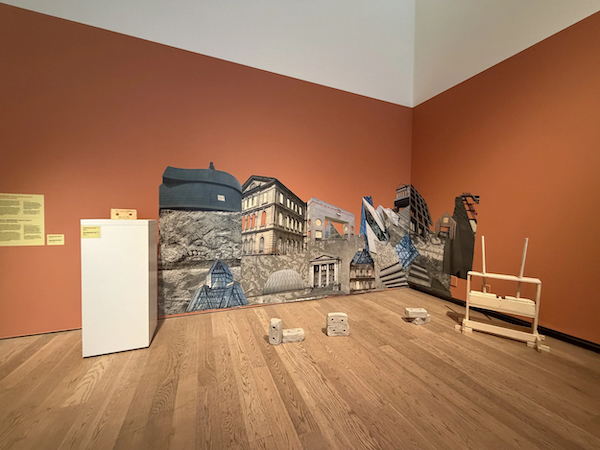
ROSEMARY Gallery, ROSEMARY SKOOL Brick Up, 2026, workshop
SM: We are not sited in any particular place, which is a fact that initially comes from the limitations of our funding streams. At the same time, we are interested in methods of being responsive to those who we represent – that requires us to be nimble in both our approaches as artists and curators, and in where we are located (and when). So far, we have existed in a retail space on Main St. in Winnipeg, the intersection of the frozen Red and Assiniboine Rivers, a museum in Toronto, and now at Platform Gallery. In part we are inserting ourselves into existing neighbourhoods and communities who we are in relation to in different ways. Other times we are looking to cultivate something that is more ephemeral or that responds to a need that doesn’t already exist.
JI: To build on that, we have partnered with galleries and universities to exhibit, maintaining a para-curatorial approach in programming to involve multivocal interdisciplinary inclusion with artists and communities. We’ve carved out artistic and/or curatorial projects either by design or by being invited into spaces that are interested in our questions and critiques about institutional experiences. Roving, migrational movement allows us to respond and be alert to significant social or cultural circumstances arising in our communities.
What’s your favourite part of running an art gallery?
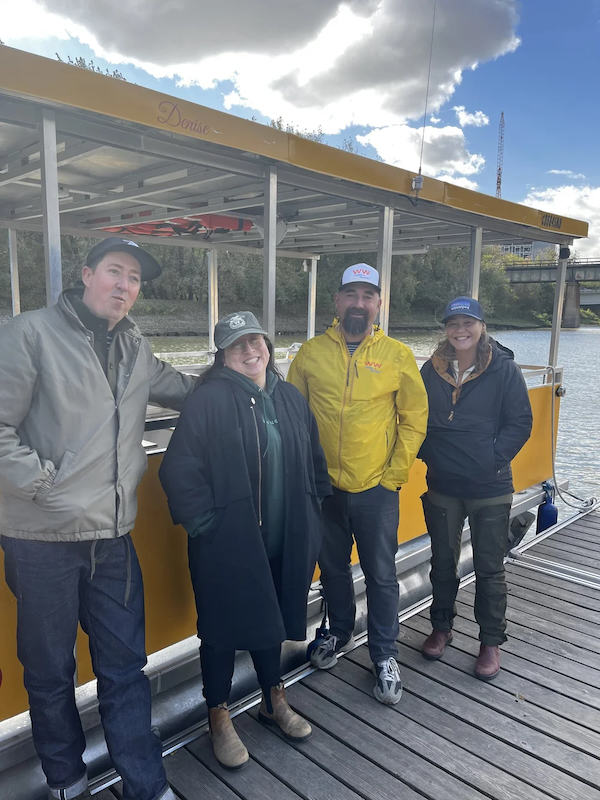
ROSEMARY Gallery, Ian August’s River Tour (with Winnipeg Waterways), 2024, performance
JI: Guided by those that we respect and have a responsibility to: we enjoy that aspect as a foundation for decisions we make, that integrity doesn’t have to be compromised. Starting something new means we can birth new models. Our guidelines don’t have to be hard and fast. We can apply more individual and unique approaches to the different projects we take on.
SM: We are fortunate to have the opportunity to work with people who we love and admire, and whose ideas and vision are the thrust behind wanting to be a space for artistic representation.
How do you find out about new artists?
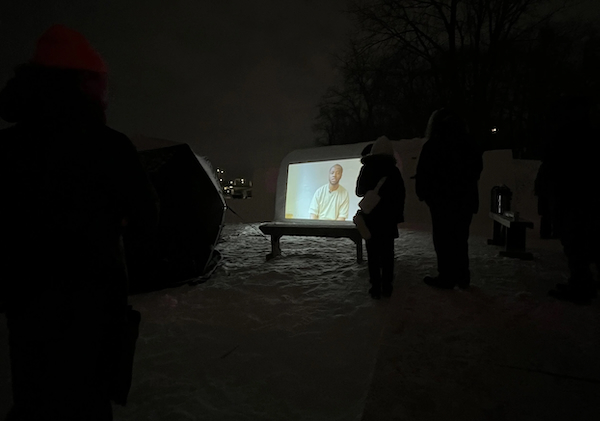
ROSEMARY Gallery, River Poetics, 2025, outdoor screening
SM: Jaimie and I have our own histories of practice both as artists and as curators. It has been wonderful to combine forces and, at least for myself, to extend my own ideas about what is possible by working with our shared networks. We have also had the chance to work with a few partners like The Forks Renewal Corporation, Anvil Tree, Sputnik Architecture, and PLATFORM Centre, who helped us to broaden both our audiences and enrich our collaborations across different sectors and facets of creative industries.
JI: Getting out to exhibitions and events, studio visits, travel, and expanding on current relationships we work to maintain and sustain. Reading, watching, and engaging with what folks are doing in different cities and countries allows us to be in tune with a wider pulse on a broader community.
Where do you see yourself in five years?
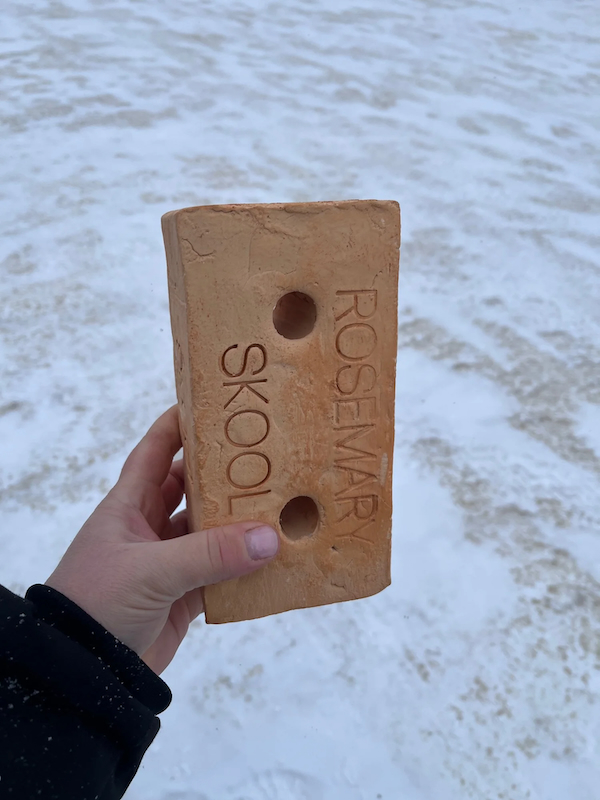
ROSEMARY SKOOL limited edition brick
JI: Continuing to advance conversations about decolonization and indigenization, creating sovereign spaces and learning more about the connection we have with the land and waters. Inviting dialogue and engagement across interdisciplinary boundaries, free of colonial impositions of what a gallery should be. Continuing to explore/experiment with interdisciplinary methods that amplify Indigenous perspectives in creating innovative and meaningful curatorial practices that resonate by not mimicking the colonial ways of doing things. Creating space and decentering. Even if that means having a space – what that could look like could have many concepts – but not being confined to a white cube.
SM: We have plans to continue responding as we do. It would be nice to see greater stability in this approach, though I think that would require broader changes to the way our sector funds artists and ideas. We debate whether we want to formalize what is essentially operating as an ad hoc collective. Being deliberately small-scale and existing outside of models that receive operating funds means that we are always teetering on the edge of not existing at all. There are advantages to this, in terms of our agility and ability to work responsively, which I think for now at least outweighs the challenges.
What excites you about your current and upcoming exhibitions?

Mahlet Cuff, What if We Kept it Between Us? (Filmstill; Film Freeway), 2026, video still
SM: We share a few dreams at the moment, and we are looking at finding ways to bring them to life. So much of this work takes place through conversations with our friends, partners, and leaders in the different communities we engage in as well as through our own strategizing around funding and need. While this part is uncertain, it is the work that ensures we are growing alongside others and maintaining our mandate to listen and respond. I am grateful to be able to do this work, and I am excited to continue with our approach.
JI: I feel fortunate to work with Suzanne, our partners, curators, and artists. The exhibition that is up right now at PLATFORM – it’s called what if house is a feeling – excites us in many ways. It combines artists connected to one another through relation and relationships where sound, music, and movement in different spaces/places and times provide a good energy. We’ve got upcoming plans and are also open for folks to get at us and scheme with us.