Nikki Middlemiss at Karsh-Masson Gallery, Ottawa
By Michael Davidge
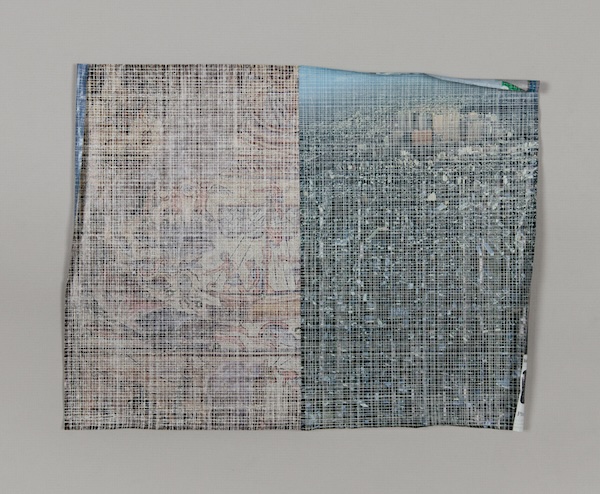
Nikki Middlemiss, Remains series, 2024, folded National Geographic magazine pages, glue
This summer, get out from underneath the heat dome in Ottawa and go to the Karsh-Masson Gallery—not only because it has air-conditioning, but also because it currently features the conceptually cool art of Nikki Middlemiss. Her exhibition Innerline consists of three recent and concurrent series of process-driven works that complement each other and create an environment conducive to reflection and contemplation, further enhanced by climate-control.
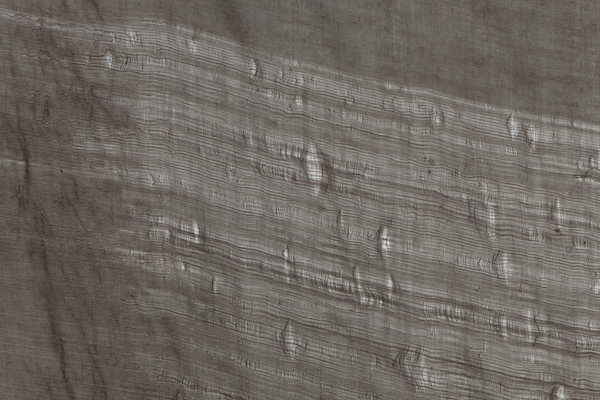
Nikki Middlemiss, Innerline series (detail), 2026, inkjet print on baryta paper
Although drawing is central to her practice, you could argue that withdrawing is a more apt verb, given that abstraction and subtraction are typical of her work. In an online interview for the Kelowna Art Gallery from 2017, Middlemiss likened her drawings to the open fields of the prairies where she grew up and found respite from the congestion of the city. You would not be remiss to think of another Saskatchewanian, Agnes Martin, as a spiritual forbearer. The elder artist’s minimalist gridded canvases and pale colours have a family resemblance to the works at the Karsh-Masson. The Supports/Surfaces movement also comes to mind through the way these works call attention to their materiality and prompt the viewer to wonder how they were made, which is really their subject, or, rather, their mystery. To bring in one more reference, if Marshall McLuhan’s notion of “hot” media, such as movies, are those laden with information, then Middlemiss’s removals (of a particular material or a referent) engineer a cooling effect and engage the viewer more in actively figuring out the work – the hallmark of McLuhan’s “cool” media.
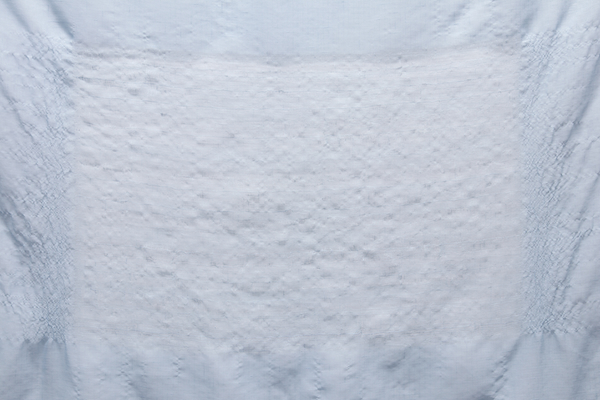
Nikki Middlemiss, Innerline series, 2023, inkjet print on baryta paper
The series which gives the exhibition its title, Innerline, begun in 2023, is represented by four inkjet prints on baryta paper featuring patterns that Middlemiss created in pieces of fabric by pulling or removing their threads, literally unravelling them. The frayed or gaping textiles are photographed against a contrasting background (in a limited palette of dark or light blue, black, grey, or beige) so that the patterns are revealed precisely by their absence. In these instances, the support has not undergone a subtractive procedure, but the subject has. However, there is a bit of trompe l’oeil to detect in the way that the prints, pinned at their corners to the wall, buckle akin to the rippling folds in the fabric.
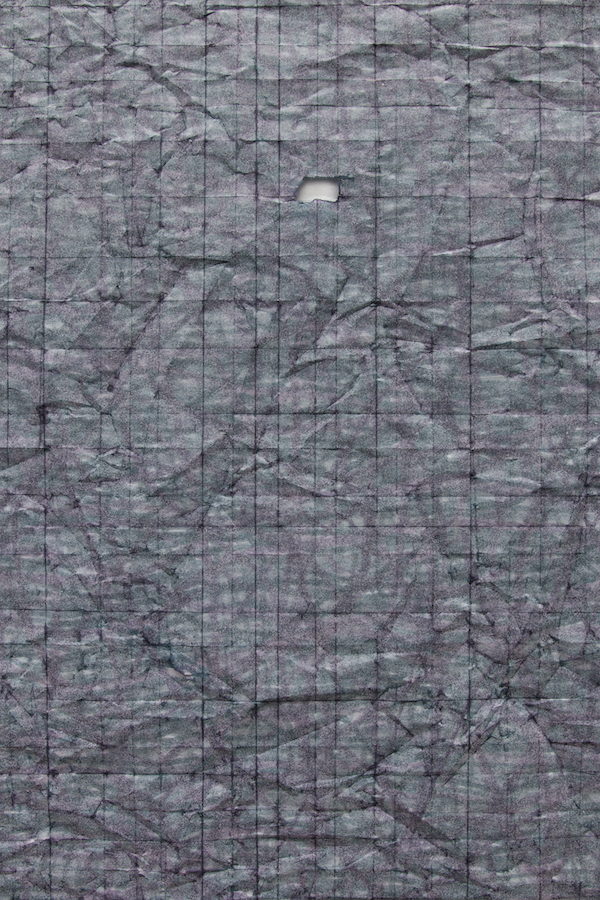
Nikki Middlemiss, Remake—Recover—Radiate series (detail), 2024, marker on crumpled and folded vellum paper
Another series on view, Remake—Recover—Radiate from 2024 and 2026, consists of eight subtle works on paper, consecutively hung with nails at their top corners in a line along the length of one side of the gallery to create a sequence of muted colour fields in ochre, grey, green, blue, and pink. Middlemiss has delineated patterns with markers on crumpled vellum paper, folded in the manner of the Japanese craft of Momigami, which renders paper soft and pliable like fabric. There is an icon of a hand with a red line across it on the tombstone label for these works, indicating that you are not supposed to touch them, but I was itching to see if that would help me to understand them better. These are two-dimensional images with lots of depth. Conjuring up doodles, maps, graph papers, networks, and capillaries, Middlemiss is somehow working within the interior of the support, like its surface has been broken open, operated on, and closed up again. Free-hanging, the works are curled and cracked, with shards missing. Shadows create even more depth.
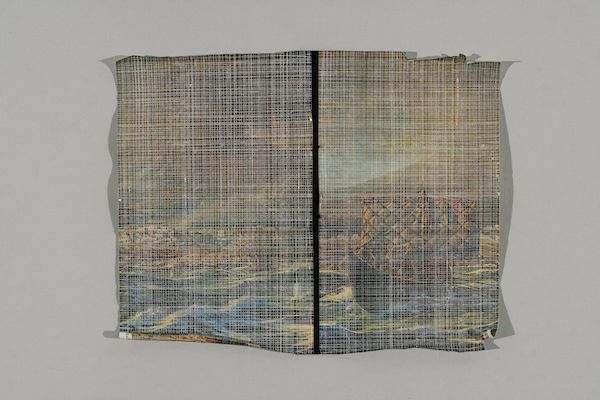
Nikki Middlemiss, Remains series, 2024, folded National Geographic magazine pages, paper, glue (photo: Guy L’Heureux)
Finally, in the back of the gallery, there is a third series, Remains from 2024 to 2026, which expands the universes within Middlemiss’s work even further by pulling in images from old National Geographics. The artist has transformed pages from the magazine through folding them as well, muting the colour and delineation of the images on them so that they seemingly recede from view. Glued together into diptychs and framed, these works resemble the scrolls of a possibly extinct, but technologically advanced civilization that could have also been featured in the magazine. The classic National Geographic subject matter that can be discerned in them include the macro and the micro: insect life, cities, civilizations, global culture, wildlife, weather phenomenon, aquatic life, volcanoes, the cosmos. A handy exhibition guide including an informative essay by Marie-Eve Beaupré suggests that, like the artist’s procedures, our collective actions can lead to both evolution and obliteration.
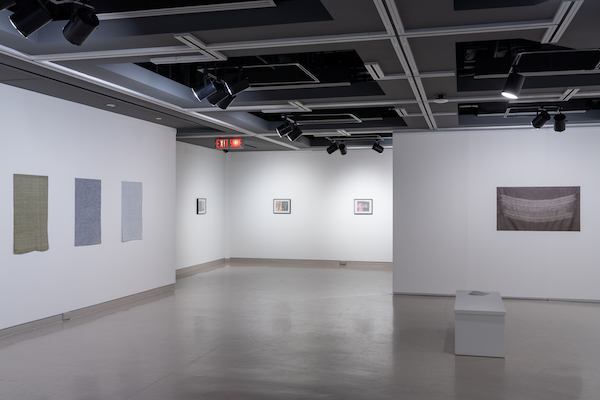
Nikki Middlemiss, Innerline, 2026, installation view at Karsh-Masson Gallery (photo: David Barbour)
With their incorporation of photography, Middlemiss’s works can be seen as relics of image-making in the Anthropocene. Hito Steyerl has brought McLuhan’s hot media up to date by underscoring the manner in which A.I. generated imagery literally creates “heat islands” on the Earth’s surface through the requisite data centres that have an enormously negative environmental impact. In this context, the precarity manifested by the works in Innerline offer a portrait of a civilization in the process of undoing itself through its own making. Let’s follow Middlemiss’s lead and try to keep things cool, instead of turning up the heat.
Nikki Middlemiss: Innerline continues until September 6.
Karsh-Masson Gallery
The gallery is accessible.
Michael Davidge is an artist and writer who lives in Ottawa. His writing on art and culture has appeared in Border Crossings, BlackFlash, and C Magazine, among other publications.