Nelly-Ève Rajotte at Contemporary Calgary
By Levin Ifko
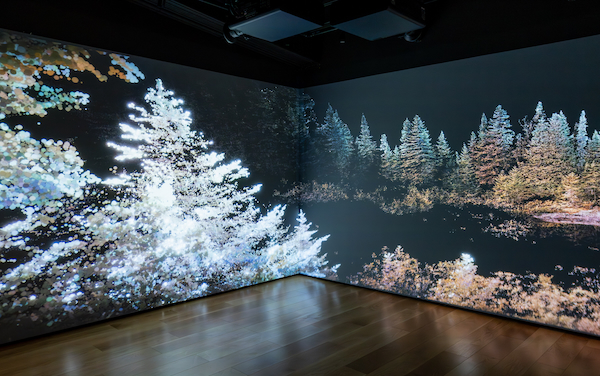
Nelly-Ève Rajotte, Trees communicate with each other at 220 hertz, 2024, installation view at Contemporary Calgary. (photo: Blaine Campbell)
Nelly-Ève Rajotte is a Montreal-based media artist who often engages with non-human methods of scanning landscapes and interacting with nature, utilizing technologies such as biosensors to create her immersive work. In Trees communicate with each other at 220 hertz, she uses LiDAR scanning to map and generate a digital representation of a forest. Presented as a video work in the darkened gallery space, the forest is depicted through thousands of dotted particles that read like a gridded mesh, warping to contour a fallen tree or pulsing gently to animate a forest floor that sinks and wriggles, almost as if to mimic the rise and fall of breath. Colourful particles not only form the forest itself, but they also capture warm light hitting the palms of leaves and branches. Sometimes, I even think I can see a blue glow in the distance, representing light from a skyline that was never rendered.
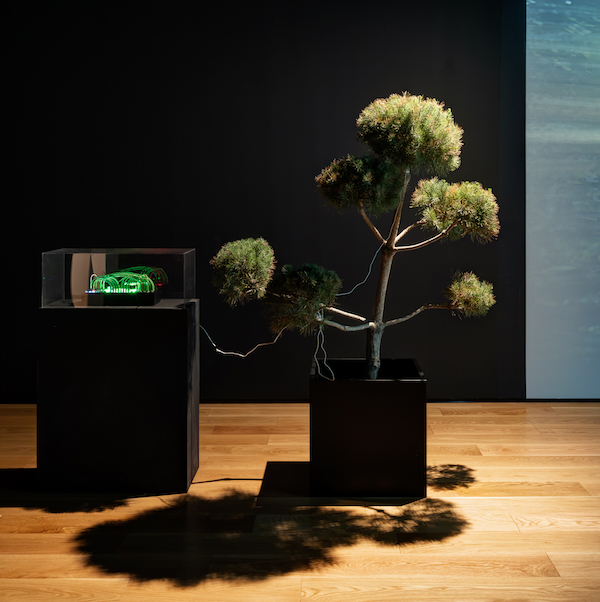
Nelly-Ève Rajotte, Trees communicate with each other at 220 hertz, 2024, installation view at Contemporary Calgary. (photo: Blaine Campbell)
Particles dissipate as the video zooms towards them, making room for the viewer to glide smoothly through rocks and tree trunks, and sink into the canopy. Sound compliments this movement, as shifts in the landscape are marked by the volume of bird calls and the noise of crickets. A modular synthesizer sits in the corner of the gallery, connected with wires to a live tree. This setup presumably contributes to the amplified audio in the space, although the connection between the video and what was coming from the synthesizer was somewhat perplexing to me. I read its technological opaqueness as a complement to the artist’s tenuous dialogue surrounding a digital program’s ability to perceive nature.
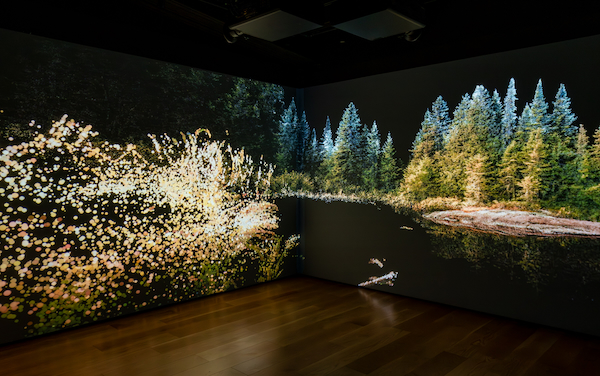
Nelly-Ève Rajotte, Trees communicate with each other at 220 hertz, 2024, installation view at Contemporary Calgary. (photo: Blaine Campbell)
Enamored with the video component, I think about my body in physical forested space. How my hand could trace the rough ridges of bark and branches, and my feet would press soil into the earth. I wonder about the capacity of these sensors to do the same thing. Could the mechanism’s touch really feel the ridges and and run its beams along the tree trunks in a way that is less about depiction and more about connection? The scanner is only running a pre-programmed function, and even though this technology is non-feeling, something about the visceral particle movement in this work combined with the soundscape made me feel more emotionally connected to the forest than my plethora of iPhone photos of bark, soil, and roots would allow.
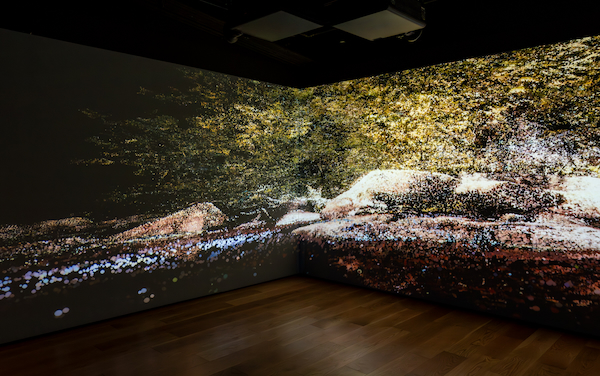
Nelly-Ève Rajotte, Trees communicate with each other at 220 hertz, 2024, installation view at Contemporary Calgary. (photo: Blaine Campbell)
This brings me back to the title, Trees communicate with each other at 220 hertz, which is to say, trees communicate in ways that are inaudible to humans. We know this because of observations aided by technology, but perhaps we register this communication ourselves on a deep subconscious level. The ability of non-human technology to perceive and represent natural environments is at the heart of the piece. It makes me wonder about our intangible, or even spiritual, human relationships to the forest. Our practical use of this mapping helps us archive and keep track of changes in these ecosystems and biomes, turning the natural world into points of data to be saved for future use. Is it dangerous to project more onto this archive?
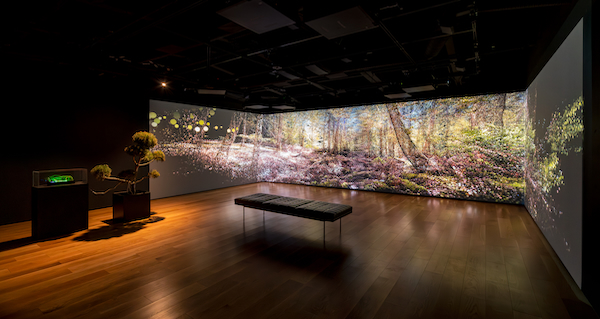
Nelly-Ève Rajotte, Trees communicate with each other at 220 hertz, 2024, installation view at Contemporary Calgary. (photo: Blaine Campbell)
As the video work comes to a close, the particle forest begins to appear as a sort of diorama. Growing smaller, this reminds me of its format as data. The particles fade out of view and I imagine the entire forest as a speck of data-dust in a hard drive, the cloud, or perhaps as an attachment being emailed to the gallery. Yet, I feel a sentimentality towards these trees that hints at something more than that.
Nelly-Ève Rajotte: Trees communicate with each other at 220 hertz continues until April 19.
Contemporary Calgary: https://www.contemporarycalgary.com/
The gallery is accessible.
Levin Ifko is an interdisciplinary artist currently based in Mohkinstsis (Calgary). They will talk your ear off about music, queerness, and media art. Mostly, they believe that art is an opportunity to connect with ourselves and our communities.