Levin Ifko on Curatorial Practices at the NaAC
The National accessArts Centre (NaAC) is an arts organization based in Calgary that supports the creation of work for over three hundred artists with disabilities in the city, and even internationally, through creative partnerships. In addition to offering studio time and technical support for these artists, the NaAC also provides specialized programming for those who are interested in diving deeper into the process of professional development and exhibiting artwork.
As part of the newly expanded Curatorial Practices program, six longstanding NaAC artists, each with artistic practices of their own, participated in a two-year mentorship program made possible by funding from Calgary Arts Development. This involved taking a disability-led approach to learning what it means to curate, engaging in conversations about local art exhibitions, and going through the process of creating a curatorial project of their own. Presented in the spring and summer of 2026, these exhibitions represented the wide range of interests of each curator. They included topics related to disability and other experiences of marginalization, but also themes such as the art-making process itself and its inevitable problem solving, and the importance of leaning into your interests, desires, and mistakes. In collaboration with arts organizations around the city, these six exhibitions featured the work of artists from across the country, and were showcased in gallery spaces that amplified and celebrated the work of these emerging curators.
The exhibitions were daring and demonstrated the many strengths of this program. In particular, they emphasized what can come when artists are given access to knowledge, attention to their support and access needs, and agency and encouragement to participate in thoughtful, complex conversations being had in the field of visual arts. Having had a chance to chat with each curator at their respective exhibition openings, many extended their utmost thanks to program facilitator Toni Cormier for her guidance and mentorship throughout this process.
All in all, this program provided an incredibly meaningful experience for the participating artists, and I was thrilled to see these years of research and learning come together in these exhibitions!
Sparks Fly
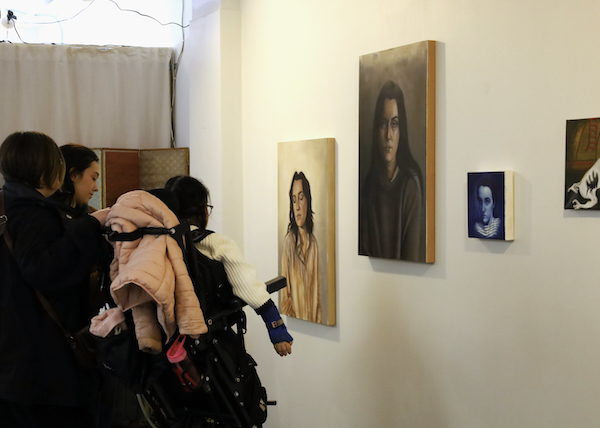
Opening reception for Sparks Fly, featuring three paintings by Louie Fermor. Left to Right: Rest Finally, 2021, oil on wood panel; Two Eyed Burnout, 2021, oil on wood panel; Blue Study, 2021, oil on wood panel.
Curated by Carla Isabella Salter, Sparks Fly was the first exhibition to be presented as part of the program. It featured artists Ashton Crowhurst, Louie Fermor, Jaz Steel, and Jodie Stevens, and was presented at Stride Gallery through March and April of 2026. The exhibition addressed the particularly unique relationships between mental health and disability, but even more so, it was a deeply emotion-driven show that considered just how strong these bright and hot “sparks” can be.
Some of the work presented represented a process of sparks building from within – the friction leading to a simmering pool of emotions only waiting to be released. The look of exhaustion that lies behind the tired eyes in Louie Fermor’s self-portrait Two Eyed Burnout and the relaxed sigh of relief pictured in Fermor’s Rest Finally resonated with me. In Jodie Steven’s sculpture and photography project Shadow Work, a light box is placed inside a home on a chair, on the stairs, or even in a plant. This glowing object of heat and light reminded me of a long-lasting emotion that radiates in the background of every space you exist in. This through line of light and shadow continued with Jaz Steel’s Depression Personified, where a warm yellow light was cast in a dimly lit underground tunnel to melt away a distorted frog-like creature and reveal the dark and sticky environment it’s in.
Ashton Crowhurst’s The Inner Workings of my Mind used layers of acrylic paint to form jagged shapes, colourful lines, and minute details. Seemingly popping from the canvas, the work reminded me of times in my own life where sparks led to the ignition of a flame far too furious to be contained. However, this explosion cannot only be interpreted as a negative thing. The exhibition description itself acknowledged the experience of bursting into flame as something “both healing and devastating.” While the sparks that fly can burn “incredibly bright and hot,” our emotions, like all forms of energy, cannot be created or destroyed. We can only work to transform this energy, and release it from the pit of our stomachs into words and actions, including art. This work is a reminder that no good comes from always suppressing these feelings deep inside, never allowing ourselves the grace of a fire.
Lurking Above
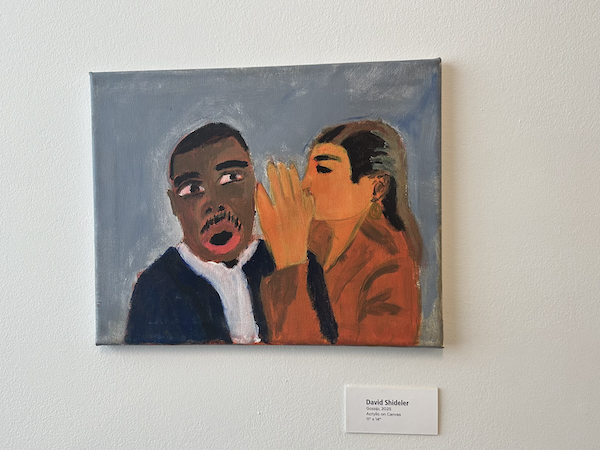
David Shideler, Gossip, 2025, acrylic on canvas
The next exhibition in the program adds to this idea by acknowledging how overwhelming it can be to hold feelings alone, asking instead, “What if we shared them instead?” Lurking Above was the debut curatorial project of Ash B, whose approach was to create a space where artists could feel comfortable sharing their own challenges with expressing themselves. In particular, their work grappled with the struggle to communicate feelings. This exhibition brought together paintings by Laura LaPeare, Joanna Mae Mones, and David Shideler.
Shideler’s series of three small-scale paintings with one-word titles depicting facial expressions hit the core of the exhibition’s theme. I was particularly impacted by Gossip. The figure in the center of the painting made my stomach turn with both excitement and a slight regret as I learned something I wasn’t supposed to know.
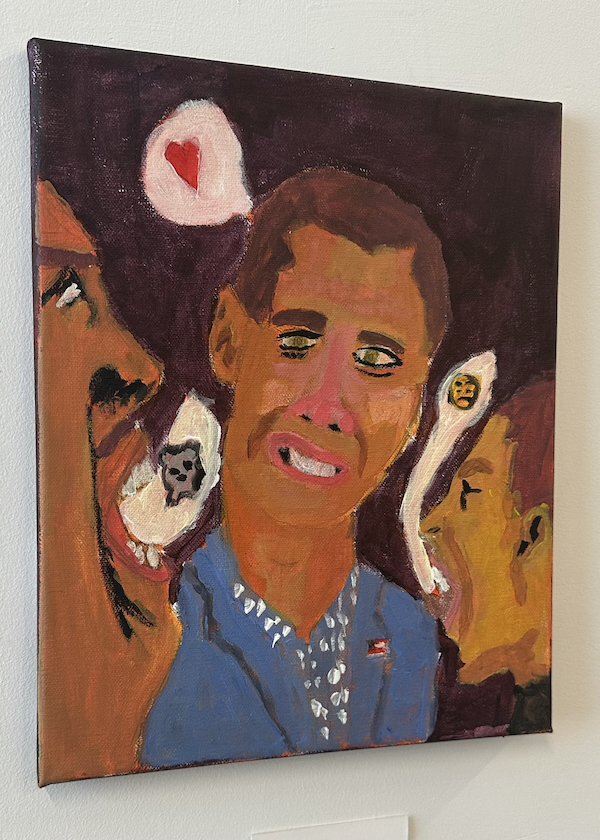
David Shideler, Chat, 2025, acrylic on canvas
In another intriguing work titled Chat, the central figure’s face appears tired and uncertain about how to navigate the situation that has unfolded in front of them. As two other faces appear to be yelling at one another with speech bubbles indicating a sense of upset or anger, the figure in the middle emits a speech bubble with a single red heart to acknowledge how much they love and care about the others despite the difficult moment between them. I left in awe of how much Shideler’s characters convey the complexities of these emotions, especially in such tense or morally confusing moments.
On the opposite wall was Mones’ Imitating, a large-scale painting with a beautifully intricate use of blue light and shadow. Mones’ work creates a scene where a crowd of people appear to be moving in the same direction, where one person faces another, appearing slightly more jagged and reflective in shape, similar to the formations of crystals. As Mones’ artistic practise centers the idea of belonging, the central figure’s slightly different form, direction, and colour suggested an attempt to camouflage or hide parts of yourself to blend in. However, any attempt to create a disguise will still stand out from the crowd.
Struggling to communicate your true thoughts and feelings towards others can be a feeling that lurks above, below, and all around us as we navigate the world. The artists here acknowledge this difficulty, while making work that carves out a space to share.
Cryptids on the Margins
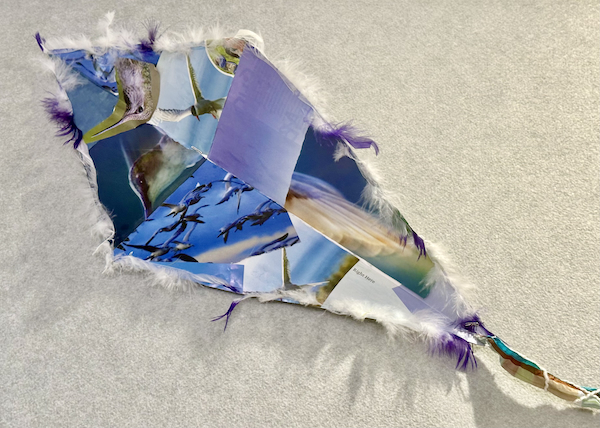
Morgan Roves, Event for Cryptids (ICE KITE) (detail), 2026, collage on paper.
Where the previous exhibition contended with the difficulty that comes from holding back, the next project presented work that celebrates the unapologetically different, as well as the collective knowledge that exists between those of us who have experienced different kinds of marginalization. Cryptids on the Margins was an exhibition conceptualized by multi-disciplinary artist Kathy M. Austin and featured artists Arash Minhas, Ashley Brodeur, Morgan Roves, Winona Julian, Míša Štorková, and Jenna Van Buekenhout.
What is a cryptid? Think tales of the Loch Ness monster, Bigfoot, or Mothman – creatures that often incite fear, or creatures that have their existence in myth and fact construed and debated, in some instances due to a colonial ignorance towards Indigenous knowledge and storytelling. As narrated in the exhibition description, “The scariest thing about Cryptids is that, like those who live in the margins of society, they may actually exist.” Framing this exhibition through the figure of the cryptid made a powerful metaphor that not only encourages the acceptance of difference, but actively proclaims that we exist and have agency.
Austin is a well-known, multi-hyphenate artist locally and within the NaAC community. As I was familiar with her charming and eccentric filmmaking, poetry, visual art, and performance work, I was excited to learn about her emerging curatorial practice. Complementary to this exhibition’s unique theme was its facilitated approach to making the exhibited work. The curatorial process for this exhibition began as a two-day artist intensive led by Austin. This blind-led and designed program was described as encouraging participating artists to “investigate the radical power of experimental, collaborative, and curiosity-based creativity.”
The exhibition was displayed on a wall inside the local DIALOG architectural office from April to June 2026. It differed from the others because it featured work that was made spontaneously and quickly inside the format of the artist workshop. Cryptids on the Margins also showcased photos from the intensive, honouring the group’s tight-knit connection that enabled them to put trust in the making process, in each other, and within themselves. Work installed upon the gallery wall included framed artist posters, flyers, and zines made with familiar materials such as crayons, coloured pencils, and stickers with collaged photo cut-outs. I read phrases advertising “Yeti World” and “SCALE POLISH” next to drawings of beautiful hairy beings and scaly water creatures. I also picked up a pamphlet promoting “The #1 Industry Convention for Peripheral Creatures,” which announced its keynote speaker as Bigfoot and a cryptid workshop series including “fur maintenance” with the Jersey Devil.
Some of the most intriguing work that came out of this theme began with a prompt gifted to participating artists by the facilitator-curator. The instruction was to create an advertisement for another cryptid. What form this artwork took, and what kind of gathering, product, or attraction would be advertised was the choice of each individual artist. I felt particularly drawn to Roves’ work, which took form as a paper kite fit with images, feathers, and a string from which the kite was strung above the other works in the exhibition. The ground-facing side of the kite featured photos of blue skies and birds, hand cut and collaged from various outdoor reporting style magazines. The other side, however, indicated a meeting place and message to all the creatures who fly above. As an advertisement, this kite was hard to read – deliberately so, because it wasn’t meant for all humans. It was a communication tool for certain minds only. With the poignant title, Event for Cryptids (ICE KITE), the piece acted as an homage to the ways cryptids must adapt to inform each other of danger – a powerful reflection upon how those of us with politically contested or marginalised identities choose to gather, connect, and fight for one another.
Poetic writing from each featured artist was included in the exhibition pamphlet. This collection of writing stemmed from another workshop prompt: writing from the perspective of a shadow. A piece of Minhas’ poetic writing lingered with me for some time. A character contends with their own existence and is appreciative to be noticed, but just as it goes to introduce itself, it disappears. Minhas writes of the realization: “So, apparently, I’m a shadow.”
Solving a Problem
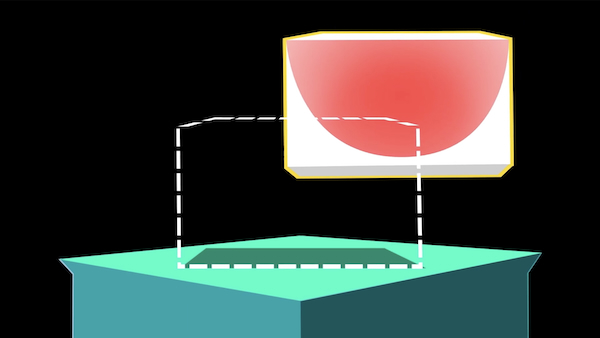
Emmanuel Ho, OMIP.PIP (still)
Mark Bedford’s curatorial project Solving a Problem, was the only exhibition in the lineup to be presented online. The New Gallery’s MainFrame space hosted the project in June 2026, and it is still available to view via the gallery’s exhibition archive. This was a fitting choice for the digital design and video-based work of participating artists Emmanuel Ho and Devin Hyndman.
Prior to this exhibition, I was primarily aware of Bedford’s work as a painter, making his curatorial interest in digitally created artwork an intriguing and pleasant surprise. I soon learned that the inspiration behind this theme came from Bedford’s passion for art, chess, and Lego building. This excitement about problem solving in games and puzzles led to his fascination with how creating art could be considered the same thing. His connection to painting then began to make sense to me, where each brushstroke is another decision, becoming layers upon layers of paint that builds up over time. At first glance, the work in Solving a Problem appears quite different to traditional painting or drawing. However, the processes behind them can be understood the same way: as a series of decisions that the artist makes to solve a problem or understand a complicated idea.
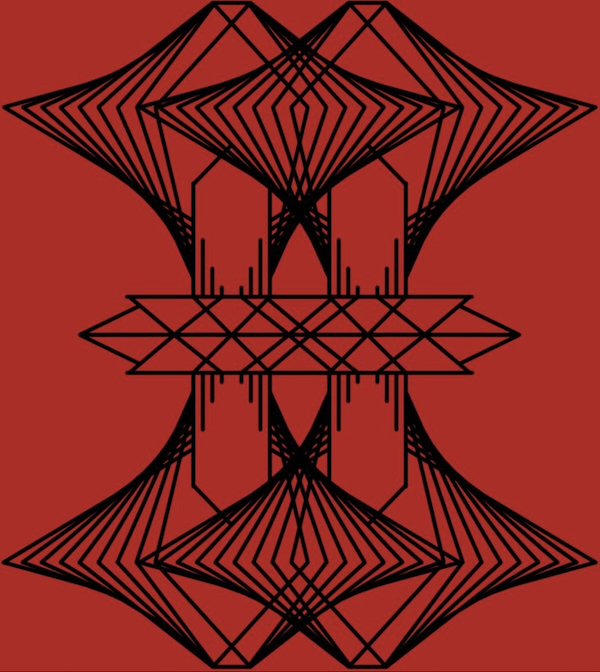
Devin Hyndman, Warps ii Redux ii
Both artists in the exhibition make work with moving lines and bright colours that come together to form geometric shapes and symbols. In OMIP.PIP, an animated video work by Ho, shapes and forms resembling landscapes and objects appear on screen to the slow beat of a dark electronic soundtrack. I was reminded of my interest in online puzzle games when one of Ho’s 3D digital shapes got dragged into its dotted outline. As my cursor wandered about the digital space, images switched places, which created my own kind of problem to solve as I navigated the maze of this online environment. The images that switched places were selected from a series of digital drawings by Hyndman. Created using Clip Paint Studio, each of these works use colourful lines and corners to form a larger image. The final pieces were similar to optical illusions where the viewer sees movement despite the lines actually staying still.
I appreciate Bedford’s curiosity towards the theme of this exhibition, and I suspect that many artists deeply relate to, or have reluctantly experienced, the ways that art making is a form of problem solving. Even as I write this essay, I’m working through a problem of my own. How do I represent the thoughts and feelings I had moving through these exhibitions in written form? What will help readers understand how each curator’s themes connect? Eventually the process of problem solving, whether through puzzles, painting, or writing, reaches a point where one decides when it’s finished, even if they are unsure about what that means.
The exhibition description describes how solving puzzles can help people access a “strange and sublime place” in their minds. Although the answers to the problems that each artist is solving may not be clear to the viewer, the process of making a piece of art often answers questions for the artists themselves.
Explosions of Curiosity
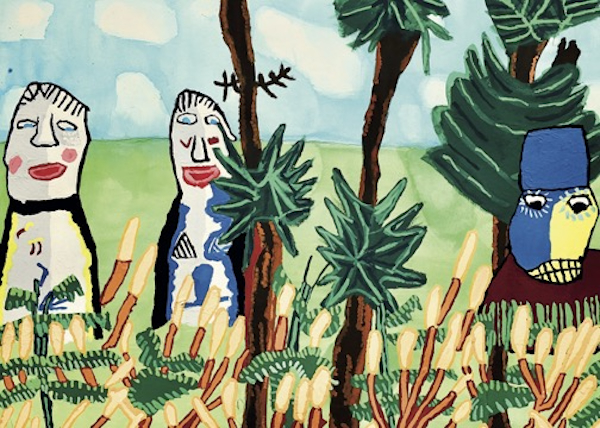
Laura LaPeare, The Memory of a Hike, gouache on paper
Sherrine Fox’s curatorial project Explosions of Curiosity presented a collection of artwork rich with texture, colour, and a sense of play. Exhibited at cSPACE King Edward through May 2026, Fox’s interests were in choosing work that portrayed a sense of wonder and depicted “adventures” that can be “challenging or unusual” to encourage viewers to step outside of their comfort zones. Artists Sophie Ouellet, Laura LaPeare, Natasha Martin, and Stéphanie Morin used different mediums, from painting and drawing techniques to ceramics and collage with objects, that often portrayed unusual characters, peculiar landscapes, and fascinating textures.
Morin’s work involved photographing materials such as cut paper combined with crocheted yarn, beads, and other small objects to build outgoing and expressive faces. They embodied the idea of an explosion of curiosity, where materials found on an artist’s cluttered desk were playfully pieced together. LaPeare’s layering of gouache paint on paper to depict dreams and memories felt central to the exhibition’s sense of storytelling. She creates bold figures using line, shape, and colour in unusual and engaging ways. The people we meet in dreams feel familiar when sleeping, but can be unrecognizable upon waking up. In a similar way, the images we know from memory can be different from the actual event, making small details feel larger, and our perspectives change. LaPeare’s visual stories remind me of the way dreams and memories can feel both far away and deeply close at the same time. Martin’s Black Orb, a photograph of a spherical ceramic vessel was a reminder of the texture and physical nature of adventure. Formed with a dark clay, this orb had clearly been scratched and stained, which the artist seemed to embrace as part of the process of building it. Lastly, while Ouellet’s watercolour paintings, often based on faces and characters, felt different from many of the other works, her colour palette and mark-making style were particularly engaging and strongly connected to the exhibition’s overall sense of world building and adventure.
No Mistakes
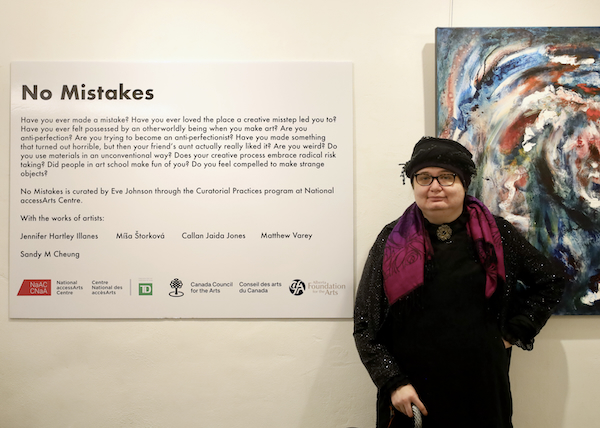
Curator Eve Johnson posing in front of the exhibition didactic, and to the left of Sandy M. Cheung’s 2018 oil painting Protection
The final exhibition to be presented as part of the Curatorial Practices program was No Mistakes, curated by Eve Johnson and featuring the work of Jennifer Hartley Illanes, Matthew Varey, Mx. Callan Jaida Jones, Sandy M. Cheung, and Míša Štorková. Writing included alongside the exhibition presented some lovely guiding questions, such as “Have you ever loved the place a creative misstep led you to?” and “Have you made something that turned out horrible, but then your friend’s aunt actually really liked it?” This love and care towards artwork and material sits at the heart of the project. I noticed this especially in the work of Hartley Illanes, whose medieval-inspired fabric sculptures brought a sense of whimsy and play to the exhibition. The title of Štorková’s collage work using spider imagery, I choose to trust, was also particularly touching.
Another guiding question was, “Have you ever felt possessed by an otherworldly being when you make art?” This recognition of the confusing and otherworldly space of artistic creation was something I strongly felt when looking at both Varey and Cheung’s respective fibre and paintings on canvas. The theme of this exhibition reminded me of another method of creation embraced by many artists: using materials in a way that inspires questions about how their use was originally intended. Jaida Jones embraces this way of working in their series Wash With Me, which uses poetic writing exposed on windowsill cyanotypes to challenge perceptions of photography as presenting a single truth.
Overall, this exhibition encouraged artistic playfulness and leaning into mistakes as an avenue to learn from and find immense meaning in. In conversation with the artists and curator, I felt that the show also suggested that honouring our mistakes, or even intentional “missteps,” might be a welcome escape from challenges associated with accessing and promoting yourself within the art world.
There are so many ways to create, not limiting ourselves to our “best” ideas, but instead focusing on what we learn from the process of making and the self-acceptance it can take to put ourselves out there. No Mistakes held an attitude I admire when it comes to sharing our niche interests, going with the flow, and allowing ourselves to be unapologetic about our presence. The ethos of this exhibition in embracing weirdness and anti-perfectionism feels like a fitting way to wrap up this experience in learning and creation alongside a supportive group of fellow artists.