Lassonde Art Trail, Toronto
By Greta Hamilton
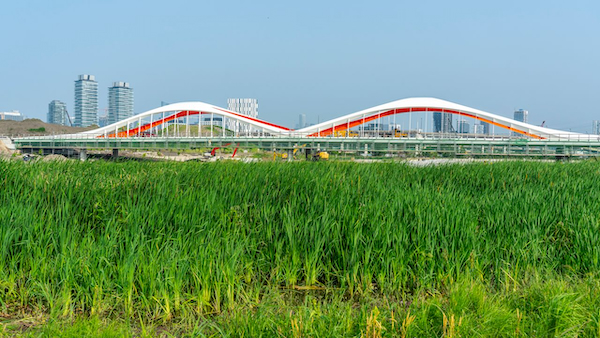
The Commissioners Street Bridge, 2024 (photo: Vid Ingelevics and Ryan Walker)
One sunny summer day, I take a stroll down Cherry Street towards the lake. I don’t live in Toronto anymore, so I’m surprised by all the development on the waterfront: a gorgeous new bike path, cascading steel bridges, an island dotted with trees. Part of the city’s Port Lands flood mitigation effort, Ookwemin Minising (the name of this re-naturalized island translates to “place of the black cherry”) has been planted with sedges, cattails, sumac, and cherry. The $1.25 billion project was funded municipally, provincially, and federally to reroute the Don River to its natural mouth in Lake Ontario, and to rewild the island into a marsh ecosystem—both of which serve as flood prevention tactics. As a gift to the public, the walking paths on Ookwemin Minising have been adorned with contemporary art.
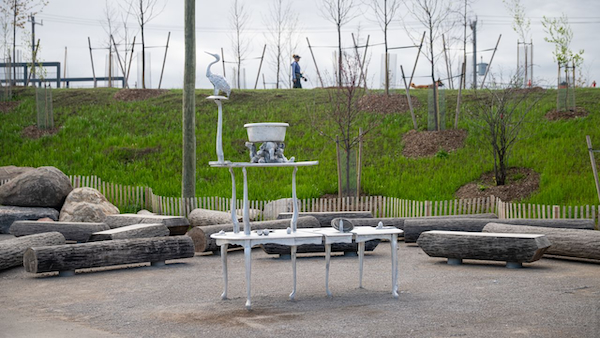
Nadia Belerique and Tony Romano, Homing, 2026, aluminum (photo: Vid Ingelevics and Ryan Walker)
The Lassonde Art Trail is a four-kilometre path that will eventually showcase the work of seventeen esteemed artists including Hank Willis Thomas, Lisa Hirmer, Tracey Emin, Nadia Belerique and Tony Romano, Caroline Monnet, and a forthcoming piece by Kent Monkman. In the heat of the afternoon, I walk the stoney paths lined with towering yellow flowers, looking at the ecosystem as much as the art. I’m taken aback by how hard it is to find some sculptures: the densely planted landscape and undulating trails, along with abysmal way-finding signage, have created a labyrinth. Luckily, I took a photo of the trail map to help me navigate the site.
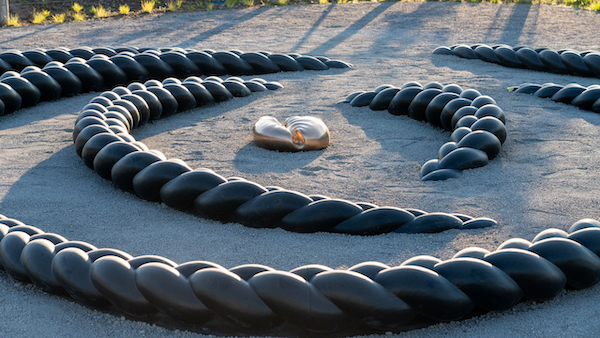
Oluseye, Crown Act, 2026, Accoya wood, stain, bronze (photo: Vid Ingelevics and Ryan Walker)
A handful of kids are working on their trick shots at Alexandre Arrechea’s Orange Functional, a series of basketball hoops organized in the shape of a tree. Further along, an installation by Oluseye emerges from the earth, a spiral of black braids arranged the way a serpent propels itself through water. Crown Act troubles the white implication of Crown Land by imbuing the earth with the artist’s Nigerian ancestry. The title of the work, though, makes reference to a US legislation that prohibits discrimination against natural hair. Further still, standout sculptures include Emin’s Roman Standard, which fills me with sadness. Her small bronze bird is trapped at the top of a flag pole, unable to fly like the swallows plummeting around it. Kara Hamilton’s Delicate Matter (for the birds) is one of the only works that uses ephemeral materials. The cob sculptures and plinths made of stratified earth evoke the organic landscape in which they’re situated—a gesture that relieves me after encountering so much brightly coloured metal.
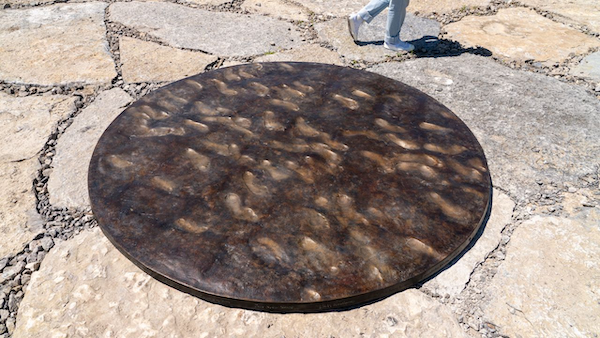
Caroline Monnet and Dean Baldwin Lew, Trajet, 2019, bronze (photo: Vid Ingelevics and Ryan Walker)
Towards the water, a sculpture by Caroline Monnet and Dean Baldwin Lew balances at the river mouth. Trajet is a bronze round that indexes the footprints of Anishinaabe, Haudenosaunee, Cree, and Dene people living in Toronto. It’s a reference to the 1908 uncovering of 11,000-year-old footprints made in blue clay on the floor of Lake Ontario. The ancient impressions were destroyed in the development of a utility tunnel at Hanlan’s Point on the Toronto Islands. Workers were estimated to have found a hundred footprints in the clay, including those of children. Monnet and Lew’s gesture reasserts this history and situates a living Indigenous presence on this land. The sculpture itself is striking: imperfect human feet step haphazardly across the bronze. Some feet barely make an imprint, others sink deeply into the mother mould. In this way, Trajet evokes the spirit of the flood mitigation project. Violent acts of industrialization and colonialism distorted this landscape for decades. Here, an attempt has been made to embrace an older way, a more natural way, for the plants, the water, the people.
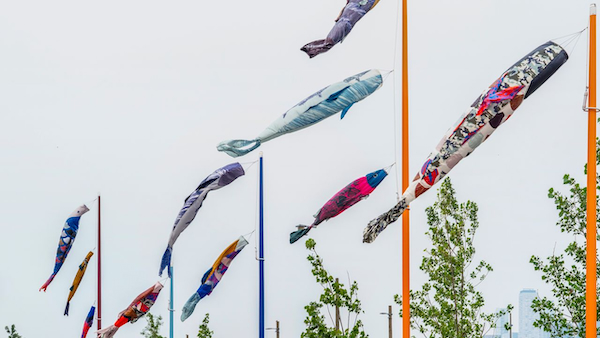
Alexa Kumiko Hatanaka, against the wind, with the wind, 2026, ripstop nylon, ink, flagpoles (photo: Vid Ingelevics and Ryan Walker)
I find a seat under a charming Alexa Kumiko Hatanaka sculpture titled against the wind, with the wind. A series of nylon fish are suspended from tall, colourful poles to emulate fishing rods. The fish represent the native species returning to Lake Ontario: Pickerel and Pumpkinseed. At this particular moment, the air is still, the fish are lifeless, although I know sometimes they swim. I feel demoralized that art can’t undo hundreds of years of violence. At the same time, I’m hopeful about the budding larch trees, the tobacco plants, and cherry. The Lassonde Art Trail imbues the landscape with intentionality; I can find my way with the sculptures as markers. I turn to look at the water. The lake is coated with bright green algae. It swells on the shore like a belly inhaling air. I can feel sad, and I can also be here, beneath the fish or beside the feet, knowing where I am.
Lassonde Art Trail: lassondearttrail.org
The exhibition is accessible.
Greta Hamilton (they/she) is a writer of poems, literary non-fiction, and emails. They are a theorist of contemporary art with a focus on environmental and land-based processes. Their essays and poems can be found in C Magazine, esse, Public Parking, Peripheral Review, Grain Magazine, Hammam Magazine, Leste, and exhibition texts distributed by international galleries and artist-run-centres.