King Arthur’s Night: Review by Terence Dick
(photo: Vince Arvidson)
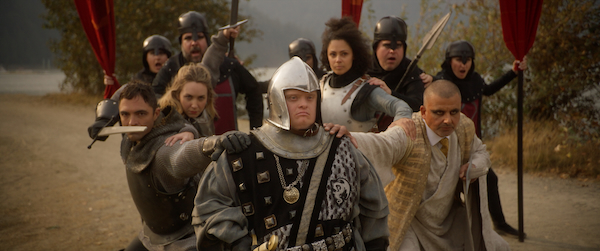
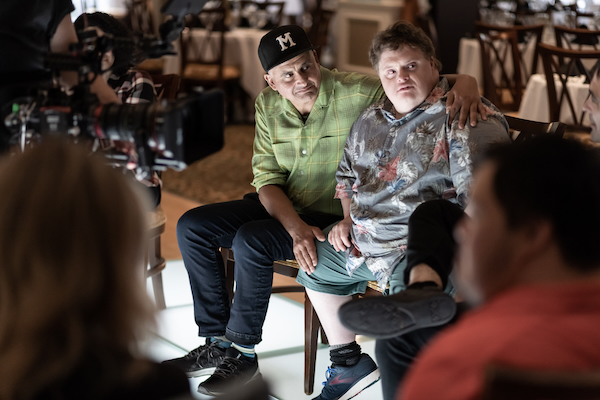
King Arthur’s Night, which has its Toronto premiere tonight (June 26) at Hot Docs Cinema as part of the 2026 Luminato Festival, is a strange creation. There was a play with the same title produced by Neworld Theatre in Vancouver that was commissioned by Luminato and had its world premiere at the 2017 festival. This is a movie version of that play, which is based on the familiar legend as recalled and rewritten by the cast member, company member, film producer, star, and subject Niall McNeill. But the movie is also a documentary directed by John Bolton of the filming of the movie he’s making, and it flips back and forth between the actors and their characters, between what’s in front of the cameras and what’s happening behind them, between what’s real and what’s make-believe, and what lies in the grey area occupied by both.
(photo: Jesse Winter)
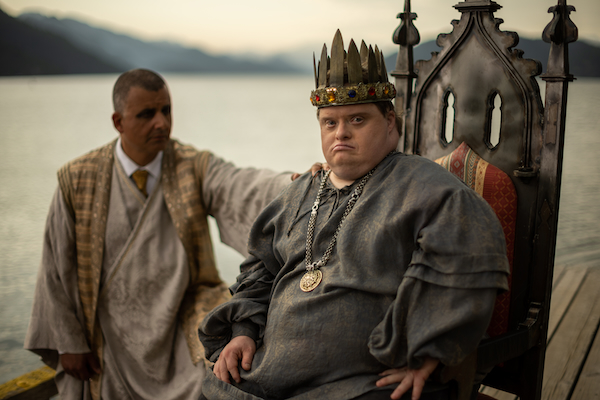
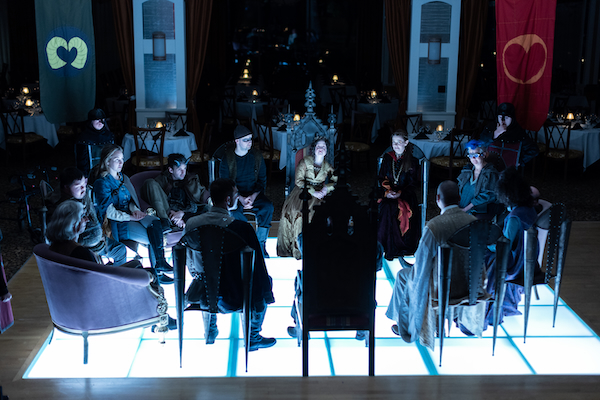
The (re)creation takes place in Camelot, but it’s also (and really) in Harrison Hot Springs, a resort town in British Columbia. The original play was subtitled “a collaboration across perceptions of cognitive difference,” which means it features cast members with and without Down syndrome. The documentary reassembles the original cast (which adds a layer of emotion to the gathering that is caught on video) to translate the play to the big screen with battle scenes and musical numbers (it’s also a musical, by the way) scaled up to match the epic backdrop of the off-season holiday town’s beaches, mountains, and hotels. The creative duo at the heart of this hybrid project is McNeill, who has Down syndrome, and Marcus Youssef, who does not. The former plays King Arthur, the latter Merlin, and that legendary collaboration between two men, their alliance, their power dynamics, their different abilities, becomes the underlying theme of the documentary.
As recounted by McNeill and recreated by the Neworld troupe and transformed into song by a trio of musicians lead by Veda Hille, the story of King Arthur is one of a conflicted regent whose Queen Guinevere falls in love with his greatest knight, Lancelot; who has a child with his sister, the witch Morgana; and whose son, the half-goat Mordred, challenges his father for the throne. The variations that are introduced into the narrative as McNeill interpolates his own memories of a bad experience with goats, his personal feelings about the other actors, and the relationship he has with Youssef are not that radical given the many versions – oral, literary, theatrical, cinematic – that the Arthurian legend has gone through over the centuries. The question of authorship is aligned with the idea of authority, be it Arthur’s, McNeill’s, Youssef’s, or Bolton’s. Because this is a collaboration, that authority is inextricably linked to the nature of consent. And because the collaborators include disabled artists, the consensual agreements that play out on the screen raise questions about allyship, inclusion, and access, particularly as it relates to cognitive difference and intellectual disability.
(photo: Jesse Winter)
None of this discourse is addressed directly in the movie. A couple of the actors without Down syndrome talk about learning to be better listeners or making more time to allow their fellow actors to express themselves, but there is no explicit discussion about what it means to work with this diverse group of people. It’s taken for a given. The movie is about the story – of Arthur, of Merlin, of Mordred, of McNeill and Youssef. The interpretation is left to the audience. However, there is one instance of the documentary moving beyond the artists involved in their creation. Bolton briefly includes a couple of the parents of the actors with Down syndrome. They express their appreciation for the opportunity the experience provides for their kids, but that’s about it.
Except the play is about fathers and sons. Arthur cannot abide by his own son, yet he sees Lancelot as a potential heir. Mordred hates and loves his father. Lancelot is loyal to his king, but also defies him by wooing his wife. The movie touches on this subject too. Youssef says he and McNeill talked a lot about fathers and sons while writing the script. When McNeill learned that Youssef’s parents were dead, he tells his friend that he will be his new dad. And, in the most heart-wrenching scene of the documentary, McNeill breaks down in tears when he talks about his own father’s passing. As the parent of an adult child with an intellectual disability, these parts of the movie hit closest to home.
(photo: Jesse Winter)
All familial relations are complicated, and they don’t get any easier as you grow up. Parent-child dynamics are fraught when you’re both new to the game as when you’re both senior citizens. The questions of responsibility and independence, holding on and letting go, are nothing new. They are the stuff of legend. But they do get more dramatic as you age and the dynamics shift. Having a child with an intellectual disability adds another layer of complication – particularly, in my case, if the child is non-verbal. As they enter the adult world, how will they represent themselves and who will pay attention? It’s the question at the core of all humanity. Will they be an object or a subject? Will they speak and be heard? Will their lives have meaning? King Arthur’s Night provides an example of one way to move forward. It’s a lot of work and it takes a committed community, but the payoff is rewarding.
Terence Dick is an arts writer living in Toronto. He is the editor of Akimblog.