Jet Coghlan on Teatro La Plaza’s Hamlet
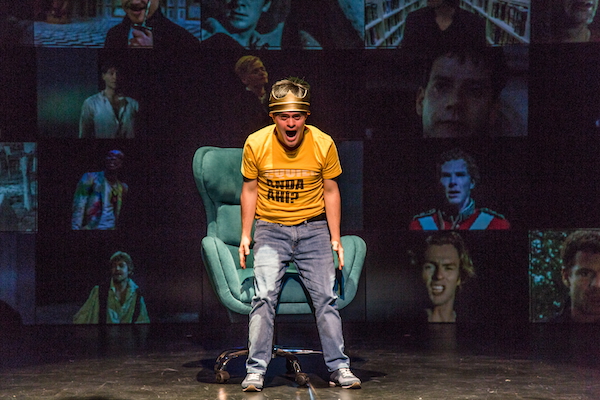
Teatro La Plaza’s adaptation of Hamlet, directed by Peruvian artist Chela De Ferrari and presented recently as part of Toronto’s 2025 Luminato Festival, reimagines Shakespeare’s classic as a collective act of resistance and interdependence. While Hamlet has been staged countless times, this production, currently mid-way through a world tour, stands apart for its bold casting and its commitment to collaborative, disability-led storytelling.
The catalyst for this radical version of the play occurred seven years ago when Jaime Cruz, who at the time worked as an usher at the company’s theatre in Lima, introduced himself to the theatre’s artistic director de Ferrari and said he wanted to be an actor. After talking with him, she was inspired to confront her own (and her audience’s) biases about disability and started with Hamlet’s famous soliloquy on whether life, despite its hardships, is worth living.
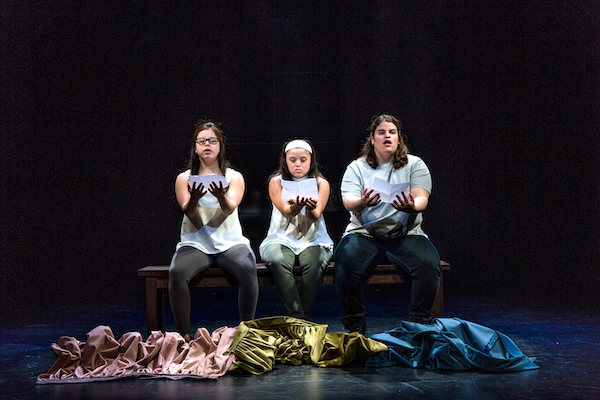
In this production, the role of Hamlet is not performed by a single actor. Instead, multiple disabled actors with Down syndrome embody different facets of the character, each bringing their own experiences, bodies, creative voices, and interpretations to the stage. This shared portrayal dismantles ableist assumptions about developmental disability and confronts lingering taboos surrounding love, sex, friendship, and autonomy – tropes that continue to frame disabled people as infantile, sexless, loveless, and burdens within capitalist systems. The result is a deeply moving, multi-dimensional performance that centers disability not as a deficit, but as a source of generative, political, and creative power.
Each performer also chose an additional character to play, expanding the narrative into a layered dialogue between selves, histories, and perspectives. This structural decision reinforces the production’s core ethos of interdependence – not only among characters, but within the ensemble, the creative process, and the relationship between performers and audience.
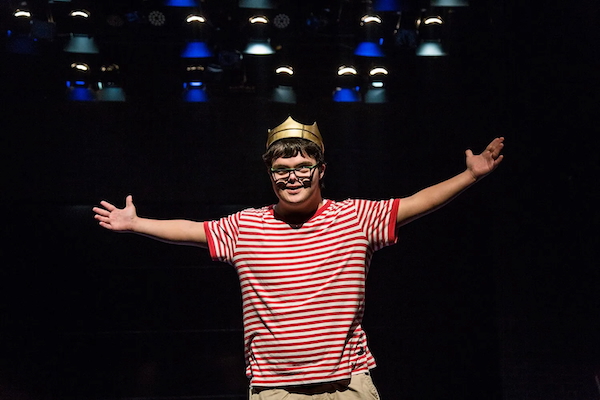
The Spanish-language performance includes English subtitles and is staged as a relaxed environment where audience members are welcome to stim, move around, or vocally express emotion. At the beginning of the play there is an access check-in that welcomes the audience while making a firm statement: if anyone feels discomfort around disability, or impatience toward tics, stimming, or atypical speech, they are free to leave. This unapologetic framing reclaims the theatrical space – empowering the audience to be fully present and to engage with art on terms not often permitted in traditional theatre, where formality and rigidity routinely exclude those who do not or cannot conform.
De Ferrari’s direction, in close collaboration with the cast and creative team, treats access not as an add-on but as a driving aesthetic. Access becomes dramaturgy. The pacing, language, and staging arise directly from the needs and strengths of the ensemble, allowing care and adaptation to shape the work from within. The cast used the rehearsal process to personalize the scenes incorporating their conversations, adaptations, and even existential reflections into the final script.
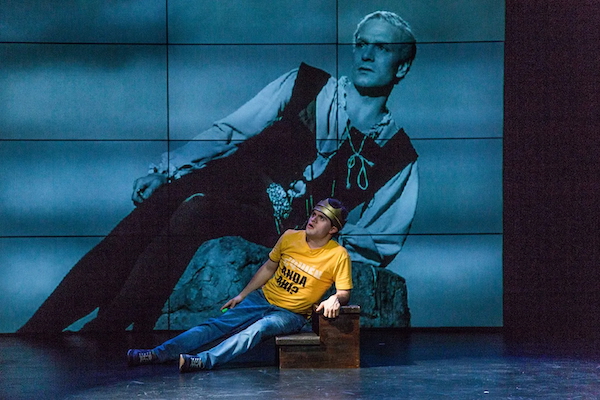
In one powerful moment, Cruz reflects on the difficulty of embodying the character of Hamlet, as images of past portrayals flash across the backdrop. These portraits show a Hamlet who is always able-bodied, white, and stereotypically masculine. Jaime, lying on a stool and wearing a crown, quietly wonders whether he can truly be Hamlet. This juxtaposition lays bare the normative boundaries of theatre and opens a window into the possibility of radical reinterpretation. His question cuts through the air, revealing how deeply the politics of casting have shaped theatrical history – and how radical it is to reimagine who gets to inherit these roles.
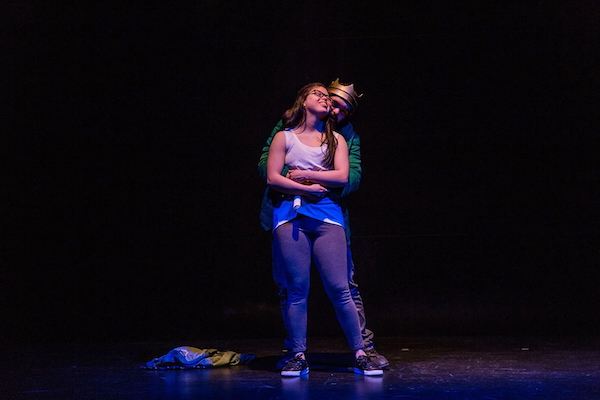
In the scene of Ophelia’s dream, actor Ximena Rodríguez delivers one of the production’s most haunting and poetic moments. In this dream, Ophelia has drowned – but underwater, she finds Hamlet. The two rest beside each other, culminating their love in a final act of tenderness. The scene is projected from a bird’s-eye view, zooming in on their gentle gestures and caresses, offering a vision of intimacy beyond language – fluid, quiet, and profound.
Ultimately, Teatro La Plaza’s Hamlet is not merely an adaptation – it is a transformation. It demonstrates that canonical works can be reimagined through the lens of disability justice to more truthfully reflect the complexity of the human condition. In doing so, it offers a glimpse of what theatre can become when care, collectivity, and access are not only included, but made central to the creative process. It asks what happens when we center disabled bodies, minds, and ways of relating, not as metaphors, but as the heart of the story. It shows us that care, access, and collective authorship are not just support systems; they are the art.
Jet Coghlan is an Autistic, Queer, Disabled, Mad researcher and performance artist, and the Digital Coordinator at Tangled Art + Disability.