Jerry Evans at Owens Art Gallery, Sackville
By Jon Claytor
As I approached the gallery, I heard the sound of wind and footsteps on snow accompanied by a soft piano melody. I entered and sat on a wooden bench. Behind me were four old drawings of maps and people. In front of me was a huge black-and-white projection of trees. The trees faded into a line of figures walking across a snowy field. They walked with determination and purpose. Hand drawn maps and sketches of the walkers dissolved in and out of the frame. The video returned again and again to the walkers as they moved closer to the forefront of the image. Then the trees returned, mirroring the walkers moving in a line across the screen. The sound of footsteps stopped and there was silence. It hit with an indescribable feeling: the maps and sketches intertwined with the portraits and the people walking evoked a deep history
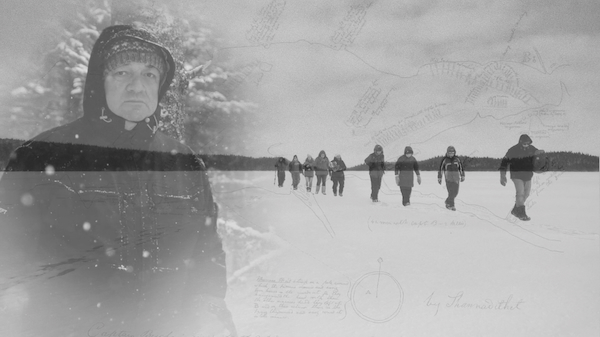
Jerry Evans, Mekwe’k L’nu – The Red People, 2023, video
The video, titled Mekwe’k L’nu – The Red People, is part of Mimajuaqne’kati | Place of Life, a solo exhibition by Ktapmkuk-based Mi’kmaw and settler artist Jerry Evans. But the four drawings on the back wall are by Shanawdithit. The exhibition booklet tells us that she was a Beothuk woman, “captured by European settlers in 1823 and displaced to St. John’s in 1828.” She made many drawings that document the Beothuk way of life and mark the genocide of the Beothuk people. Evans has, in a way, collaborated with her by using parts of these images in his video. He connects the past with the present, questioning colonial history such as the idea that Shanawdithit was the “Last Beothuk.” The exhibition booklet states, “oral histories by Mi’kmaq from Ktapmkuk refute this claim and acknowledge the interwoven histories between the two peoples.” Evans’ video layers meaning, memory, place, and history with the emotional presence of past and present simultaneously walking across the screen.

Jerry Evans, Red Ochre, 2009, video
A second video, titled Red Ochre, followed the first. It begins with the camera high above an open expanse as it moves closer and closer to the earth. A door appears, then opens, inviting the viewer into a world of super-8 films, creativity, and family. There are sounds of laughter, luminescent greys and blues, big smiles, gatherings, and dancers in regalia. The moving images morph into paintings and prints. We see the artist at work in the studio, and get a sense of how he uses family documents as inspiration. The last images are of a father and child standing in front of a teepee as the camera moves skyward. It fades to the sound of singing. The catalog describes the video as presenting, “a personal, impressionistic rendering of what it is like growing up Mi’kmaq in Newfoundland, while living in a culture of denial.” Again, Evans collaborates with the past, and the effect is ephemeral and endless all at once.

Jerry Evans, Mimajuaqne’kati — Place of Life, 2019, lithograph
I watched and rewatched these two films, and spent time with Shanawdithit’s drawings before moving to the next room full of Evans’ prints. They are similar to the videos in mood and evocation of life cycles and migration. Animals move across the paper in works such as Seasonal Round from 2001 and Migration Cycles from 2002. Prints such as Living Spirits from 1999 are evocative and touching portraits that seem to move emotionally between past and present. This is a powerful exhibition that covers thirty years of Jerry Evans’ career. I left the gallery knowing I’d be back. In fact, I went back as soon as I finished writing this review.
Jerry Evans: Mimajuaqne’kati | Place of Life continues until September 15.
Owens Art Gallery: https://owensartgallery.com/
The gallery is partially accessible.
Jon Claytor is an artist living and working in Sackville, New Brunswick.