James Jean at CICA Vancouver
By Lin Li
Walking into James Jean’s solo exhibition at CICA Vancouver, visitors are greeted by the barely legible title of the exhibition, printed in silver-coloured vinyl with custom graffiti-styled typography, on a pink-painted gallery wall alongside the introductory exhibition text. This title, Meadowlark, as well as the introduction, sets the tone for the richly-hued exhibition space that features Jean’s most recent paintings, sculptures, and animated video. Meadowlarks are a bird breed known for their mastery of mimicking the calls of other birds. This adaptability echoes the artist’s experience of migration as well as pluralism in his creative process, while the text fonts are designed to be unreadable and psychedelic, implying “a loss of language [and] the struggle to decipher symbols and to communicate.”
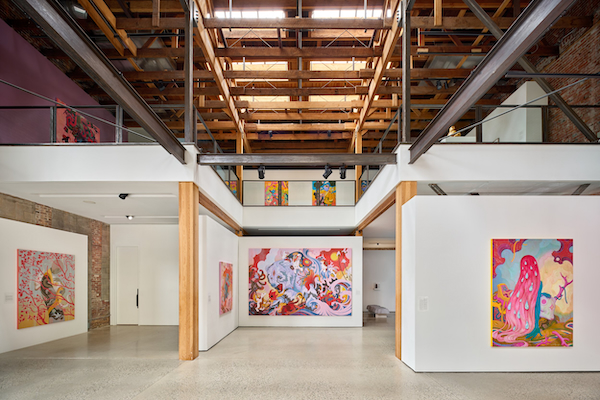
James Jean, installation view of Meadowlark exhibition, 2024 (courtesy of CICA Vancouver; photo: Brandon Shigeta)
This long-awaited return of Jean’s art to North America after a series of successful exhibitions in Asia introduces visitors to a world of fairy tales, mythologies, and vicious imaginations, blended into the artist’s continuous exploration of his multifaceted identities as a Taiwanese American by, as he says in this interview, “combining elements from the East and the West.” We see motifs and icons from East Asian cultural heritage, including but not limited to literati rocks, abstracted Chinese radicals, ink-wash landscape paintings, Asian instruments, and celebrated beasts like cranes and deer. Meanwhile, drawing on his experience as a renowned DC comics cover illustrator, Jean also incorporates icons from pop culture. For instance, the main character of Study from 2023, displayed on the second floor of the gallery space, is based on a popular Capcom game character. Centred on a Mega Man-looking boy sitting at a study table, this work is a good example of how the artist uses visual clues from Asian culture, combines them with memories of his family history, and integrates everything through his dreamlike world decorated with icons of pop culture. In parallel, Jean’s visual universe, often perceived as a fantastical dreamscape, subtly reveals underlying themes of sorrow and ambiguity. This is particularly evident in the portrayal of scars, wounds, and sombre expression of the painting’s protagonist. These elements contribute to a layered narrative, offering glimpses of vulnerability and psychological nuance amid the whimsical settings.
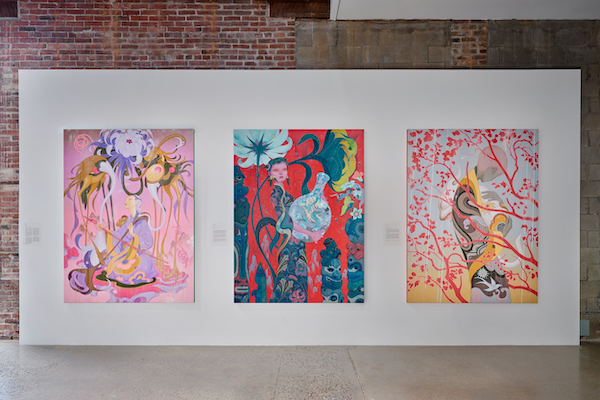
James Jean, installation view of Meadowlark exhibition, 2024 (courtesy of CICA Vancouver; photo: Brandon Shigeta)
In addition to presenting a selection of works showcasing the artist’s continuous exploration of diverse media, Meadowlark also highlights the artist’s study of colour through a display of both hand drawings and digital drafts of his paintings. These drafts illustrate the artist’s use of tools like Photoshop to determine his colour choices, offering viewers insight into Jean’s creative process and especially his bold application of highly saturated hues. To further enhance the visitor’s comprehension of Jean’s practice, all the works are accompanied by informative labels that provide brief visual analyses and introduce key conceptual elements of Jean’s work.
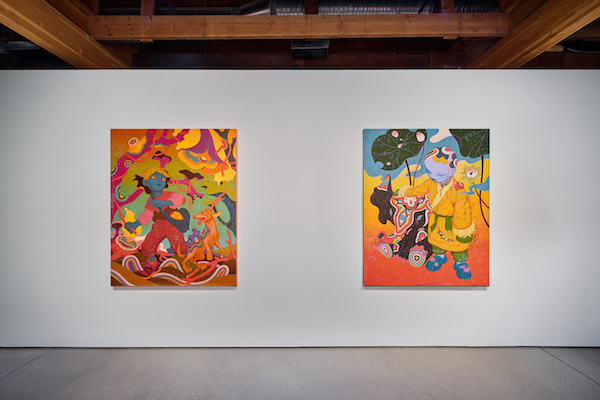
James Jean, installation view of Meadowlark exhibition, 2024 (courtesy of CICA Vancouver; photo: Brandon Shigeta)
While these labels reflect a meticulous curatorial effort for public education, over-generalization and misappropriation is evident in some of them. For example, the label accompanying Alluvium from 2024 references the main character wearing “a traditional Chinese dress (cheongsam in Cantonese and qipao in Mandarin),” but this overlooks the fact that the qipao, which emerged in China after the 1920s, has a relatively brief history and is viewed as “the clothing that represents Chinese women, in the eyes of foreigners” (for more information, check out the book History of Social Life in Modern China (1840-1949)). Additionally, labels for Erhu II from 2024 and Study describe similar visual motifs of ink landscapes as “contemplative shan-shui (mountain and water) paintings of the Song dynasty” in the former and as “mountains reminiscent of Japanese scroll painting” in the latter, without offering further explanation or references to the specific sources or origins of these motifs.
James Jean: Meadowlark continues until September 15.
CICA Vancouver: https://cicavancouver.com/
The gallery is partially accessible.
Note: A reservation is required to visit the show.
Lin Li is an independent curator and writer based in Vancouver, on the ancestral and unceded territories of the xʷməθkʷəy̓əm (Musqueam), Sḵwx̱wú7mesh (Squamish), and səlilwətaɬ (Tsleil-Waututh) Nations. Her curatorial interests encompass a variety of topics, such as the decolonization and decentralization of Asian art, the identity crisis in an age of globalization and digitalization, and the contradictory, interconnected relationship between art and technology. She holds a Master degree in East Asian Studies from the University of Alberta.