Gift Tshuma on Accessibility and Improvisation
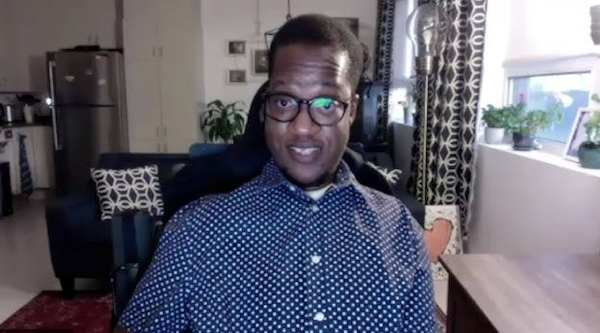
Gift Tshuma is a musician, technologist, and disability-rights advocate who will be presenting a talk entitled Unscripted: How Disabled Creativity Reshapes Art and Community as part of this weekend’s Haptic Horizons Art Symposium in Hamilton. Akimblog recently spoke with him about making music, making instruments, and making trouble.
I grew up around gospel music since I was five years old and had my own gospel group for about twelve years. I composed songs for a six-piece band with ten vocalists, and relied on music technology quite a bit, but the technology I was using didn’t have any accessibility features to make my work easier. I had to rejig the gear and figure out how different pieces of musical software could communicate together to produce the outcomes that I was hoping to achieve. That started very early on, when I was a teenager, about twenty years ago.
The technology I was using at the time didn’t meet my accessibility needs. Most of the software that exists right now has accessibility features that are split into categories of disabilities, like for physical access or for sensory needs. But that didn’t exist at all at the time. Since I cannot physically hold an instrument, I had to combine different tools. I used vocal pitch correction software called Melodyne to voice out the melodies of the instruments that I wanted. I’d save them as MIDI files and transfer those files into software called Digital Performer to create MIDI instruments. Then I’d use something called Sibelius to create musical charts, so that I could give musicians sheet music and they could play what was in my head.
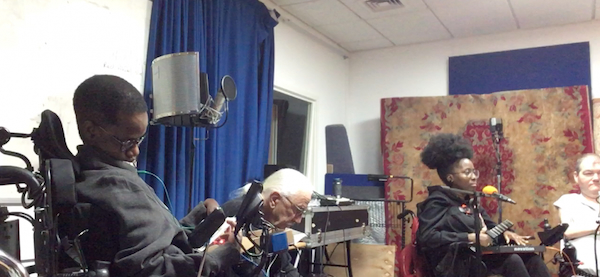
(photo courtesy of Blurring the Boundaries)
When I started doing music, I didn’t know any artists with disabilities who were working in the same genre that I was. I didn’t have as extensive a network as I do now. I just had to figure out how to make it work for myself and made do with what I had. I’m much more connected to the disabled artist community than I was twenty years ago. All this started about seven years ago with the pandemic when a friend of mine was trying to figure out how people could have jam sessions remotely without having to meet in person and put their health at risk. We were able to create digital instruments that could communicate with each other without any lag. In doing so, we created spaces where people could still have an outlet for musical expression at a time where there was a lot of isolation happening around the world.
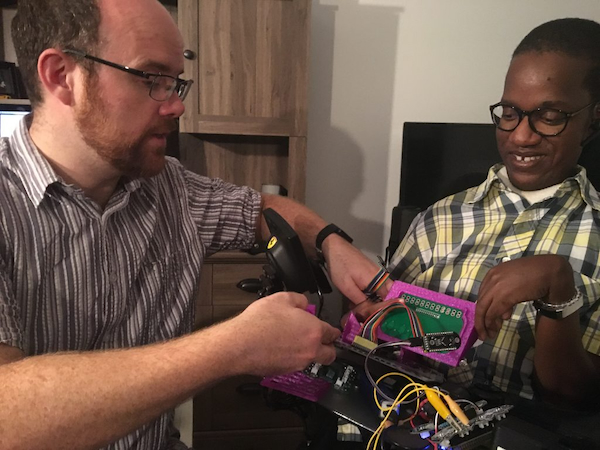
(photo courtesy of Blurring the Boundaries)
Right now, I’m working with business partners to create digital musical instruments that are built with accessibility in mind from the ground up. I’m working with other artists with disabilities who are able to bring a different perspective on access to mind. I’m working with music technologists who know how to speak the language of programing, who are able to bring the vision that I have to life. It’s important that we create instruments that you’re able to play live. Our instruments don’t look like conventional instruments, but are able to achieve the same level of expression and creativity as a conventional looking guitar or as a conventional looking keyboard. For example, you’d have a flashlight and tinfoil that is triggered with sensors. Depending on how much I expose the light to those sensors, I’m able to produce either a guitar sound or a keyboard synth sound, and I’m able to perform alongside someone who is playing a conventional unaltered instrument.
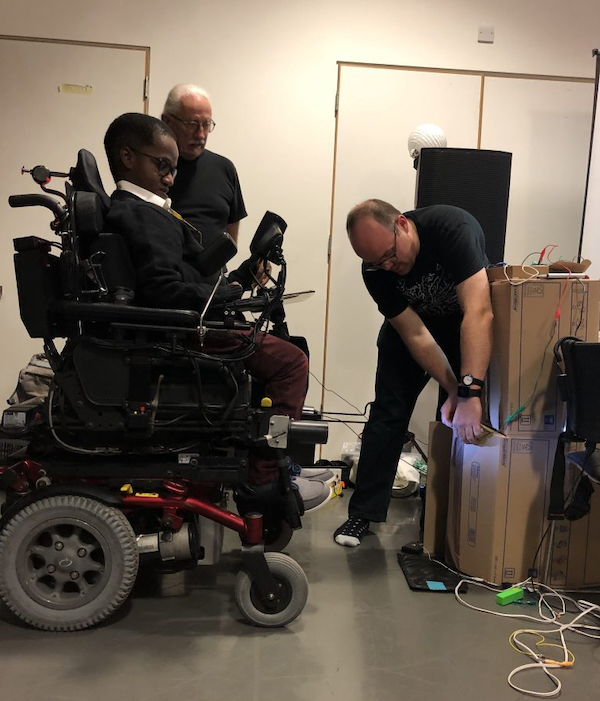
(photo courtesy of Blurring the Boundaries)
I want to take into consideration as many disabilities as possible. As a person with a disability, I do have a lot of expertise, but it’s hard for me to fully take into account all of the access needs that are out there, which is why collaboration is super important. Wherever I don’t have that expertise, I pull in other artists who are able to bring their expertise to inform the research and development phase of that digital instrument. For example, I’ve worked with David Bobier of VibraFusionLab. We’re able to partner together and explore how these digital instruments can communicate with his vibrotactile devices, how they can connect to the vibrations of the life jacket or the pillow that he’s using. My organization is called Blurring the Boundaries because I am trying to blur the boundaries that are imposed on us, as artists, so that we can achieve musical expression as much as possible.
The speech that I’m giving at the conference this Saturday is about the art of improvisation and how improvisation can be woven into every part of your artistic life – not just in performance, but also in the discovery of what you can do. My past use of musical software that wasn’t designed for my needs involved a level of improvisation, and that came natural to me because of gospel music. I was surrounded with singers and musicians in the Black gospel church where none of the people had formal musical training. They just picked up an instrument, learned it by ear, and played it like a virtuoso. Same thing with vocals. I used that skill to inform my musical practice. Regardless of your musical background or your musical ability, if you have the drive to improvise, the sky’s the limit in terms of how much you can create. By daring to push those boundaries, you’re opening up space for other people to contribute to the creation of something beautiful. That’s the approach I’ve always tried to take on as an artist.
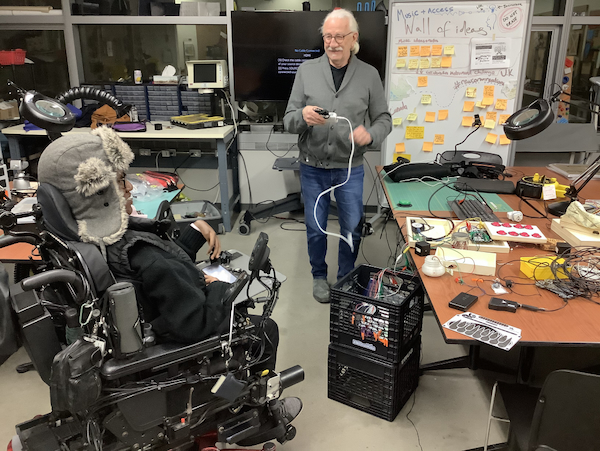
(photo courtesy of Blurring the Boundaries)
Improvisation plays a huge part in my life beyond music. It plays into my day-to-day life where I have to navigate spaces and systems that aren’t accessible. If something’s not designed with you in mind and you want to be included or you want to contribute, you have to make space for yourself. You have to create a path where there’s no path. And to create a path where there’s no path, you need to improvise. You need to figure out how to do that. When it comes to employment or when it comes to education, that’s the approach I’ve taken. Improvisation requires you to be nimble. It requires you to be flexible and adapt to the different altitudes of life, the different barriers, to get to what you want.
Being disabled is something that disabled people navigate on a daily basis. They’re always improvising. They’re improvising how to get themselves dressed if they have reduced mobility. They figure out how to do things. They’re still able to drive. They’re able to paint. They adapt. They improvise. If your mind or your body is forced into a situation, you learn to adapt quickly and work with what you have. That’s improvisation. Everyone has the capacity to improvise when they are put in the right situation or where they have no choice but to do so.
Improvisation is a form of advocacy, and it’s also a form of rebellion. It’s an act of saying that you’re not accepting the status quo. You’re not accepting the way things are supposed to be in order for you to be right. In order for me to be me, I need to create some sort of discord. People should not be afraid to bend the rules, to push the boundaries, and to create different pathways. When you don’t do that, you’re robbing yourself of expression, you’re robbing yourself of being included or having a seat at the table. Dare to redefine the rules and dare to create your own pathway if a pathway is not made for you – whatever that pathway may be. It could be an artistic expression. It could be in community. It could be in employment. Wherever, whatever that looks like in your life, dare to improvise.
Note: Haptic Horizons will livestream all of their symposium presentations. A link to join the broadcast will be posted online once the symposium is live.