Frida Orupabo at VOX, Montreal
By oualie frost
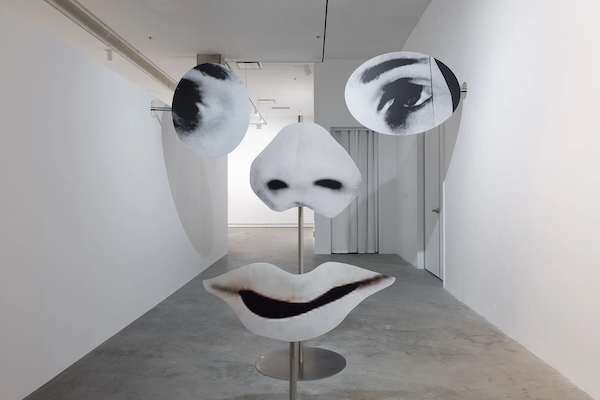
Frida Orupabo, Of Course Everything Is Real, 2024, installation view (photo: Michael Patten/MOMENTA)
A giant disembodied face gazes vaguely at the viewer as they enter the gallery to visit Oslo-based artist/sociologist Frida Orupabo’s Momenta Biennale exhibition at VOX. Each feature, separate and large, pierces the attendee in a confrontational way. Examining the gaze foisted upon Black women, On Lies, Secrets and Silence considers how this objectification manifests, how it affects those to whom it is directed, and the stark realities from which it emerges. Walking through the face and turning into the exhibition space, I am approached at all angles by art. From near foot level to above my head, Orupabo’s works are displayed on plinths and along the walls, creating a jarring sense of scale where I cannot tell if I am tiny or large.
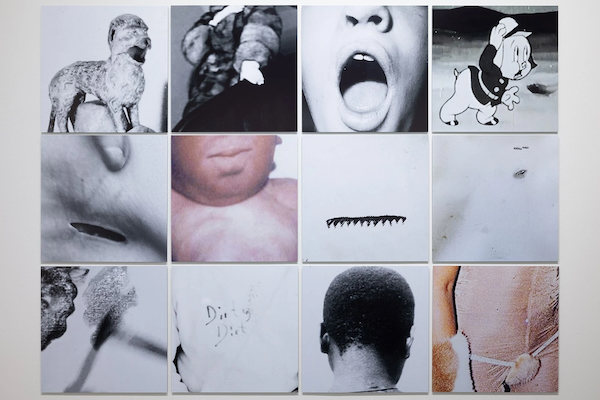
Frida Orupabo, Cloud of Confusion, 2024, installation view (photo: Michael Patten/MOMENTA)
Aptly called Cloud of Confusion and mounted in a grid on one wall are twelve images. Each close-cropped snapshot is barely identifiable: a cartoonish pig, an open mouth, “Dirty dirt”, a head of hair, stab wounds, more. These pictures feel pathological, as if they come from textbooks – be they colonially ethnographic, medical, or forensic. Near them on plinths are On My Hands and Knees II, aluminum CMYK prints, relatively literal to their name, belying a sense of frustration, domesticity, and subjugation. The notion of home is also brought into the exhibition through multiple works such as Objects and Comb. The former, cut-out prints of a house, comb, underwear, and a shoe; and the latter, a collaged comb with a face where the teeth are, speak to the way Black women’s bodies, and specifically their hair, become political sites under the societal gaze.
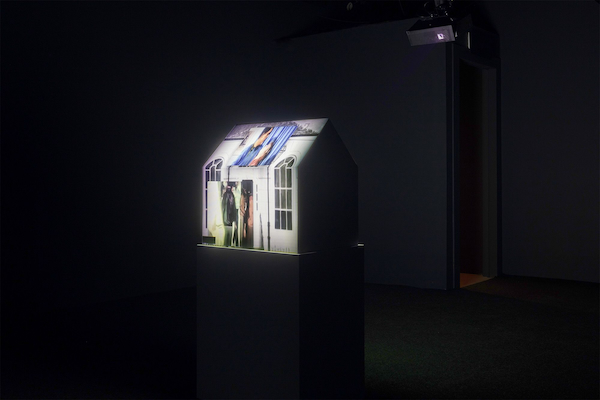
Frida Orupabo, House Party, 2024, installation view (photo: Michael Patten/MOMENTA)
A troubled sense of home is furthered with the addition of House Party, where scenes of a party are projected onto a house while a man with a dripping face forces a kiss onto an uncomfortable woman. There is a horror movie quality to it all, which presents the home not as a place where one could escape the gaze, but as a potential site of violence. “I’m depressed,” says the audio component of the video work, “I don’t have peace of mind.” A different voice replies that they don’t understand what the speaker means, exemplifying the effects the violent gaze has on Black women’s mental health and the lack of empathy and understanding surrounding it.
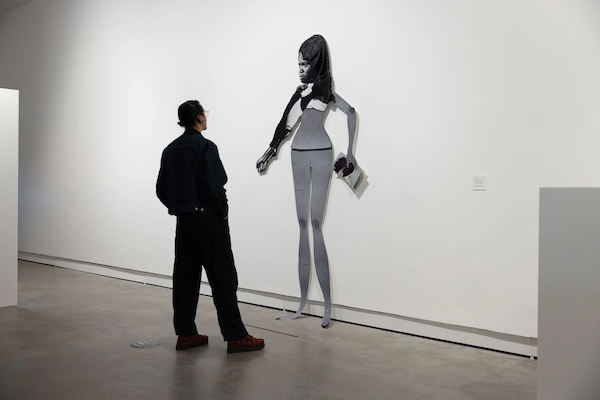
Frida Orupabo, Big Girl I, 2024, installation view (photo: Michael Patten/MOMENTA)
Despite all this, there are the two Big Girls (I & II), larger than life, collaged metal prints of women – determined, disinterested, poised. Consisting of multiple layers of images bolted together, these girls have depth beyond the shallowness the gaze affords them. Big Girl I seems to be wearing armor and carrying a baton, showing that big girls fight back; they will not be held down or defined by what the world tells them they are.
In On Lies, Secrets and Silence, Orupabo exposes the weight of the gaze by playing it back at the viewer and presenting figures of defiance. In its disquieting nature and through the staring face with which it opens, the exhibition enacts on each visitor a small fragment of the discomfort the white patriarchal gaze causes Black women to feel. In a sense, on entry one enters a staring contest: prepared to gaze at a gallery, one finds the gallery gazing back.
Frida Orupabo: On Lies, Secrets and Silence continues until November 29.
VOX, Centre de l’image contemporaine: https://centrevox.ca/en
The gallery is accessible.
oualie frost is a casual artist, writer, and activist currently based in Tiohti:áke/Mooniyang (Montréal) whose writing centers primarily around the art and experiences of Black, mixed-Black, and other racialized people, as well as loose cultural critique. They are a former founding member of the Afros in the City media collective, with writing published on various platforms, including Akimblog, the Rozsa Foundation, and Canadian Art.