Evan Penny at Blouin Division, Toronto
By Terence Dick
The enticing, troubling, perturbing, and, some might even say, poetic thing about generative AI is that even the experts don’t know exactly how it works. ChatGPT and its cohort were released on the world with only an inkling of their impact and have run rampant in our collective imagination. As a writer, I have had a hard time seeing anything but the worst in this technology. As a critic, I should have predicted that the creative potential of these tools would best be revealed by artists rather than programmers or promoters. It took sculptor Evan Penny’s recent exhibition at Blouin Division’s Toronto gallery for that penny to drop.
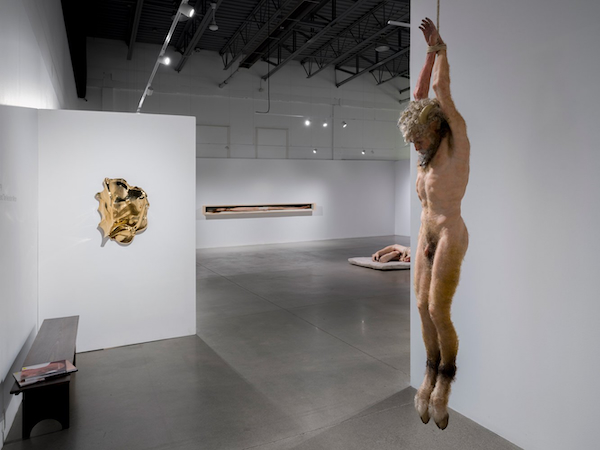
Evan Penny, Marsyas and the Venetian Mirror, 2024, installation view
With his long history of crafting depictions and distortions of the human form, Penny is well suited to engage with the means as well as the meaning of machines that purportedly learn like we do and emulate our ability to represent or reflect the world – albeit at extremely high speed and, depending on the prompts, with unpredictable results. But Penny has never been an artist to traffic simply in novelty (though the “surprise” factor in his work has often been part of its initial appeal); his mind is too far ranging to limit his art to illustrating effects. In the body of work gathered under the exhibition titled Marsyas and the Venetian Mirror, he draws on ancient Greek myth, distorting mirrors, hand prints, flayed skin, body horror, cellphone selfies, and more to trace a network of relations across human history and entertain the possibility that what seems to be the newest jewel in our creation is actually as old as time immemorial. We’ve been wrestling with the limits of our identity since the first time we caught our reflection in a puddle of water.
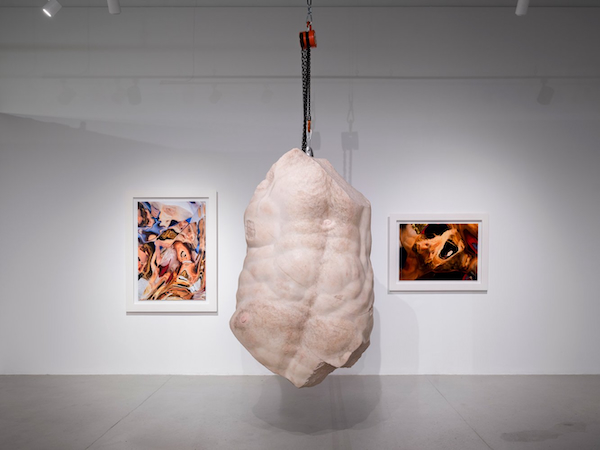
Evan Penny, Marsyas and the Venetian Mirror, 2024, installation view
The exhibition is bookended with two striking suspended figures that serve to draw the viewer in while also holding them back. At the entrance, a hyper-realistic depiction of the chastened satyr who failed in his attempt to challenge the god Apollo greets visitors and invites them to be intrigued and repelled by the uncanny nude body. The final work is a giant torso carved in stone (though with chest hair intact) and supported from the ceiling with a heavy chain. It too is beautiful and imposing in equal measures, and confronts one with the fact of the body as not just a material thing but also the catalyst for self-reflection out of which art emerges.

Evan Penny, Venetian Mirror 3, 2021, gold-plated bronze
As an added bonus, there is a secret interactive aspect to the exhibition whereby visitors can replicate the fun-house mirror images of Penny’s creations by taking a picture of themselves in the reflection of seemingly abstract gold sculptures that are in fact molds of the inside of the artist’s hand created when grasping clay. From this primitive imprint through the selfies and now into the world of artificial intelligence, we have generated versions of ourselves and had to deal with the implications of our creation. Penny helps us understand that the cutting edge of technology is rooted in an impulse we’ve had for millennia.
Evan Penny: Marsyas and the Venetian Mirror was on display from September 14 to October 26.
Blouin Division: www.blouin-division.com
The gallery is partially accessible.
Terence Dick is a freelance writer living in Toronto. He is the editor of Akimblog.