Erica Rutherford at Owens Art Gallery, Sackville
By Jon Claytor
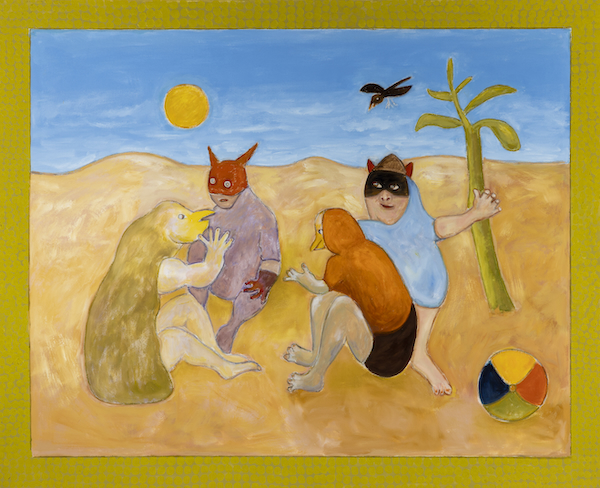
Erica Rutherford, Whispers, Human Comedy Series, 2000, oil on canvas (courtesy: Confederation Centre Art Gallery, ©Estate of Erica Rutherford)
The exhibition of Erica Rutherford’s paintings and prints currently on display at Owens Art Gallery takes place in two rooms, and they could not be more different. One is a calm, deep, rich exploration of mostly tertiary hues (green, purple, orange) and balanced blocks of colour. Every shape is meticulously planned, as is evident by the still visible pencil marks. There is harmony and peacefulness, but also mystery. The figures are solitary with eyes unseen or hidden, and the landscapes, although bucolic, are eerily absent of figures. Then there is the explosive cacophony of the second room. Each painting is a theatrical dreamscape of unique figures that is deeply emotional and encompasses a strange and mythic society. It is at once grandiose and grounded. The work in both rooms is a thrill to the senses and the mind, and the pleasure is heightened by the daring and delightful contrast between the two.
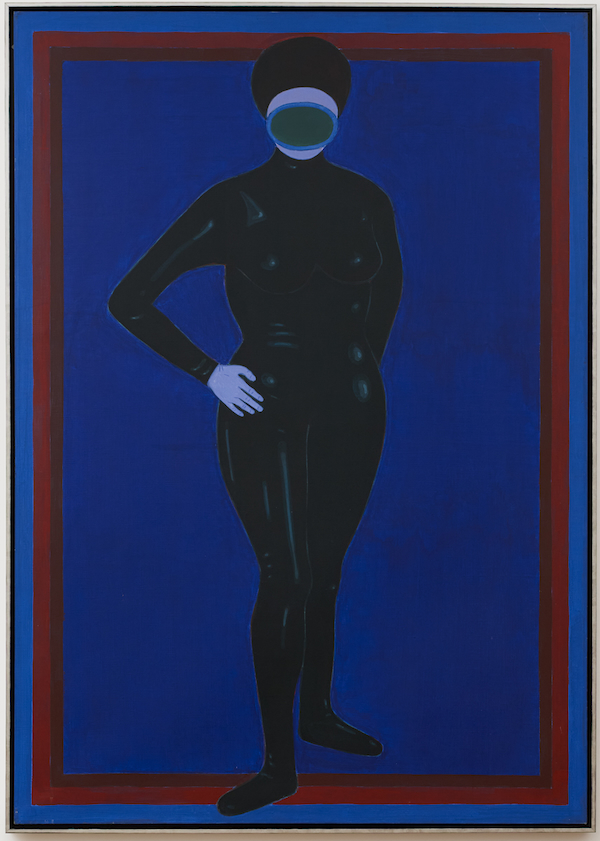
Erica Rutherford, The Diver, 1968, acrylic on canvas (courtesy: National Gallery of Canda, © Estate of Erica Rutherford)
The first room contains the earliest works (1968 to 1980). The paint is applied flat and opaque. The shapes of colour are simple, but instantly convey figures (always solo) and rural landscapes (always devoid of figures). Rutherford is a colourist, and there is such magic in her use of colour – how it draws out emotion in its relation to the colour beside it and imbues the composition with extra meaning. In The Diver (1968), a masked diver in a black suit confronts the viewer head on. The figure is painted on a background that skirts the definition of purple and avoids being considered true blue. The colour, the figure, and the title create a mood that remains out of reach. Perhaps this is the key to the exhibition, for a diver dives to discover, asking only what is out there in the deep, in the almost blue of the ocean.
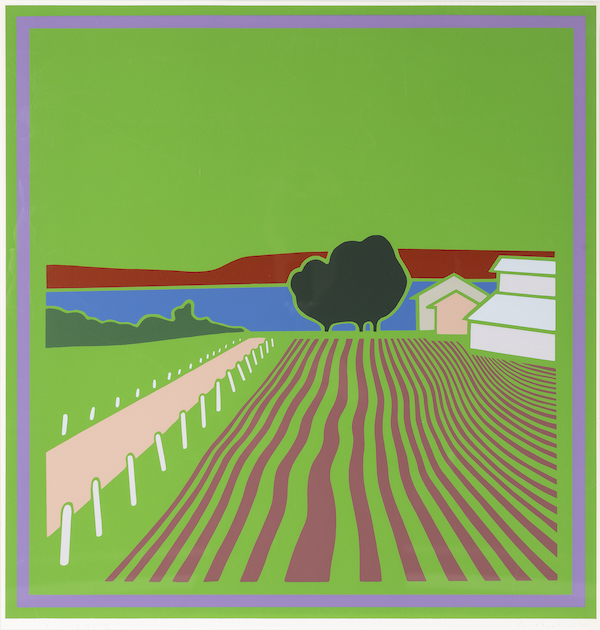
Erica Rutherford, Earnscliffe, PEI, 1978, serigraph on paper (courtesy: Confederation Centre Art Gallery, ©Estate of Erica Rutherford)
And then there are the landscapes. All rural scenes, all without people. The colour palate achieves a balance of mostly tertiary colours (not easily done), which creates a feeling of contentment and mystery, as if a peace has arrived but not without something still to be revealed. Tertiary colours, the colours that are made by mixing primaries, exist between extremes. They are nuanced, full of layers, and have a certain sensitivity. They exist in harmony or discord, as a reaction to colours beside them. In these paintings, while the figures are solitary and the landscapes are absent of humans, the colours are having a conversation, dancing together, creating an ecosystem. The fact that Rutherford had gender affirming surgery shortly before painting most of these in PEI, where she moved in the 1970s and had found a new peace and a degree of acceptance, may be one part of the complicated harmony these paintings reflect. In her autobiography Nine Lives, she writes, “I felt at home [in PEI] for the first time since I came to America.” A simple sounding statement, but like her paintings, nowhere near as simple as it appears. Her art offers a complexity of colour and hue existing in harmony, but not without a lifetime of experience and knowledge at work behind the scenes.
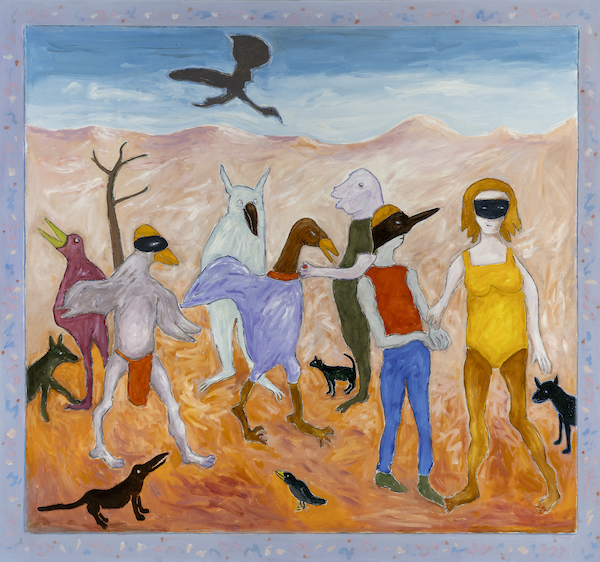
Erica Rutherford, The Reunion, Human Comedy Series, 1997, oil on canvas (courtesy: Collection of the Rutherford Family, ©Estate of Erica Rutherford)
The second room is so incredibly different. In these paintings, creatures of all sorts mix and mingle with human-like beings in a desolate landscape. Theatrical and mysterious, everyone appears to have a role to play, even if the nature of the role is not immediately evident. The colours are brighter, though still muted, and more primary colours appear and energize this strange and wonderous symphony. I felt thrilled, excited, and in awe as I took in the various scenes, filled with freedom, seduction, drama, and mythos. Works such as The Reunion (1997), may be an echo of Erica Rutherford’s time as a set designer in England in the 1940s. The figures appear as if on a stage, mid-conversation, arguing about the big questions. I like to think the artist’s personal journey led her to this moment where she could find space to turn from the internal to the external. Here she examines the world around us. The characters in The Reunion seem to be asking: Why are we here? What can we give? What do we ask for? How are we satisfied? Rutherford approaches these philosophical inquiries with a sense of humour and playfulness. After all, the abyss is too dark to explore without protection. Just think of that diver. But even so, these paintings will consume you if you let them, and I dare you to resist. The tragedy here is that shortly after Rutherford reached this magical state of connection with raw creativity, she entered the early stages of dementia. Some of these paintings were completed shortly after her diagnosis, and she was never able to see where this new way of painting would lead her or to experience the later success of her work.
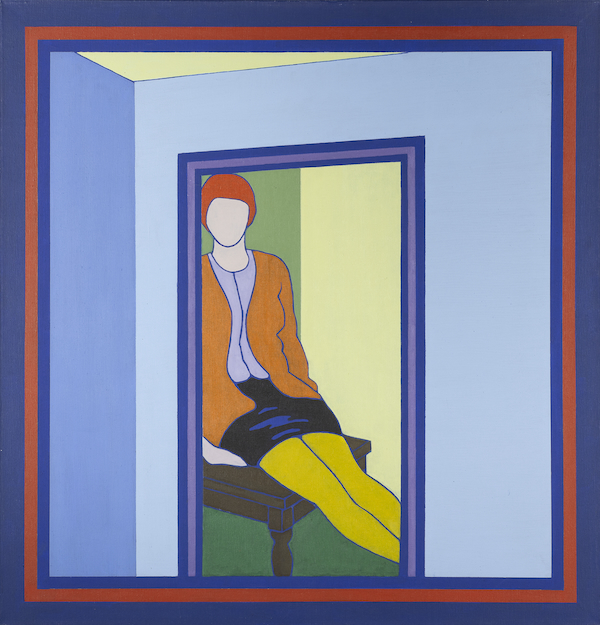
Erica Rutherford, Self-Portrait with Yellow Stockings, 1971, acrylic on canvas (courtesy: Art Gallery of Nova Scotia, ©Estate of Erica Rutherford)
This traveling exhibit coincides with an excellent book Erica Rutherford: Her Lives And Works (Goose Lane Editions, 2026, edited by exhibition curator Pan Wendt). The book explores her incredible life and work in detail, and I highly recommend it. What a life, what a journey, what an inspiration she was, and what fascinating paintings were left behind as her legacy.
Erica Rutherford: Her Lives and Works continues until September 13.
Owens Art Gallery: owensartgallery.com
The gallery is partially accessible.
Jon Claytor is an artist living and working in Sackville, New Brunswick.