CreativePEI on AI in the Arts: Automating Creativity & Outsourcing Equity
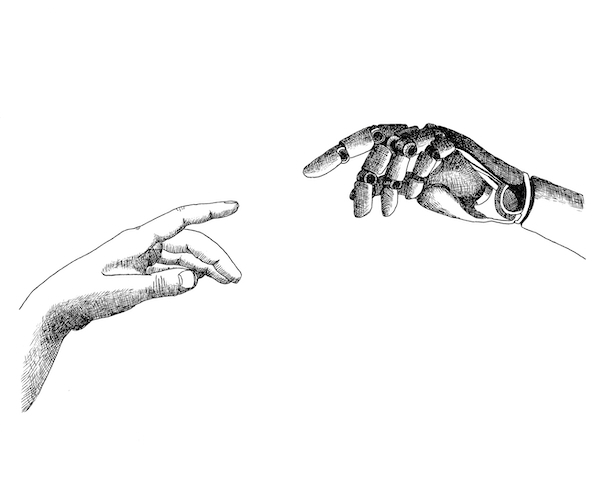
Alexis Bulman, hand-drawing of an AI-generated image, 2026, ink on paper
A participant in a recent roundtable on arts, culture, and artificial intelligence in scenic Prince Edward Island reflected on seeing an AI-generated image of PEI: “The more I looked, the more uncanny the image. I wondered, Where is this? Nowhere. Diversity and culture are what they want to show [in marketing PEI]. If we lose the distinctiveness of those things, I wonder if the idea of PEI has anything left.”
Prince Edward Island is the smallest province in Canada, both in land mass and population. To scale, our arts and culture community is also small, but we punch well above our weight. Take Lucy Maud Montgomery for example, whose stories have travelled the world and continue to resonate with readers across generations. Despite this rich creative legacy, established internationally well before the computer age, PEI’s creative sector is being affected by the global obsession with artificial intelligence in ways that touch our creative identity.
Our island and its creative sector are vulnerable to government choices around AI, because it is the only province in Canada without an independent, arms-length arts council. In 2016 the PEI Council of the Arts was dissolved, with its art grant programs taken up by Innovation PEI, a provincial government agency. In February 2026, the umbrella department for Innovation PEI was renamed the Department of Economic Development, Trade and Artificial Intelligence, while the word “culture” disappeared from the name of any provincial department.
PEI’s creative sector is grappling with questions about the growing influence of artificial intelligence in a context with multiple uncertainties. For artists and arts workers with disabilities and/or neurodivergence, uncertainty about the future of the arts intersects with existing barriers to participation and sustainability.
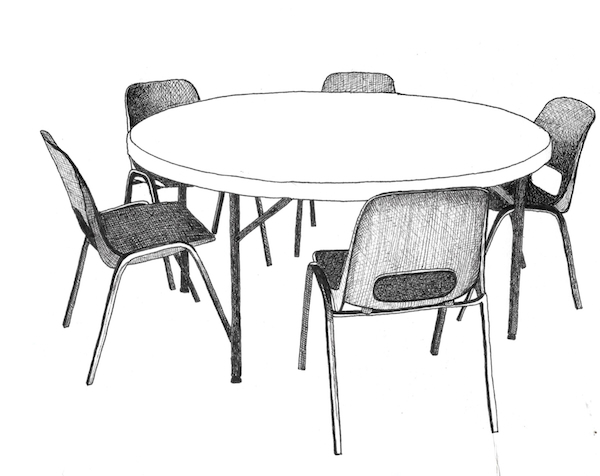
Alexis Bulman, Round table, 2026, ink on paper, hand-drawing of an AI-generated image
To better understand these concerns, CreativePEI, the sector council representing Prince Edward Island’s arts, culture, and creative professionals, hosted a series of five roundtables exploring the intersections of arts, culture, and AI. One roundtable focused specifically on Access, Inclusion, and AI in the Arts and Culture Sector, though accessibility and inclusion were discussed across the other conversations as well. Several priorities emerged, including accessibility-focused training, grant-writing support, advocacy skill-building, and community-based learning. Roundtable participants emphasized the value of human connection and peer support, insisting that AI should complement, not replace, the relationships and supports that make meaningful participation possible.
“AI is seen as a support for vulnerable populations, but is it truly equitable when it is used because structures and workflows are lacking equity and accommodation? When human training and skill-building is missing?” (from CreativePEI’s Artificial Intelligence report)
A tension surfaced in conversations with disabled/neurodivergent artists working professionally in the sector. Several described relying on AI as an accessibility and accommodation tool when health-related barriers make administrative tasks difficult. The pressure of art grant applications, proposals, and other competitive deadlines can be immense, particularly in a system with few accommodations for individual needs. For some, AI has become a way to keep pace with their non-disabled and neurotypical peers.
It makes you wonder if, in this case, AI is a band-aid where a balm is needed. Rather than expecting artists to turn to potentially exploitative technologies just to keep up, shouldn’t we be looking at how our systems could change to better accommodate people instead?
Notably, artists participating in the roundtable who acknowledged using AI tools under these circumstances also expressed feelings of shame about doing so. Participants wondered why artists are left navigating the ethical complexities of using these tools, while art institutions, let alone the companies and investors behind AI, remain largely unaccountable for the broader systems and inequities they perpetuate. Participants suggested too much of the ethical responsibility surrounding AI continues to fall on individual artists, rather than the institutions and systems shaping the conditions in which they work.
“I hear artists express a feeling of shame for using AI: how does shame connect with vulnerability? It is not up to the arts and culture sector to fall on our sword. We hold arts and culture to a very high standard, but I would hate for people to feel shame for doing what they feel they have to do to get by.” (from CreativePEI’s Artificial Intelligence report)
Questions of accessibility and equity also emerged in conversations about AI in the artistic process. Experiences were varied: some participants described AI as lowering barriers to artistic creation, while
others felt it undermined the learning and labour involved in developing their craft. Beneath these differing perspectives was a shared concern about the devaluation of human time. Human labour seems inefficient compared with AI, creating impossible expectations to work and produce art at machine speed. The importance of time came up at several roundtables, and participants consistently linked it to accessibility. One participant emphasized that the choice to make art has always been accessible in principle regardless of a beginner’s talent or ability. The problem, they explained, is that art takes time to learn, and AI is adding to, not solving, the problem of artists’ time.
One participant suggested that perhaps this is an opportunity to question the very definition of productivity, rather than simply trying to keep up, and introduced the concept of Crip time, a disability justice framework. Rather than bending disabled bodies and minds to meet the clock, Crip time asks us to bend the clock to meet disabled bodies and minds. This perspective reflects the social model of disability.
“‘Crip time’ is a unicorn – it doesn’t exist in society – but it would be the accommodation most valuable to the most disability types. It means broadening the parameters of time, open deadlines or no deadlines, changed understanding of productivity and expectation of what can be done in a period of time.” (from CreativePEI’s Artificial Intelligence report)
Despite differing views on AI, participants’ greatest hopes for AI centred on its potential as a support tool, rather than a replacement for human care, creativity, and connection. They also expressed a strong desire to see accessibility embedded throughout the arts sector and its funding systems rather than treated as an afterthought.
These conversations cannot be separated from broader funding realities. Roundtable participants expressed desire for human-made art to be recognized, valued, and adequately supported. While PEI’s most recent provincial budget maintained arts funding levels, rising costs of living mean many organizations and artists are still being asked to do more with less. At the same time, the growing prominence of AI in provincial economic development raises important questions about the investments being made in the people, supports, and infrastructure that sustain artistic communities.
The roundtables demonstrated the importance of acknowledging both the potential benefits and very real risks of AI without allowing differing perspectives to divide us. A strong sense of community has always been essential to sustaining people through times of uncertainty, especially those who face the greatest barriers to being heard. As a sector, and as individuals, we have a responsibility to remain curious, critical, and accountable: to keep learning, to support one another, and to continue advocating for the systemic change our creative community deserves.
AI could improve accessibility and lower barriers to participation, but it cannot replace the human relationships and systemic changes that make genuine inclusion possible. Nor should artists, particularly those with disabilities and/or neurodivergence, be expected to shoulder the responsibility of navigating systems that have not been designed with them in mind. We can’t technology our way out of inequity; we need to invest in one another, our communities, and the structures that allow people to participate and create on their own terms.
Our small Island arts community has always been capable of producing work that reaches far beyond its shores. The question is whether the systems meant to support that creativity are willing to meet artists where they are and give them the resources and room to create and inspire future generations. Perhaps the future of the arts is not about learning to keep pace with AI, but about building a sector that finally makes room for all of us.
Alexis Bulman, Noah Moss, and Jane Ledwell of CreativePEI co-authored this article.